ASML’s stock is surging back toward record territory, and that is exactly why the case for giving children shares in world-class companies at birth is gaining traction.
ASML Rises Near Record on AI Demand
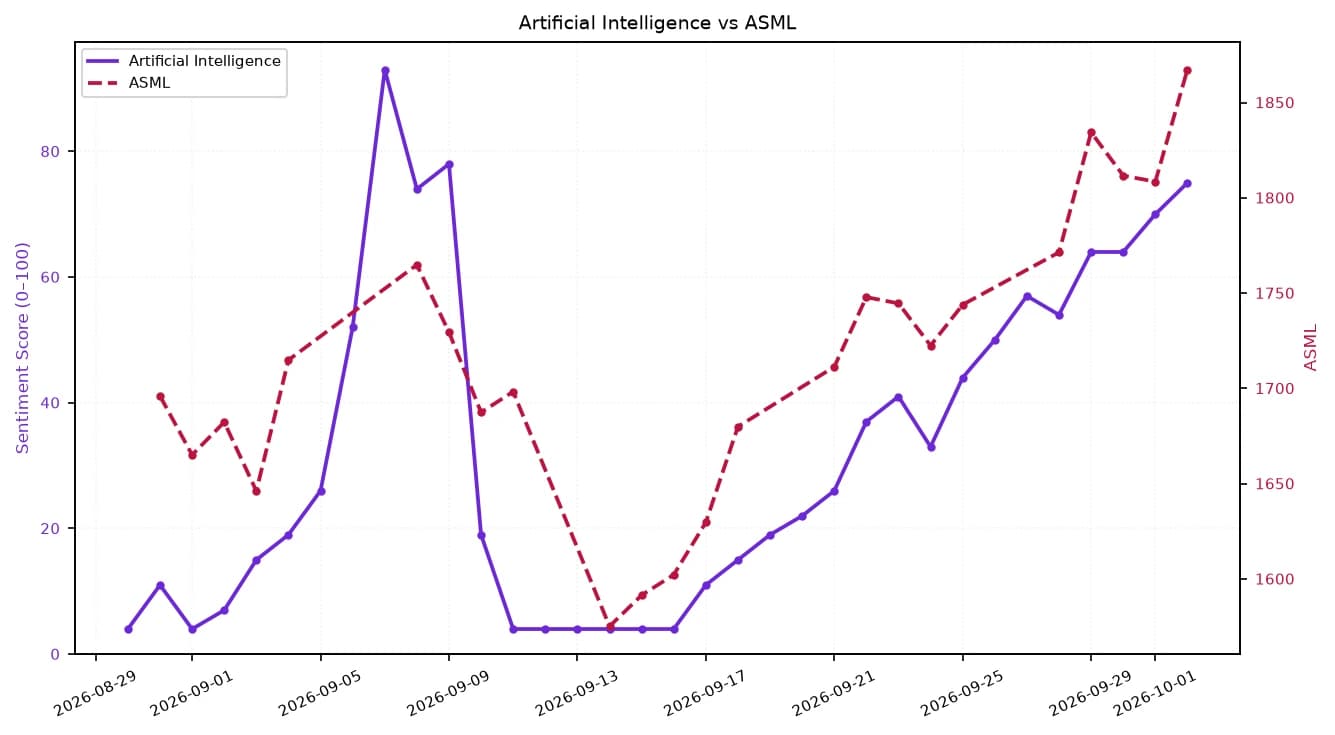
The Dutch chip-equipment giant closed at 1,867.31 euros on Oct. 2, up sharply from 1,288.32 euros in early March, as investors continue to price in a durable artificial-intelligence buildout and the company’s tightening grip on the most critical bottleneck in semiconductor manufacturing. For Pim de Witte, the point is bigger than one stock: the world’s most strategically important companies are compounding so fast that ordinary families are being priced out of the gains before they even start.
Sentiment IndicatorsⓘProprietary · adalytica.com · October 3, 2026
This is a snapshot — live sentiment, awareness and momentum for 130+ markets update continuously in the dashboard.Open AlphaPulse
That matters economically because ASML sits at the center of the AI capex supercycle. Without its extreme ultraviolet lithography tools, the most advanced chips cannot be made at scale, which means every new data center, accelerator and AI model still funnels capital back to the same supply-chain choke point. The company’s own outlook underscores the demand: it told investors in July that 2026 sales should land between 43 billion and 45 billion euros, with gross margins of 54% to 56%, after a strong first half.
The market is already voting with its feet. ASML has climbed well above its 50-day moving average of 1,721.49 euros and its 200-day moving average of 1,539.72 euros, while RSI readings near 87 suggest the stock is technically overbought but still in a powerful momentum trend. The broader semiconductor trade is moving with it: SOXX closed at 588.90, SMH at 630.60, both far above their 50-day averages and near the upper end of their recent ranges. In other words, this is not just an ASML story; it is the market’s renewed conviction that AI infrastructure spending is still early.
That is why de Witte’s idea hits a nerve. If the next generation is to benefit from the same secular wealth creation that has rewarded today’s investors, then ownership needs to start earlier. A child given a stake in ASML, Nvidia, TSMC or the other infrastructure toll roads at birth would be participating in the longest runway in markets today: the monetization of compute. The concept is provocative, but the economics are straightforward. Inflation is still running near 3.3% in the latest CPI data and the Fed funds rate remains above 3.7%, so cash does little to compound purchasing power over time. Ownership in scarce, high-margin technology assets does.
For investors, the real takeaway is that ASML is not merely a stock to trade around earnings; it is a proxy for the AI industrial revolution and a beneficiary of capital scarcity in a world where advanced chipmaking is still concentrated in a handful of names. The company’s supply chain is even being reinforced with a 15 million euro state-backed investment in supplier KMWE International in Malaysia, a reminder that the entire ecosystem is being pulled tighter around ASML’s demand profile.
That is the setup de Witte is pointing to, whether he is talking about children’s portfolios or the next generation of market winners. The market underestimates how much wealth will be created by AI infrastructure and how few companies will capture it. For long-term investors, the asymmetric move is to own the picks-and-shovels now, not later.
| Entity | Gains | Losses |
|---|---|---|
| ASML | ▲AI capex demand | ▼Latecomer buyers |
| Semiconductor ETFs | ▲Momentum flows | ▼Short sellers |
| Long-term shareholders | ▲Compounding upside | ▼Cash holders |
| Families with early ownership | ▲Generational wealth | ▼Buyers at higher prices |