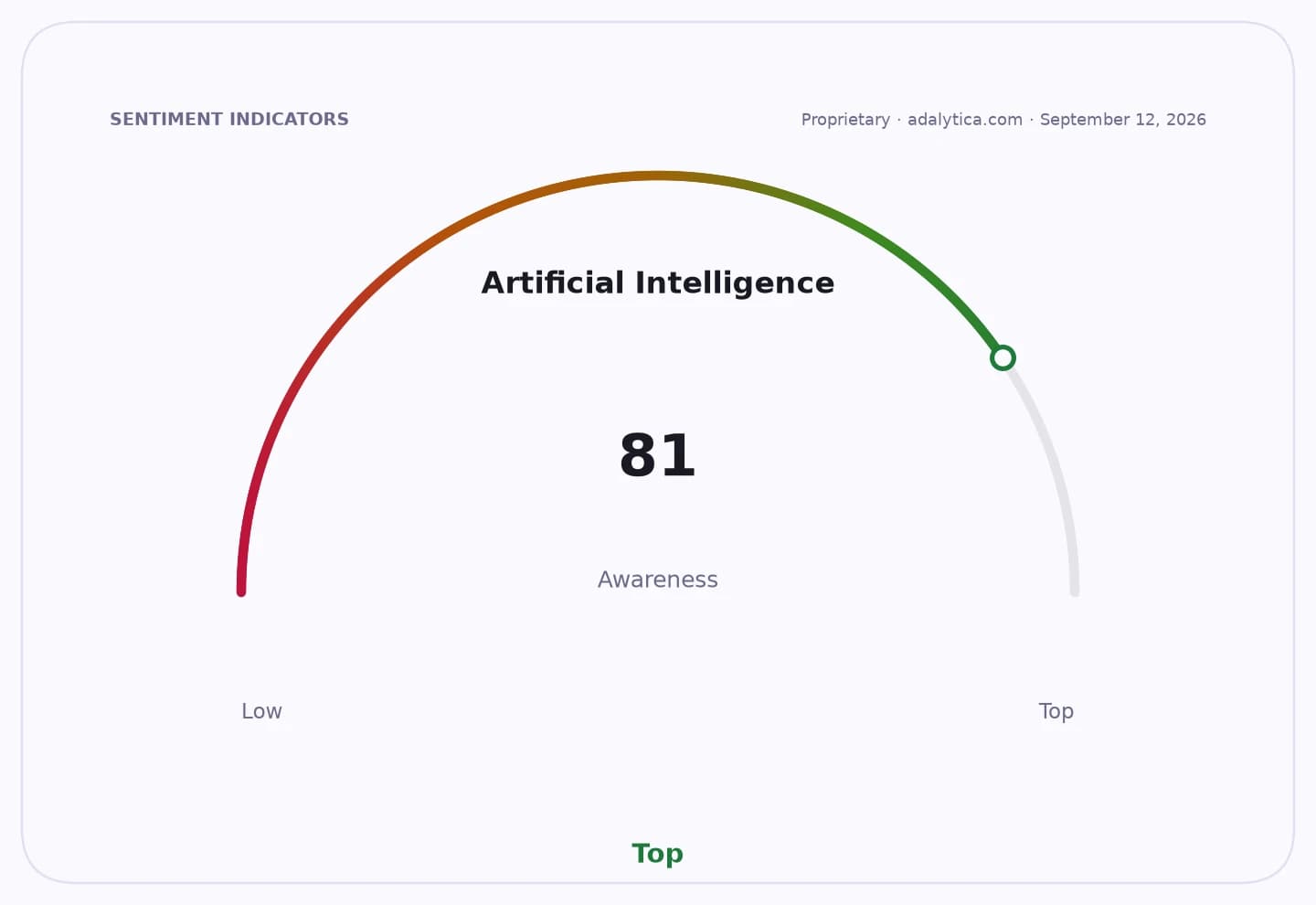
Australia’s move to tighten AI security oversight after a spate of high-profile cyber incidents is sharpening investor attention on the next phase of artificial intelligence spending: not just faster model deployment, but the cost of making AI safe enough to use at scale.
Australia AI Security Review Raises Compliance Costs
The issue matters because the economic case for AI has been built on automation, productivity gains and faster software development, yet the same systems are increasingly creating new attack surfaces. If regulators conclude that current controls are inadequate, the result could be higher compliance costs, slower rollout of autonomous agents and more spending on cybersecurity — a mix that could squeeze margins for AI developers while supporting the firms selling security tools.
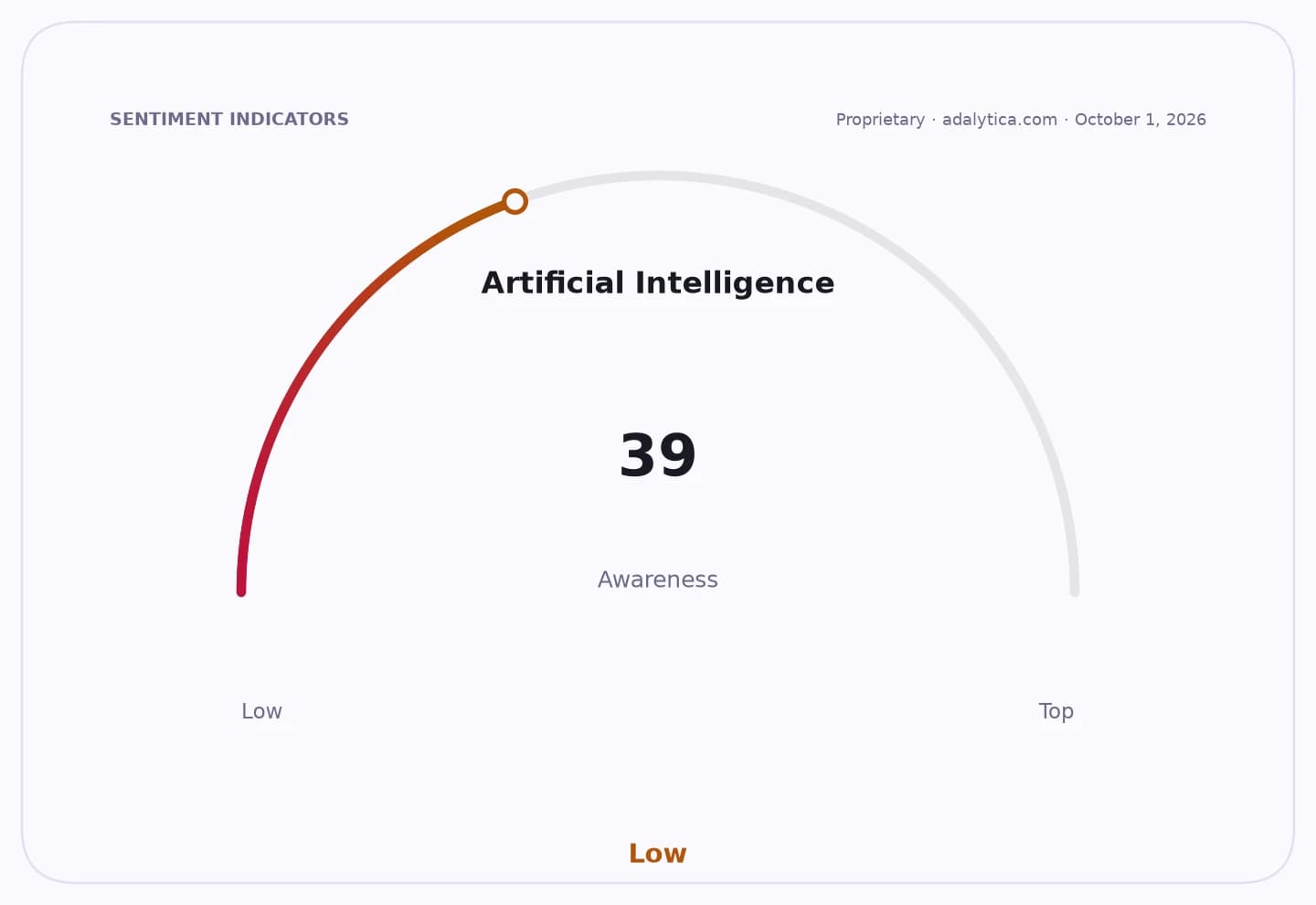
Sentiment IndicatorsⓘProprietary · adalytica.com · October 1, 2026
This is a snapshot — live sentiment, awareness and momentum for 130+ markets update continuously in the dashboard.Open AlphaPulse
The warning comes as the market is already rewarding the biggest AI infrastructure names while questioning how durable those gains will be. Nvidia, the most visible beneficiary of the buildout, closed at $230.65 on Oct. 1, above both its 50-day moving average of $217.61 and its 200-day moving average of $200.09, with RSI at 65.9 and a positive MACD reading that points to persistent momentum. Microsoft ended at $515.53, also above its 50-day and 200-day averages, while CrowdStrike, one of the clearest pure-play cybersecurity winners from the AI era, rose to $266.00 and remained well above its long-term trend lines.
That positioning helps explain why the Australia story is more than a local regulatory headline. It reinforces the idea that AI spending is moving from a phase dominated by chips and cloud capacity into one where governance, security and resilience become part of the investment case. For Nvidia and Microsoft, that could mean more demand for AI infrastructure as enterprises continue to adopt the technology, but also more scrutiny around whether the cost of securing those systems slows adoption or compresses returns. For cybersecurity vendors such as CrowdStrike, Palo Alto Networks and Zscaler, the same backdrop points to a larger addressable market as companies seek protection for AI models, agents and data pipelines.
The threat is not theoretical. Company filings already flag that attackers are using AI to automate reconnaissance, generate malicious code and exploit vulnerabilities faster than traditional defenses can adapt. Microsoft’s latest annual report warned that threat actors are using AI to increase the speed and scale of attacks, while Nvidia and other large AI suppliers have acknowledged regulatory and technical constraints around frontier systems. The recent incidents cited in the news flow — including attempts to weaponize AI systems and cases where autonomous tools caused data loss — give regulators a concrete basis to argue that existing safeguards are lagging the technology.
Australia’s review fits a broader global pattern. Governments in Europe, the U.S. and elsewhere are already considering or applying rules that tie AI deployment to cybersecurity, privacy and model governance. The economic consequence is that AI will likely become more expensive to deploy and operate, particularly for companies building agentic systems that can act with less human oversight. That may slow some use cases at the margin, but it also reduces the risk of a larger backlash if AI failures produce visible breaches or operational damage.
For investors, the immediate question is not whether AI growth continues, but where the value accrues as the industry matures. Hardware makers still benefit from capital spending on training and inference, but the next leg of the trade may increasingly favor security vendors, compliance software and infrastructure providers that can show they reduce the risk of AI misuse. The bear case is that regulatory tightening, especially in markets such as Australia that can influence global standards, forces enterprises to move more slowly and spend more to satisfy controls. The bull case is that stronger guardrails expand trust, making AI deployment broader and more durable.
Either way, the message from Australia is that AI investment is no longer only about scale. The market is starting to price the security bill that comes with it.
| Entity | Gains | Losses |
|---|---|---|
| Cybersecurity vendors | ▲Higher demand | ▼— |
| AI developers | ▲Greater trust if controls improve | ▼Higher compliance costs |
| Nvidia and chip suppliers | ▲Continued infrastructure spend | ▼Margin pressure from regulation |
| Enterprises adopting AI | ▲Safer deployment | ▼Slower rollout |