Australia’s inflation backdrop is keeping the Reserve Bank of Australia on track to raise rates again, and that matters because the market is pricing the next move in the Australian dollar less as a policy surprise than as a test of how far the RBA is willing to push tightening into a slowing economy.
Australia inflation keeps RBA hike bets alive

The Australian dollar finished Friday at 0.7032 against the U.S. dollar, just above the psychologically important US70¢ level and close enough to a technical breakout that a hawkish RBA could send it toward 0.7050 and then 0.7100. For currency investors, the key issue is not simply whether the central bank delivers a fifth rate hike on Tuesday to 4.85%, but whether Governor Michele Bullock signals that more tightening is still possible if inflation remains sticky.
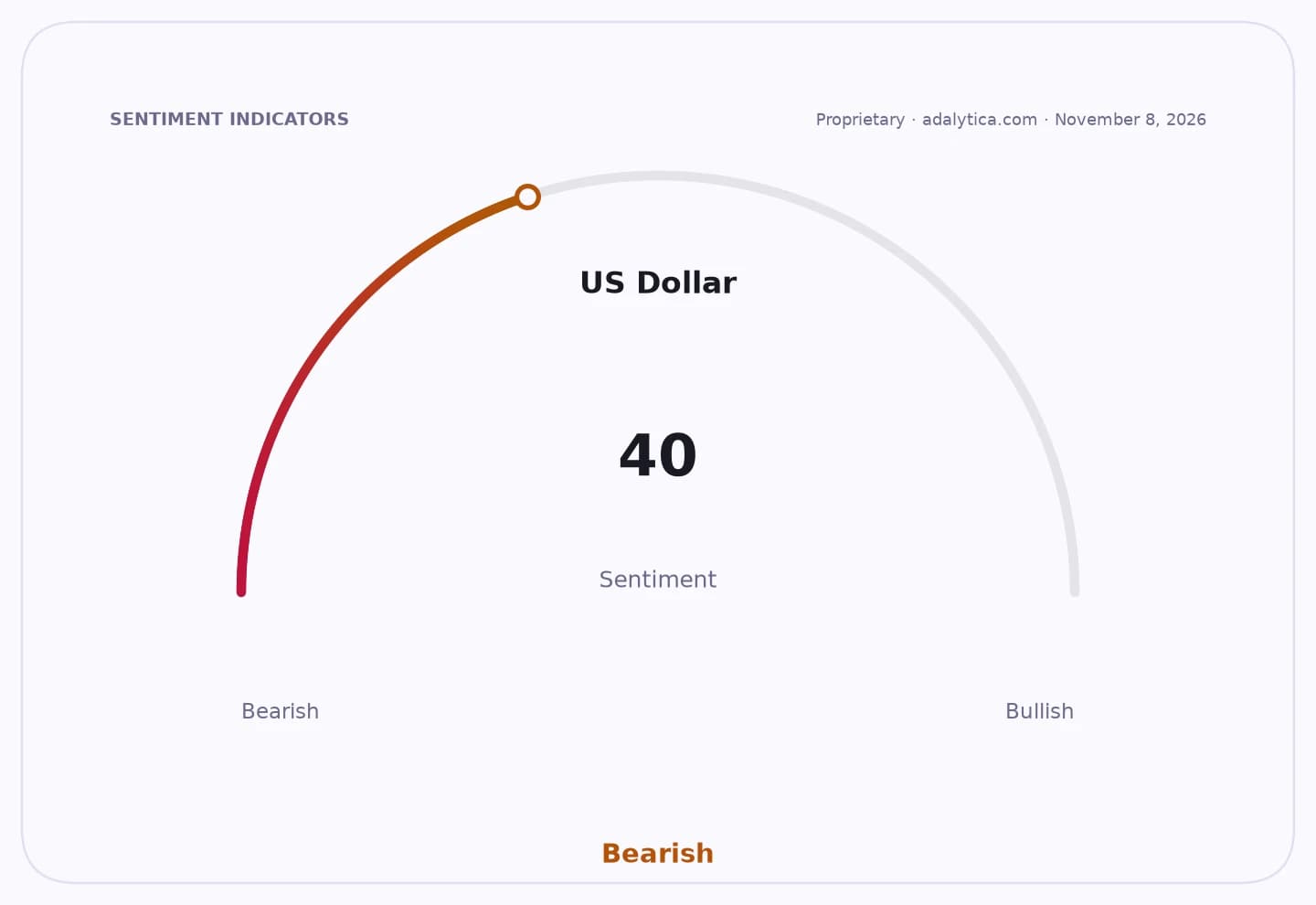
Sentiment Indicators
That is where the domestic data becomes decisive. Australia’s trimmed-mean inflation rose 1.0% in the September quarter, underscoring that price pressures are not fading quickly enough for the RBA to declare victory. Bullock has already tied persistent underlying inflation to capacity constraints and weak productivity, a warning that weaker hiring alone may not be enough to cool demand. In other words, the economy can slow without inflation disappearing fast enough to end the tightening cycle.
For the Australian dollar, that creates a classic policy-support trade. Higher rates lift the currency’s yield appeal, especially if the RBA’s updated forecasts and Statement on Monetary Policy make it clear that inflation will take longer to return to target. Crédit Agricole said the rates market is already about 70% priced for a hike next week, but only about one-third priced for another move after that. That means the real upside for AUD/USD comes from guidance, not the decision itself.
Technically, the pair is sitting near a battleground. AUD/USD has repeatedly traded around 0.7050, and a clean hold above that level would strengthen the case for a run toward 0.71. The 50-day and 200-day moving averages are clustered around 0.71, while RSI readings in recent sessions have improved from oversold levels, suggesting the pair has room to extend if policy messaging turns more hawkish.
But the market is not trading Australia in isolation. Risk appetite remains the swing factor, and that is why the currency can still stumble even if the RBA sounds tough. Disappointing U.S. technology earnings have already pressured broader risk assets, and JPMorgan’s FX desk has flagged the Australian dollar as vulnerable when global sentiment sours. Middle East tensions add another layer: higher oil prices can support Australia’s terms of trade, but a broader risk-off move would likely swamp that benefit.
That is the investable narrative here. The market underestimates how much of the next leg in AUD/USD depends on whether the RBA confirms that inflation is still too hot for comfort, even as growth softens and household spending weakens. If the central bank’s forecast update pushes the return to target further out, traders will be forced to price in more tightening, and the Australian dollar can extend its rebound. If Bullock instead leans heavily on the lagged effect of past hikes and downshifts the policy tone, the pair is more likely to fade back below US70¢.
For investors, that makes Tuesday’s RBA meeting more than a rate decision. It is a test of whether Australia can keep monetary policy tight enough to defend the currency without breaking growth. The near-term trade is AUD strength on a hawkish surprise; the medium-term opportunity is in assets that benefit from a prolonged higher-rate environment while the market is still reluctant to fully price it in.
| Entity | Gains | Losses |
|---|---|---|
| AUD/USD bulls | ▲Higher RBA yield support | ▼Risk-off selling |
| RBA hawks | ▲More policy room to curb inflation | ▼Growth-sensitive borrowers |
| Australian dollar | ▲Hawkish guidance and tighter pricing | ▼Softer global risk appetite |
| U.S. dollar | ▲Safe-haven flows if markets wobble | ▼Narrowing rate advantage if RBA stays hawkish |