Banks must prove their AI systems can withstand operational, reputational and cyber risks before they go live, a warning from Deputy Governor Murmu that raises the bar for deployment across the financial sector and reinforces that AI adoption in banking will be judged as a governance issue, not just a productivity play.
Banks face tighter AI risk controls before rollout

The message matters because lenders are racing to embed generative AI into customer service, compliance, trading support and credit workflows, but regulators are increasingly focused on model failures, data leakage, fraud, and market manipulation. For large banks, that means AI spend may be scrutinized alongside capital and risk controls rather than treated as a simple technology upgrade.
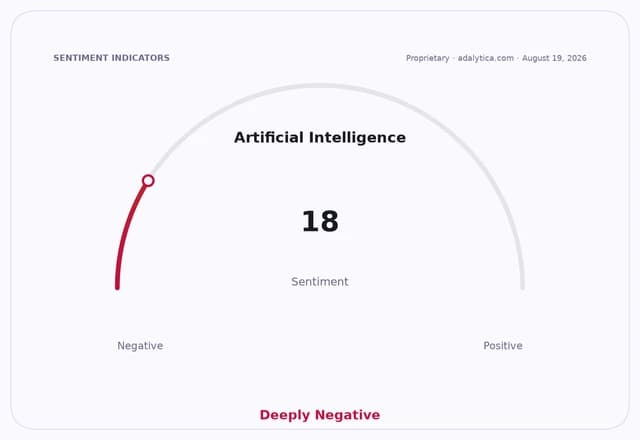
Sentiment IndicatorsⓘProprietary · adalytica.com · August 19, 2026
This is a snapshot — live sentiment, awareness and momentum for 130+ markets update continuously in the dashboard.Open AlphaPulse
That regulatory tone lands at a time when investors are already paying up for U.S. money-center banks. JPMorgan Chase shares were last at $356.71, below the recent $363.25 close but still far above the 50-day moving average of $341.81 and the 200-day average of $313.37, while Bank of America traded at $63.19 and Wells Fargo at $85.96, both near their recent highs and above their 50-day trends.
The technical backdrop suggests the group has had a strong run, even as momentum has cooled from earlier overbought readings. JPMorgan’s RSI reading had topped 90 earlier this cycle and was 58.8 in the latest data, while Bank of America’s and Wells Fargo’s RSI readings were 60.9 and 54.4, respectively, suggesting the shares remain supported but less stretched than during their sharpest advances.
Artificial Intelligence — 30-day sentimentadalytica.com
Explore this data interactively — full history, time series and cross-market comparisons.Open AlphaPulse
The broader narrative is that AI is moving from a growth story to a governance story. Adalytica’s sentiment snapshot on the AI theme shows “Fear” at 18 and “Extreme Fear” awareness at 4, while Microsoft’s earnings sentiment sits in “Greed,” underscoring how investors still like the revenue opportunity but are becoming more selective about execution and risk.
For banks, the practical takeaway is that AI systems may need testing standards closer to those used for trading models, stress scenarios and operational controls. That could slow deployment in the near term, but it may also reduce the odds of costly failures, making the sector’s AI buildout more durable over time.
The next catalyst is likely more disclosure from banks and supervisors on how AI risk is embedded into model governance, cybersecurity and vendor oversight, with investors watching whether compliance costs rise before the productivity benefits show up in earnings.
| Entity | Gains | Losses |
|---|---|---|
| Large banks | ▲safer AI rollout | ▼faster deployment |
| Regulators | ▲stronger oversight | ▼less flexibility for banks |
| AI vendors | ▲demand for compliance tools | ▼unchecked experimentation |
| Shareholders | ▲lower tail-risk | ▼near-term margin pressure |