Barclays is trimming about 5,000 jobs while it shifts spending toward artificial intelligence, a sign that the biggest banks are moving from pilot projects to a full-scale reallocation of capital that could reshape margins, staffing and returns across the financial sector.
Barclays Cuts 5,000 Jobs for AI Spending
For investors, that matters because AI is no longer just a productivity story — it is becoming a capital-allocation story. When a bank says it is cutting headcount for “organisational simplification and technology change efficiency driven by AI,” it is effectively telling the market that software, automation and data infrastructure are now taking priority over labor-intensive support functions. About 60% of Barclays’ cuts will come from support roles, including developers, underscoring how deeply AI is now reaching into back-office and technology jobs.
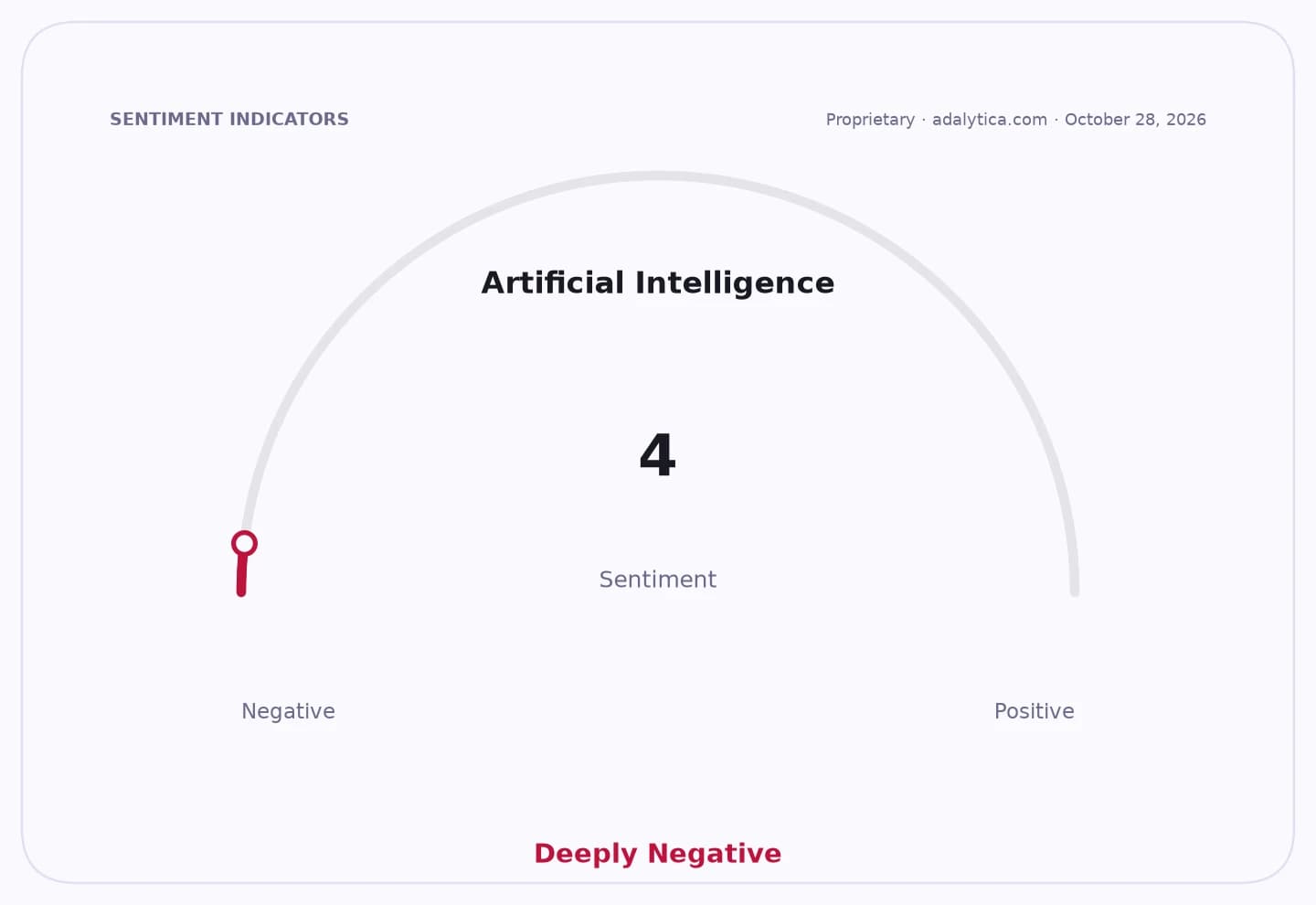
Sentiment Indicators
That makes the earnings math important. Barclays is not alone. DNB, Commerzbank and Standard Chartered have all linked staffing reductions to automation and AI, while U.S.-listed peers such as JPMorgan Chase and Goldman Sachs continue to spend heavily on technology even as they manage costs. The industry-wide message is clear: banks are trying to defend returns by shrinking fixed costs and using AI to make each employee more productive. In a low-growth, highly regulated business, that can be one of the few ways to widen margins without taking on more balance-sheet risk.
The market is also starting to price this shift in. Barclays shares have been volatile around the bank’s latest restructuring push, recently trading just above the $23 level after a sharp recovery from earlier lows this year. The stock remains only modestly above its 200-day moving average, which suggests investors are still waiting for proof that the cost cuts translate into durable earnings power rather than just one-time savings. JPMorgan and Goldman, by contrast, have held up far better, reflecting the market’s preference for banks with stronger fee generation, scale and the ability to absorb heavy technology spending.
The bigger thesis is that AI is creating a new kind of financial-services winner: the institutions that can spend aggressively on compute, cloud and automation while using those tools to take out costs faster than rivals. That is bullish for the strongest banks, software vendors, data-center operators and AI infrastructure suppliers. It is less friendly to labor-heavy business lines, legacy outsourcing models and any bank that delays the transition and ends up with a bloated cost base.
Barclays’ move also fits a broader market narrative: AI is not just inflating valuations in tech, it is forcing every sector to fund the buildout somehow. The near-term cost is job cuts. The longer-term prize is a structurally higher return on equity for the banks that can turn AI into a permanent operating advantage. Investors should treat this as an early-stage margin revolution, not a one-off restructuring.
| Entity | Gains | Losses |
|---|---|---|
| Barclays | ▲Lower costs, higher efficiency | ▼Workforce reduction, transition risk |
| AI infrastructure suppliers | ▲More enterprise demand | ▼— |
| Large diversified banks | ▲Better productivity leverage | ▼Smaller banks with higher cost bases |
| Support staff and legacy vendors | ▲— | ▼Job losses, budget cuts |