Alphabet, Microsoft and Meta are pouring unprecedented money into U.S. lobbying as the artificial intelligence boom shifts from a race to build models into a fight over rules, chips, government contracts and market power.
Big Tech Boosts AI Lobbying
The spending surge matters because policy is becoming one of the biggest determinants of who captures the economics of AI. With Washington weighing everything from export controls and antitrust scrutiny to safety standards and public-sector adoption, the largest tech groups are no longer lobbying at the margin — they are trying to shape the cost of doing business, the pace of deployment and the size of the addressable market.
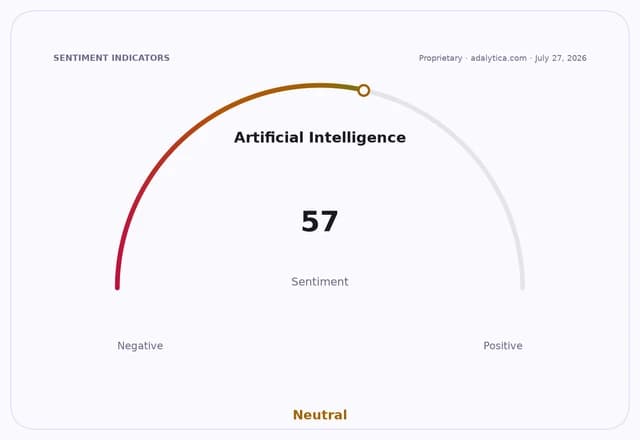
Sentiment IndicatorsⓘProprietary · adalytica.com · July 27, 2026
This is a snapshot — live sentiment, awareness and momentum for 130+ markets update continuously in the dashboard.Open AlphaPulse

The money also reflects how far AI has moved beyond a purely commercial story. Companies are trying to secure access to advanced semiconductors, influence federal procurement, and blunt any regulations that could slow product launches or raise compliance costs. That makes lobbying a strategic investment rather than a political sideshow: for the biggest platforms, small changes in policy can shift billions of dollars in future revenue and margins.
For investors, the implication is twofold. In the bull case, intense lobbying can help preserve the current AI buildout, protect cloud and ad businesses from tougher restrictions, and support continued capital spending on infrastructure. In the bear case, record spending is itself a sign that the sector expects heavier oversight, greater antitrust risk and more public scrutiny of how AI models are trained, deployed and monetized.
The stakes are especially high for Alphabet and Microsoft, whose shares have been pressured this year even as they remain central to AI infrastructure and software adoption. Microsoft’s stock has fallen below both its 50-day and 200-day moving averages, while Alphabet is trading well under its 200-day line, a sign that investors are reassessing how much of the AI opportunity will translate into near-term returns. Meta has also retreated from recent highs despite still benefiting from AI-driven ad targeting and engagement.
That caution contrasts with the broader enthusiasm around the sector, where conventional technical indicators suggest a market still trying to balance optimism and fear. Adalytica’s AI sentiment gauge is neutral, but awareness remains elevated, indicating that investors are highly attuned to policy and capital-spending risks even after periods of strong AI-related inflows.
The lobbying push also fits a wider global pattern. Governments in the U.S. and Asia are racing to build secure AI and semiconductor supply chains, while firms from Alphabet to Anthropic are spending heavily to ensure they can operate in that environment. South Korea’s newly announced AI alliance with the United States underscores how closely industrial policy and AI strategy are now intertwined.
The next test will be whether lobbying can soften the regulatory path enough to keep AI spending accelerating without triggering a broader clampdown. If Washington opts for stricter oversight, the biggest platforms may still win over time, but the path to monetization could lengthen and the industry’s valuation premium could come under pressure.
| Entity | Gains | Losses |
|---|---|---|
| Alphabet, Microsoft, Meta | ▲Policy influence | ▼Higher compliance burden |
| U.S. AI and chip suppliers | ▲Federal support | ▼Regulatory uncertainty |
| Investors in AI leaders | ▲Moat preservation | ▼Margin pressure risk |
| Smaller AI rivals | ▲Sector legitimacy | ▼Harder competitive access |