Big Tech is spending like the cycle is still young, and that is exactly why long-term investors should be careful.
Big Tech AI Spending Raises Valuation Risks
The money is pouring into artificial intelligence infrastructure, data centers, chips and power in a way that is already reshaping the market’s winners and losers. Microsoft, Nvidia and Amazon all still look like winners over a multi-year horizon, but the scale of their capital deployment is a reminder that the AI buildout is no longer a cheap experiment. It is becoming a capital-intensive race, and those races can create great businesses — while also punishing anyone who pays too much for the story.
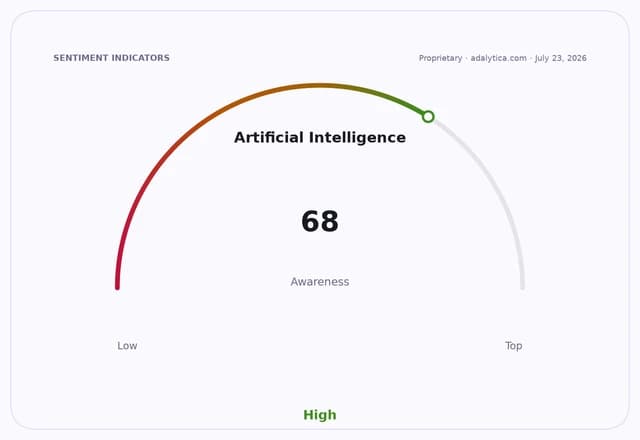
Sentiment IndicatorsⓘProprietary · adalytica.com · July 23, 2026
This is a snapshot — live sentiment, awareness and momentum for 130+ markets update continuously in the dashboard.Open AlphaPulse
That matters economically because capital spending on this scale does not just lift earnings for the chipmakers and cloud platforms. It ripples through electricity demand, construction, networking gear, memory chips, server supply chains and financing markets. In other words, AI is turning from a software narrative into a hard-asset investment cycle. For the broader economy, that can be powerful: it creates demand, jobs and productivity gains. But for investors, it also raises the risk that today’s enthusiasm is already pulling forward years of spending and growth.
The market data already shows how fierce the competition is. Nvidia has held up better than the rest, with the stock near $212 after rebounding from earlier weakness, and technical indicators such as the 50-day moving average and RSI readings suggest momentum has improved. Amazon has also stabilized around $245 after a volatile stretch, while Microsoft has slipped to about $390 and is still below its 200-day moving average, a sign that investors are demanding more proof that its AI spending will translate into durable profit growth.
Artificial Intelligence vs MSFTadalytica.com
Explore this data interactively — full history, time series and cross-market comparisons.Open AlphaPulse
That is the key question behind the chart investors are looking at now: how much of this spending will become lasting competitive advantage, and how much will simply get recycled into faster depreciation and thinner returns? Microsoft’s own filings say it will keep investing in product support infrastructure, technology and acquisitions. Amazon has tapped the debt market to fund itself. Meta has warned that AI investments are pressuring cash flow and margins. These are not signs of retreat; they are signs of an arms race.
For investors, that creates a very familiar tension. The companies building the AI backbone may still be the right long-term holdings, but their future returns will depend on execution, pricing power and free cash flow, not just the size of the opportunity. The best businesses can compound through heavy investment, but only if those dollars earn attractive returns over time. That is why a diversified approach still matters. You do not need to guess the single biggest winner in AI to benefit from the trend; you need exposure to the ecosystem and patience to let the cycle mature.
Volatility should not scare away long-term investors, but it should make them disciplined. When spending accelerates this quickly, valuations can become more fragile, especially if growth expectations get ahead of profit conversion. The market is still rewarding scale, but it will eventually reward efficiency too.
The bottom line: Big Tech’s spending boom is a powerful signal that AI is real, durable and still early — but it is also a warning that the easy gains may be behind us. Investors should keep the best names on the watchlist, stay diversified, and focus on companies that can turn today’s massive investment into years of compounding.
| Entity | Gains | Losses |
|---|---|---|
| Nvidia | ▲More chip demand | ▼Higher expectations |
| Microsoft | ▲AI platform scale | ▼Margin pressure |
| Amazon | ▲Cloud infrastructure growth | ▼Heavier capital outlays |
| Investors chasing the theme | ▲Near-term upside | ▼Valuation risk |