Bitcoin slipped to about $81,400 as a renewed selloff in Asian chipmakers and heavy demand for downside protection showed investors are no longer treating the cryptocurrency as immune from the AI trade unwind.
Bitcoin Falls on AI Chip Selloff and ETF Inflows

That matters because the latest move is not being driven by a lack of cash. U.S. spot bitcoin ETFs just pulled in $526.6 million, their biggest daily inflow in nearly a month, yet the token still faded 0.5% from midnight UTC. When fresh ETF demand cannot offset risk-off pressure, it tells you the market’s short-term direction is being set by macro fear, not just crypto-specific flows.
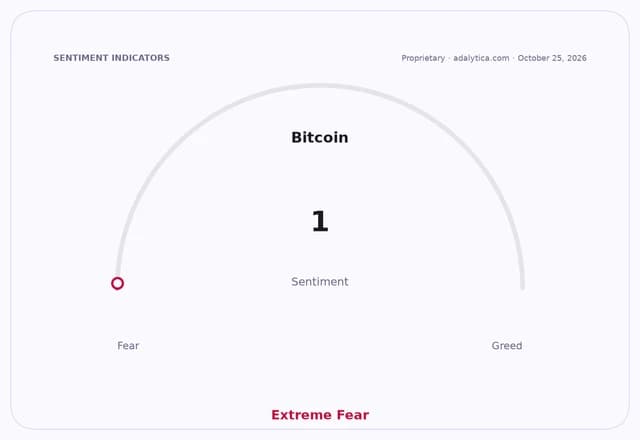
Sentiment IndicatorsⓘProprietary · adalytica.com · October 25, 2026
This is a snapshot — live sentiment, awareness and momentum for 130+ markets update continuously in the dashboard.Open AlphaPulse
The trigger came from Asia, where South Korea’s Kospi fell 3.73% to its lowest close since April 7 as SK Hynix and Samsung Electronics dropped on renewed worries that the AI spending boom may be losing momentum. That is important for Bitcoin holders because crypto has increasingly traded as a high-beta risk asset alongside AI-linked equities and Nasdaq futures, which also slipped. When chip stocks wobble, leveraged speculative exposure gets de-rated across the board.
Options traders are reinforcing that message. On Deribit, puts outtraded calls by more than two to one over the past 24 hours, with the Oct. 30 $80,000 put the busiest contract. Out-of-the-money puts are also richer than comparable calls by 2.5 to 4 volatility points across expiries, a clear bearish skew that shows traders paying up for insurance even as some open interest remains clustered at $90,000 to $100,000 strikes. In plain terms, the market is positioning for more downside, not a quick rebound.
The technical picture supports that caution. Bitcoin is hovering just above the lower end of its recent Bollinger Band range and below its 50-day moving average near $81,800, while the RSI has slipped to 41.8, signaling weak momentum without yet flashing full capitulation. Adalytica’s Bitcoin Fear & Greed snapshot shows extreme fear, underscoring how quickly sentiment has collapsed even after months of bullish ETF narratives.
The spillover is broader than bitcoin. Ether fell 0.9%, the CoinDesk 80 and CoinDesk 5 indices both declined, and DeFi gave back Monday’s gains. That tells investors this is not a one-coin story. It is a repricing of the entire digital-asset complex as a risk proxy in a market still worried about AI capex, higher energy costs and tighter financial conditions.
For investors, the lesson is straightforward: the market is underestimating how sensitive bitcoin has become to equity beta and semiconductor sentiment. If AI spending fears deepen or chip stocks keep rolling over, crypto could remain trapped in a liquidity-led correction even with ETF inflows intact. The asymmetric play here is less about chasing spot strength and more about waiting for the options skew to normalize before assuming the next leg higher.
| Entity | Gains | Losses |
|---|---|---|
| Deribit put buyers | ▲Downside protection | ▼Premium cost |
| Bitcoin bears | ▲Lower entry levels | ▼Carry risk |
| AI chipmakers | ▲— | ▼Re-rating pressure |
| Spot ETF inflows | ▲Structural demand signal | ▼Not enough to lift price |