Bitcoin’s slide toward the low-$60,000s is putting the token on track for its worst fourth quarter since 2018, with traders now watching whether a further break can carry it toward $50,000. The immediate pressure comes from a more hawkish Federal Reserve backdrop, rising U.S. yields and a stronger dollar, which are draining demand from risk assets just as crypto’s own fund flows and on-chain metrics weaken.
Bitcoin falls toward $60,000 on Fed and yield pressure
The latest FOMC minutes showed almost all Fed officials favoring more tightening to bring inflation back to target, and some even leaving room for a 50-basis-point move if data worsens. Markets are already pricing another December hike, with CME-fed futures implying a 100% chance of a move and a 92.7% probability of a 25-basis-point increase. The prospect of higher-for-longer rates has helped push the Dollar Index to its highest level in months and lifted 10-year Treasury yields above 5.1%, a combination that typically weighs on speculative assets.
Sentiment Indicators
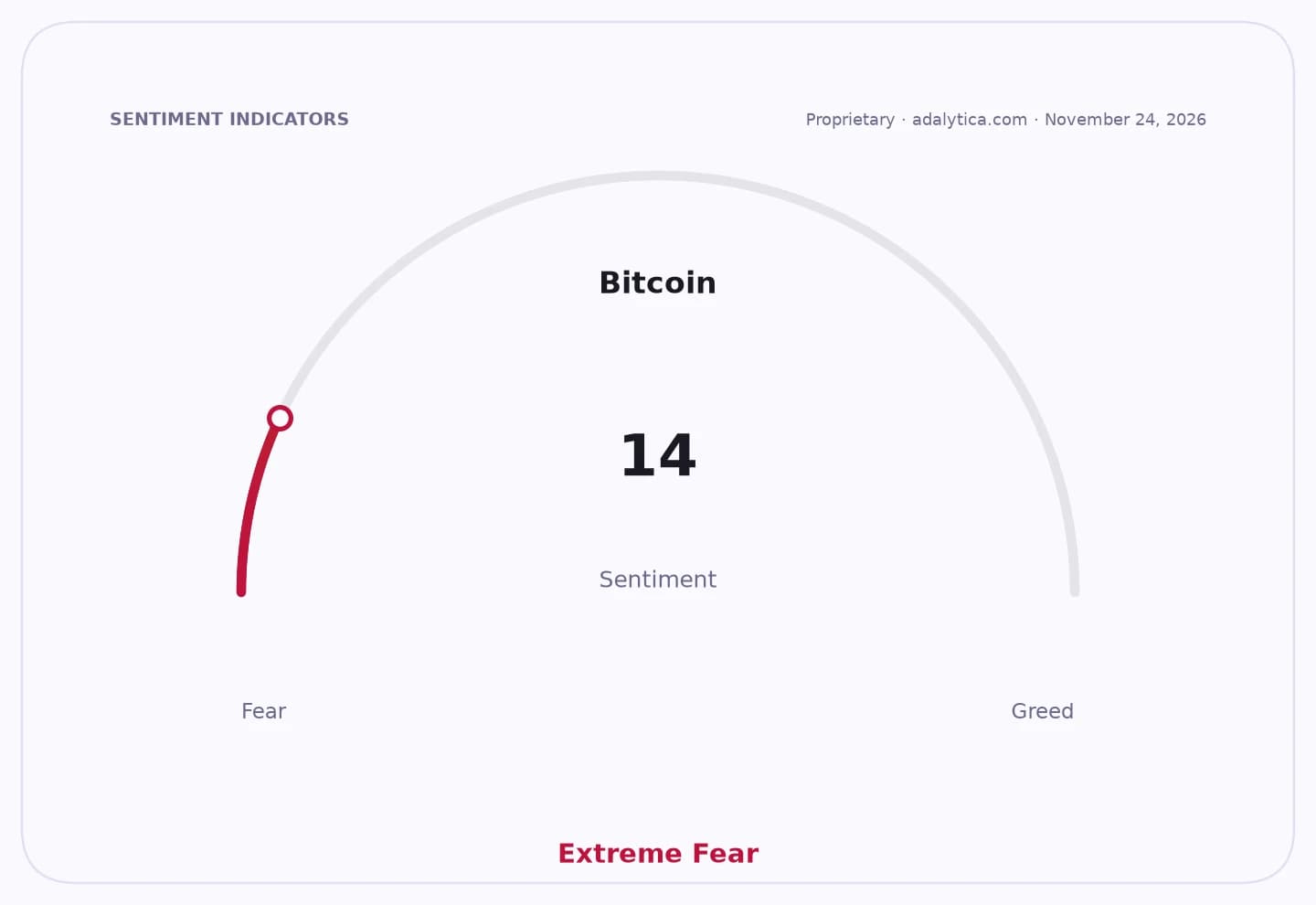
Bitcoin
Bitcoin has already fallen 24.45% in the quarter, with November losses alone deepening the drawdown. That still leaves it short of the 43.5% collapse seen in Q4 2018, but the gap is narrowing fast if selling continues into year-end. Wintermute said flows remain negative, the spot Bitcoin ETF complex is $1.9 billion net negative for 2026, and traders are leaning on downside hedges, including a $60,000 put cluster on Deribit.
The technical picture is equally weak. Bitcoin closed at $59,249.18 on Nov. 25, down more than 7% from its Nov. 22 close and well below its 50-day moving average of $75,627.79 and 200-day average of $72,127.40. Its RSI reading of 17.4 points to deeply oversold conditions, but it has not yet produced a durable rebound.

On-chain data is reinforcing the caution. Glassnode said losses are being realized at levels last seen near prior market bottoms, while CryptoQuant put Bitcoin’s 30-day net realized profit/loss at minus $8.4 billion, the weakest since summer. Long-term holders are also distributing into weakness, with SOPR at 0.73, and a break below $60,000 could trigger liquidations across nearly 20% of short-term holder supply, according to the data cited.
That matters for investors because Bitcoin’s weakness is spilling into crypto-linked equities and the broader risk complex. Coinbase shares have dropped to $102.35 from $183.81 in mid-October, while MicroStrategy has slumped to $77.55 from $143.24 over the same stretch, reflecting the market’s tighter link between Bitcoin and listed proxies. Adalytica’s Bitcoin Fear & Greed Index is at 10, or “Extreme Fear,” underscoring how quickly sentiment has deteriorated.
For now, the market’s next catalyst is the December Fed meeting, along with any new shift in spot ETF flows or macro data that might ease pressure on rates and the dollar. If those do not improve, Wintermute’s $50,000 downside target is likely to stay in play, keeping Bitcoin’s worst-Q4-since-2018 narrative intact.
| Entity | Gains | Losses |
|---|---|---|
| Bitcoin bears | ▲Lower prices, momentum selling | ▼None if support breaks |
| Bitcoin holders | ▲None | ▼Mark-to-market losses, liquidation risk |
| Coinbase, MicroStrategy | ▲Trading volume, volatility | ▼Share price pressure from BTC weakness |
| Dollar, Treasury yields | ▲Safe-haven demand, higher-rate support | ▼Risk-asset appetite |