Bitcoin is deepening its slide toward $81,000, with the token losing momentum even as broader financial markets show pockets of dollar softness and mixed risk appetite.
Bitcoin Falls Toward $80,000 as Fear Rises
Bitcoin
The move matters because Bitcoin is no longer behaving like a standalone speculative asset; it has become a highly crowded macro trade, and when that trade unwinds it tends to drag on the wider crypto complex. With Bitcoin at $80,263.71 in the latest trading session, the world’s largest cryptocurrency is sitting just above the psychologically important $80,000 level and below its 50-day moving average of $81,868.14, a technical break that leaves traders focused on whether support near the mid-$70,000s can hold.
Sentiment Indicators
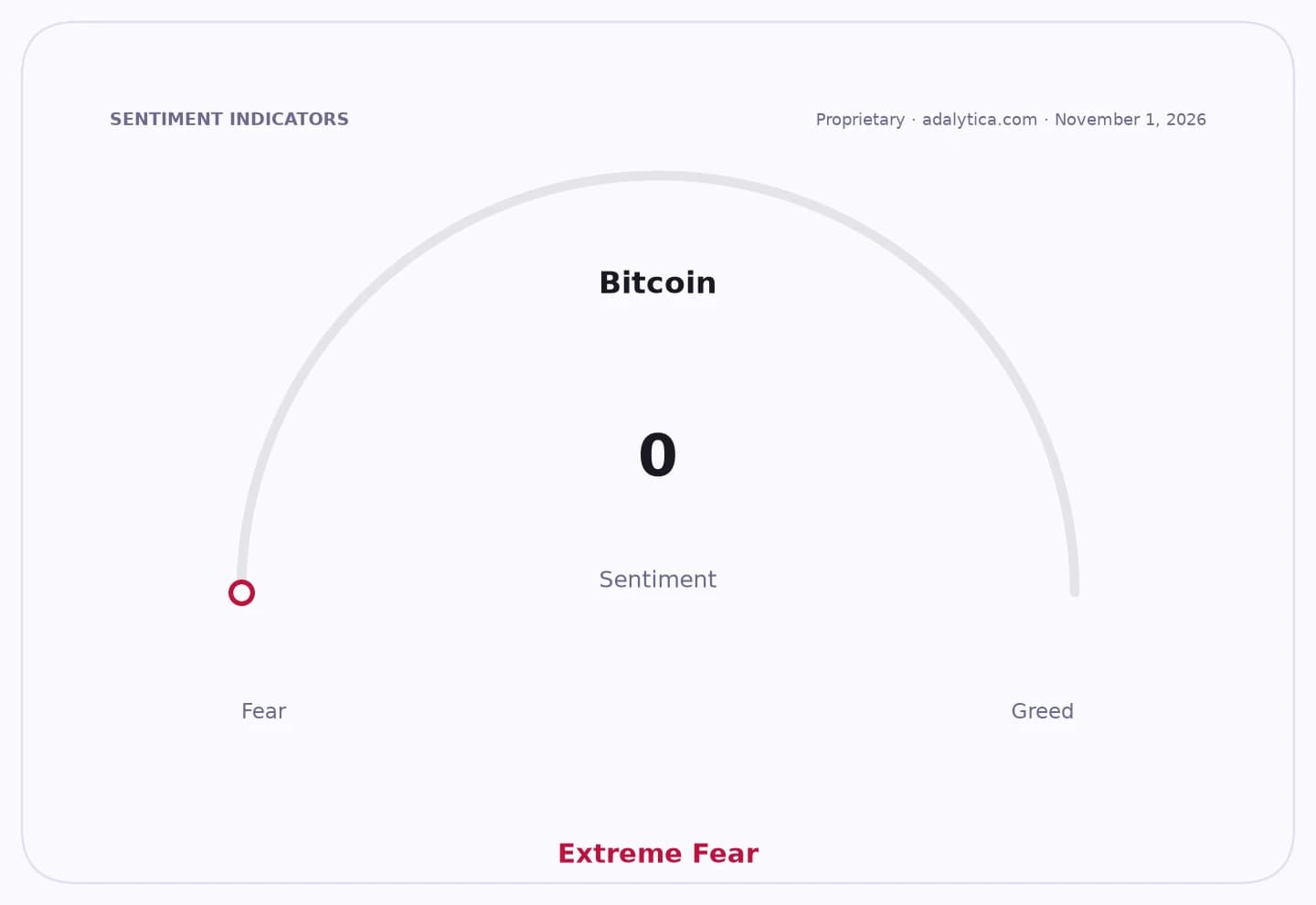
The decline is also showing up in market positioning and risk gauges. Adalytica’s Bitcoin Fear & Greed Index is at 10, or “Extreme Fear,” while awareness is at 12, also in “Extreme Fear,” after a 30-day drop of 46 points in sentiment. In other words, the market has moved from complacency to capitulation territory in a matter of weeks, a shift that often amplifies volatility and forces levered holders to cut exposure.
Technical signals point to a market that remains fragile rather than stabilizing. Bitcoin’s relative strength index was 43.3 in the latest reading, below the neutral 50 mark, while the MACD remains negative, indicating bearish momentum is still intact even after brief rebounds. The price is also pressed against the lower end of its Bollinger Band range, a sign that selling pressure has not yet fully exhausted itself.
Bitcoin — 30-day sentimentadalytica.com
Explore this data interactively — full history, time series and cross-market comparisons.
For investors, the bigger issue is what the drop means for crypto-linked equities and balance sheets built around Bitcoin exposure. MicroStrategy, one of the largest corporate holders of the token, has seen its shares weaken from recent levels as Bitcoin fell back below its recent highs, while Coinbase has also softened, reflecting the direct hit to trading activity, sentiment and the value of crypto assets on investor screens. When Bitcoin breaks lower, it usually tightens financial conditions across the sector, from miners to exchange operators to funds holding digital assets.
The macro backdrop is not helping. A stronger dollar has historically been a headwind for Bitcoin, which trades as a liquidity-sensitive asset that benefits when investors are willing to take on duration and speculative risk. Adalytica’s dollar trade signals still show extreme greed in awareness, suggesting the greenback remains an important cross-current even as sentiment on the dollar itself has weakened. That leaves crypto vulnerable if investors continue to favor cash and short-duration assets over risk.
There is still a bull case. Bitcoin has repeatedly rebounded after sharp drawdowns, and some traders will argue that extreme fear readings can mark a washout phase that eventually clears the way for a tactical recovery. A move back above the 50-day average and a firming in momentum indicators would be needed to shift that narrative.
For now, though, the dominant story is straightforward: Bitcoin is losing altitude in a market that looks increasingly unwilling to pay up for risk, and a decisive break of $80,000 would likely force another round of de-risking across crypto.
| Entity | Gains | Losses |
|---|---|---|
| Cash holders | ▲Preserve capital | ▼Miss upside if rebound follows |
| Short-term bears | ▲Profit from downside momentum | ▼Risk squeeze on oversold bounce |
| MicroStrategy holders | ▲Potential long-term BTC rebound | ▼Equity pressure from BTC weakness |
| Coinbase and crypto brokers | ▲Higher volatility can spur activity | ▼Lower asset prices reduce sentiment |