Jordan Bardella’s re-election to the top of France’s far-right National Rally cements him as the party’s day-to-day leader and the likely stand-in should Marine Le Pen be barred from running in the 2027 presidential race.
Jordan Bardella Re-elected to Lead France's National Rally

That matters because the National Rally is not just another opposition party: it is now a leading contender in French politics, and any change in its leadership affects the prospects for France’s next government, the balance of power in parliament and the broader direction of European nationalism. Bardella, 31, won an overwhelming 98.98% of the vote at the party congress in Orléans, with turnout near 68%, a result that underlines both his control of the party apparatus and the absence of any real internal challenge.
Sentiment Indicators
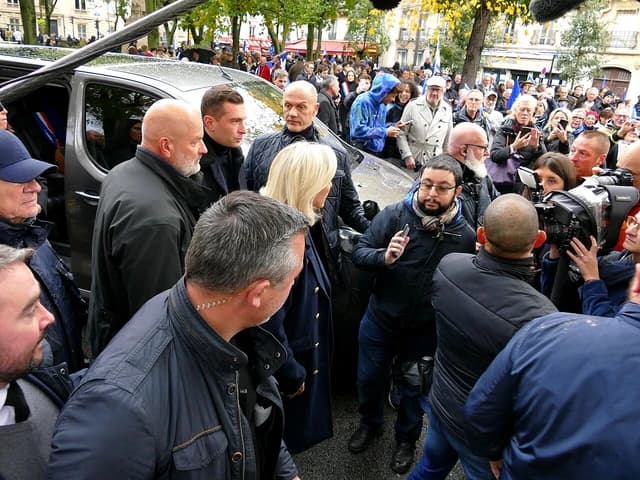
The vote comes as Le Pen remains under legal pressure after being convicted over misuse of public funds and illegal campaign financing. If that ruling is upheld on appeal, Bardella would likely become the party’s presidential candidate. For investors and policymakers, that keeps open the possibility of a more market-sensitive version of the National Rally, one that could combine anti-establishment politics with a clearer effort to look governing-ready.
The question is not only who leads the party, but what kind of National Rally emerges from this arrangement. Bardella is widely seen as Le Pen’s protégé and as the face of the party’s push to broaden its appeal beyond protest voters. His continued grip on the leadership should help the party maintain discipline and message control as France heads toward a contentious election cycle shadowed by unrest, anti-government anger and weak confidence in mainstream parties.
That backdrop has already fed broader political risk in France, where street protests and social unrest have added to concerns about economic stagnation, public debt and a fragmented parliament. A stronger Bardella only reinforces the likelihood that the National Rally remains central to that instability rather than a bystander to it.
For markets, the immediate effect is limited, but the medium-term stakes are clear. France’s fiscal trajectory, its relationship with the European Union and the future of policy on immigration and public spending all become harder to price when a leading party can pivot from Le Pen to Bardella without much internal friction. The longer Le Pen’s legal case hangs over the party, the more Bardella becomes the market’s proxy for the far right’s governing ambitions.
Whether the National Rally can convert popularity into a durable governing coalition will matter more than the leadership vote itself. But the Orléans result shows that, for now, the party is not preparing for a transition away from Le Pen’s orbit. It is preparing to preserve it.
| Entity | Gains | Losses |
|---|---|---|
| Jordan Bardella | ▲Party control; presidential readiness | ▼Limited room to define his own brand |
| Marine Le Pen | ▲Succession plan protected | ▼Legal uncertainty remains |
| National Rally | ▲Leadership continuity; electoral discipline | ▼Risks being tied to Le Pen’s court case |
| French centrist rivals | ▲Clearer far-right challenger to campaign against | ▼More pressure on fragmented mainstream politics |