Bitcoin’s slide toward the $80,000 area is now looking less like a routine pullback and more like a test of whether institutional demand can still absorb a worsening macro backdrop, Coinbase said.
Bitcoin tests $80,000 support as Coinbase warns
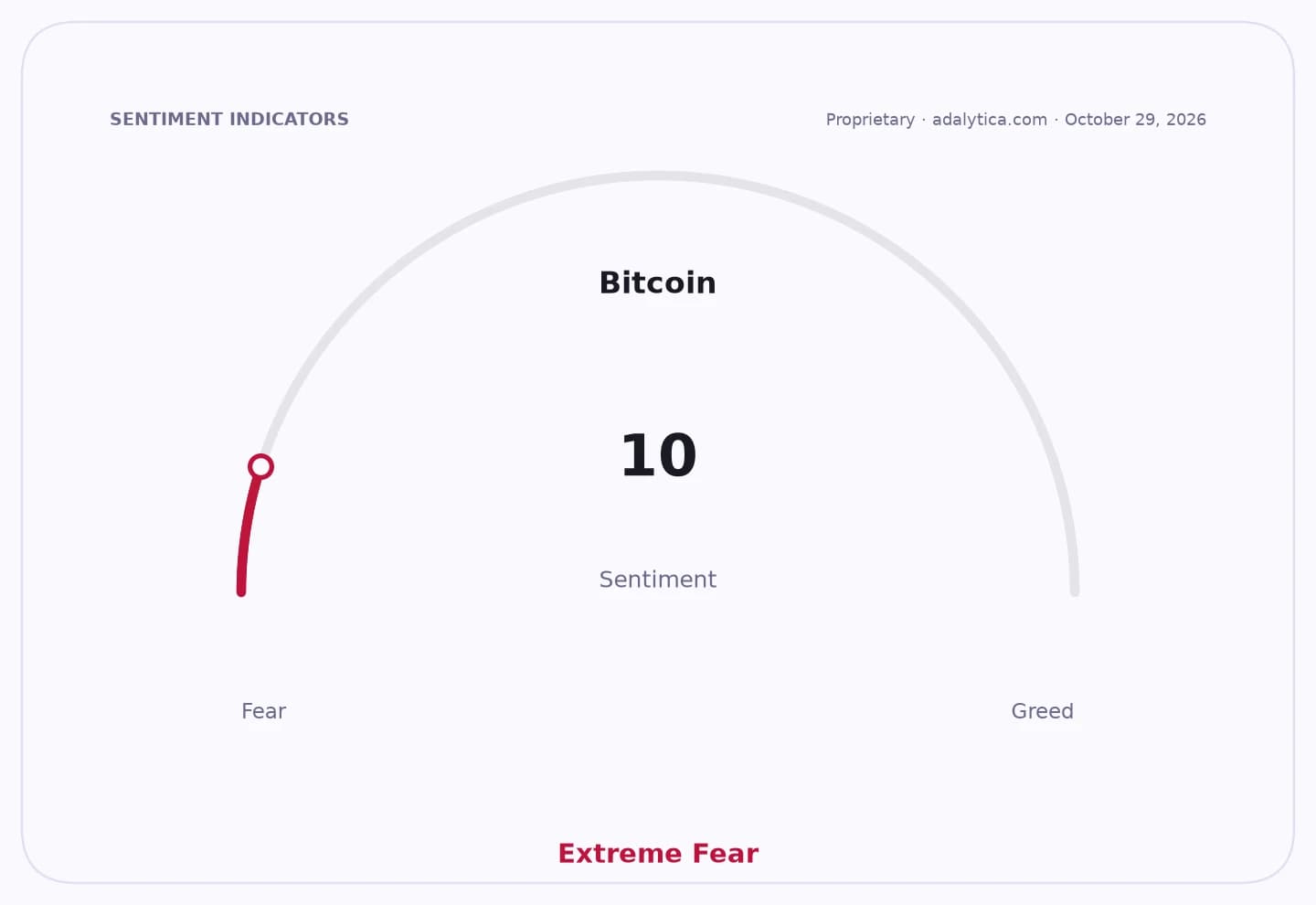
Bitcoin
In its latest market review, the exchange said sticky inflation, a high probability of another Federal Reserve rate increase in December and renewed geopolitical tension could push bitcoin through its near-term support band and toward $73,000 to $75,000 if $80,000 to $82,000 gives way. That matters because the current range is not just a chart level: Coinbase says it also lines up with the 50-day moving average and ETF purchase costs, making it a key line of defense for holders who bought the recent rally.
Sentiment Indicators
The warning lands at a fragile moment for crypto markets. Coinbase said treasury demand for bitcoin has faded in the second half of 2026, leaving U.S. spot exchange-traded funds to shoulder most of the buying. Even that bid has weakened, with the spot ETF complex seeing $635 million in net outflows on Oct. 23, one of the largest single-day withdrawals in the second half of the year. At the same time, crypto-native liquidity has deteriorated, with stablecoin supply down by nearly $13 billion from its May peak, while the Coinbase premium has stayed negative in October, suggesting U.S. spot demand has not fully returned.
For investors, the setup raises the odds that any break below $80,000 could force a fresh round of deleveraging. Bitcoin was last trading around $77,500, below its 50-day moving average of about $81,900 and not far above the lower Bollinger Band, a sign momentum remains weak. The relative strength index is in the mid-30s, which points to oversold conditions, but not necessarily a durable floor if macro pressure intensifies. Options positioning also shows institutions paying up for downside protection, with the 25-delta skew for one-day and one-week tenors rising sharply, a sign that hedging demand has increased around the Fed decision and U.S.-Iran tensions.
The bear case is straightforward: a more hawkish Fed, softer risk appetite and thinning liquidity could leave bitcoin vulnerable to a deeper flush toward the mid-$70,000s, especially if a heavy supply cluster between roughly $87,500 and $91,700 blocks any rebound. The bull case is that the market’s longer-term options posture still looks relatively calm, implying institutions may see the current shock as temporary rather than the start of a structural breakdown.
Coinbase itself is not arguing for disaster, but for a market in which support is narrowing and macro is doing more of the pricing than crypto fundamentals. If bitcoin cannot hold the low-$80,000s, the next move lower could force investors to reassess how much of the year’s rally was driven by durable demand versus a temporary liquidity wave.
| Entity | Gains | Losses |
|---|---|---|
| Bitcoin bears | ▲Lower entry levels | ▼Risk of short squeeze |
| Bitcoin bulls | ▲Oversold bounce potential | ▼Support break risk |
| Spot ETF buyers | ▲Cheaper accumulation | ▼Mark-to-market losses |
| Coinbase | ▲Trading volatility | ▼Weaker crypto sentiment |