Bitcoin is the biggest omission in IOSCO’s new quantum-risk warning, even as the global securities watchdog says financial markets should start preparing now for a threat that could force costly, slow and fragmented upgrades across blockchains.
Bitcoin omitted from IOSCO quantum-risk warning
The 63-page report, published Thursday, puts quantum computing on the list of medium-to-long-term cyber risks and warns that migrating distributed ledgers to quantum-resistant cryptography may be especially difficult. IOSCO cites Ethereum, Solana and Tron as examples, but not bitcoin, despite estimates that roughly 6.93 million BTC — about 34.6% of supply — sit in outputs with exposed public keys.
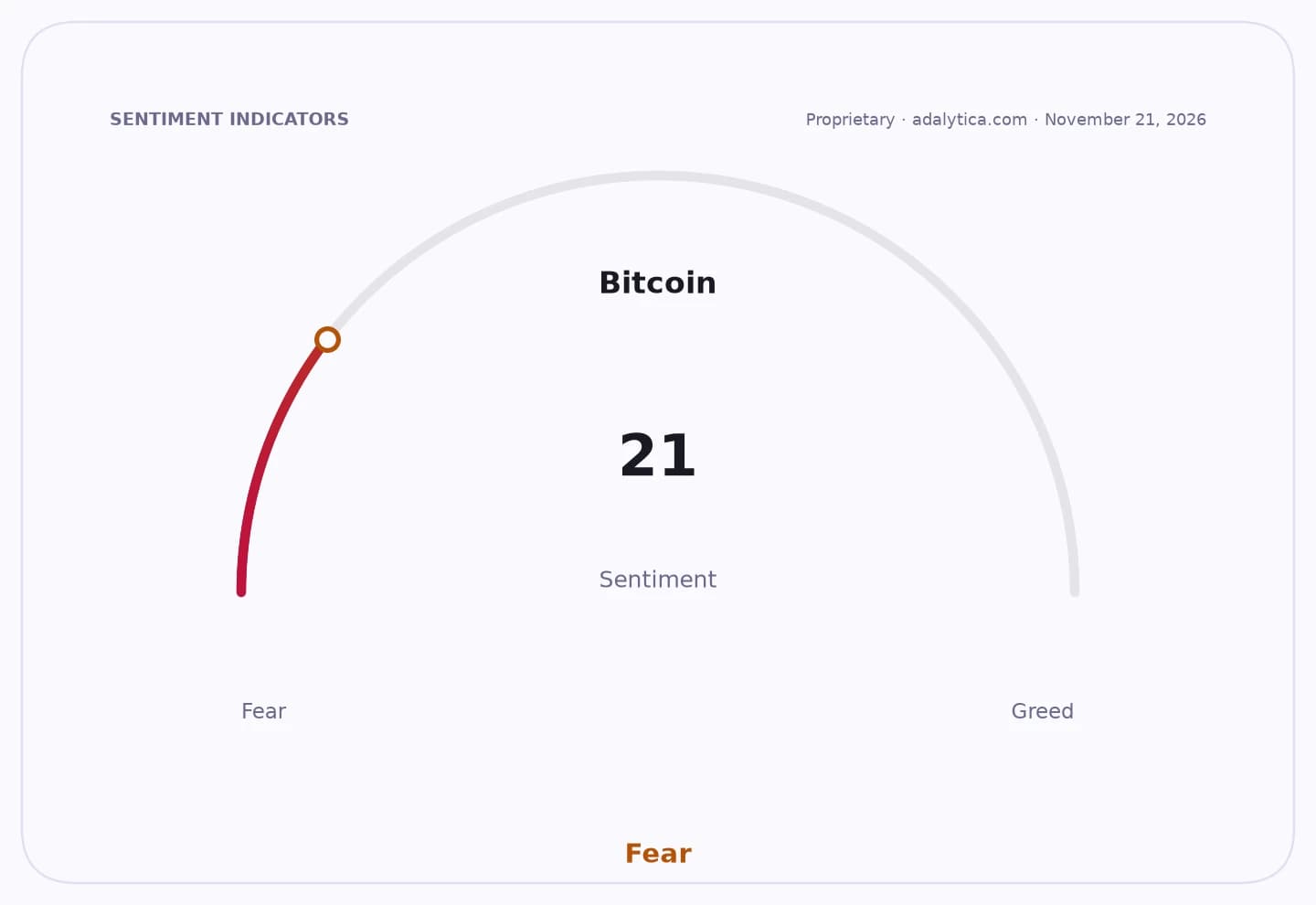
Sentiment Indicators
That gap matters because a powerful quantum computer could eventually derive private keys from public keys already visible on a network, putting dormant coins and reused addresses at risk. For bitcoin, where early pay-to-public-key outputs and address reuse are still part of the supply, the problem is not just theoretical: the report says holders of exposed assets may be unable to move them in time if they are hard to identify or cannot act.
IOSCO board chair Jean-Paul Servais said the scale and duration of the transition mean the financial sector should begin preparing today. The watchdog stopped short of setting rules, but warned of “quantum-procrastination,” where firms delay action until regulators or technology force their hand.
The report also underlines why the fix is not simple. Replacing blockchain signatures would require hard forks and coordination across thousands of independent validators, and the report says that could make any migration “slow and fragmented.” It points to the trade-off between security and performance: a post-quantum signature standard from the U.S. National Institute of Standards and Technology is about 35 to 40 times larger than bitcoin’s current signatures, while a test on Solana’s quantum-resistant network in April saw throughput fall by about 90%.
For investors, the immediate issue is not a quantum attack today, but the re-pricing of long-duration tech risk across crypto markets. Bitcoin remains the largest and most liquid crypto asset, yet it also carries the most widely cited pool of exposed keys, making it the network with the greatest latent migration burden if post-quantum standards become mandatory or widely adopted.
The market is already under pressure. Bitcoin traded around $62,156 on Friday, down sharply from above $86,000 in mid-December, while Ether was near $1,759 and Solana around $72.6. Adalytica’s Bitcoin Fear & Greed Index showed “Extreme Fear” at 13, underscoring how fragile sentiment is even before any real-world quantum breakthrough.
Draft proposals such as BIP 360, which would add a new output type that keeps public keys off chain, and BIP 361, which would phase out legacy signatures, point to the kind of overhaul that may be needed. But Lopp, who co-authored BIP 361, has said the next steps do not include it for now.
IOSCO said it will keep quantum computing a priority in 2027, leaving bitcoin, Ethereum, Solana and the wider crypto market with a clear signal: the countdown to post-quantum security has started, even if the deadline is still uncertain.
| Entity | Gains | Losses |
|---|---|---|
| Post-quantum crypto vendors | ▲demand for migration tools | ▼delayed spending cycles |
| Bitcoin holders with exposed keys | ▲nothing immediate | ▼higher future key-risk scrutiny |
| Ethereum, Solana, Tron ecosystems | ▲policy attention and planning urgency | ▼upgrade cost and throughput pressure |
| Exchanges and custodians | ▲need for security upgrades | ▼compliance and infrastructure expense |