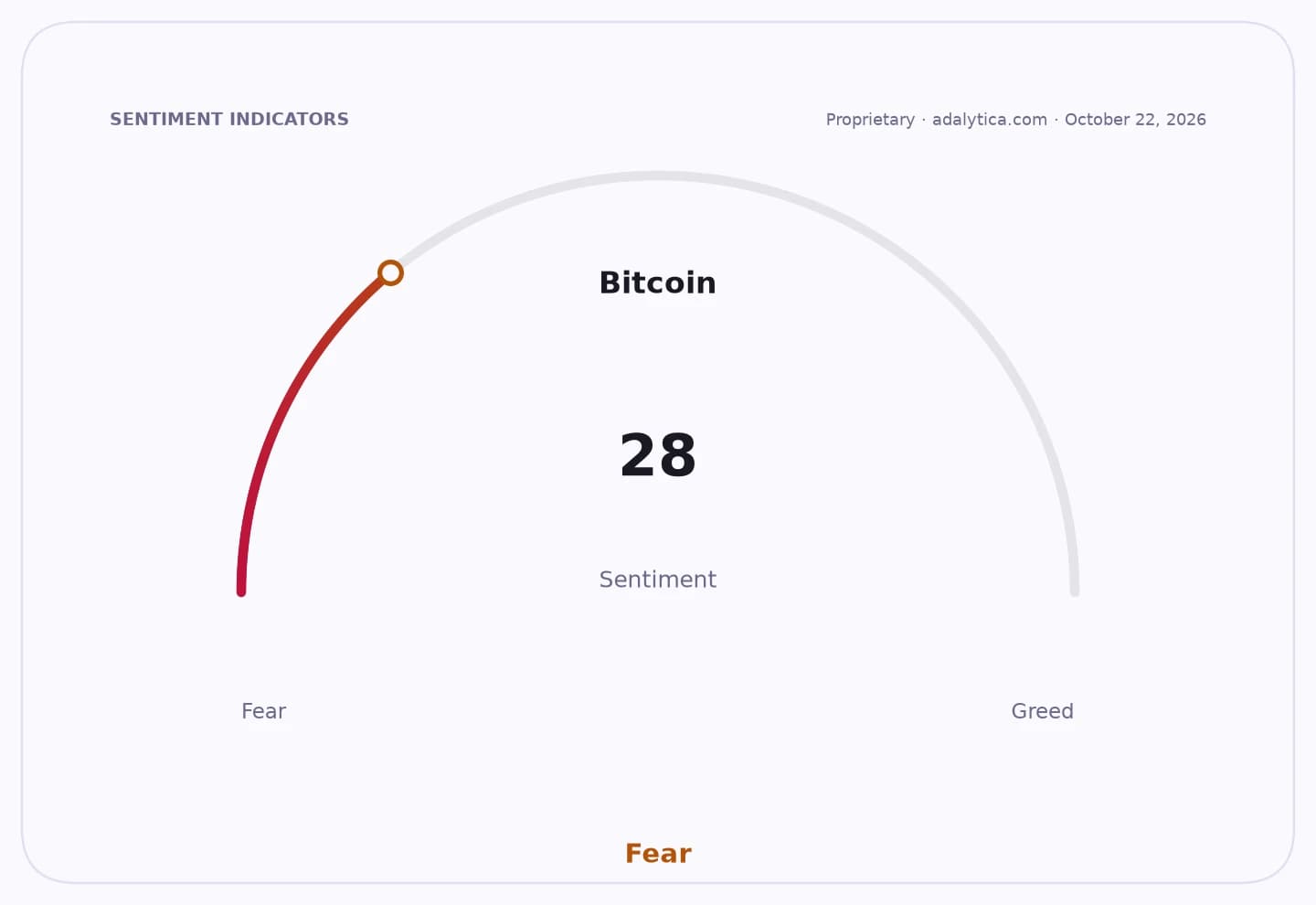
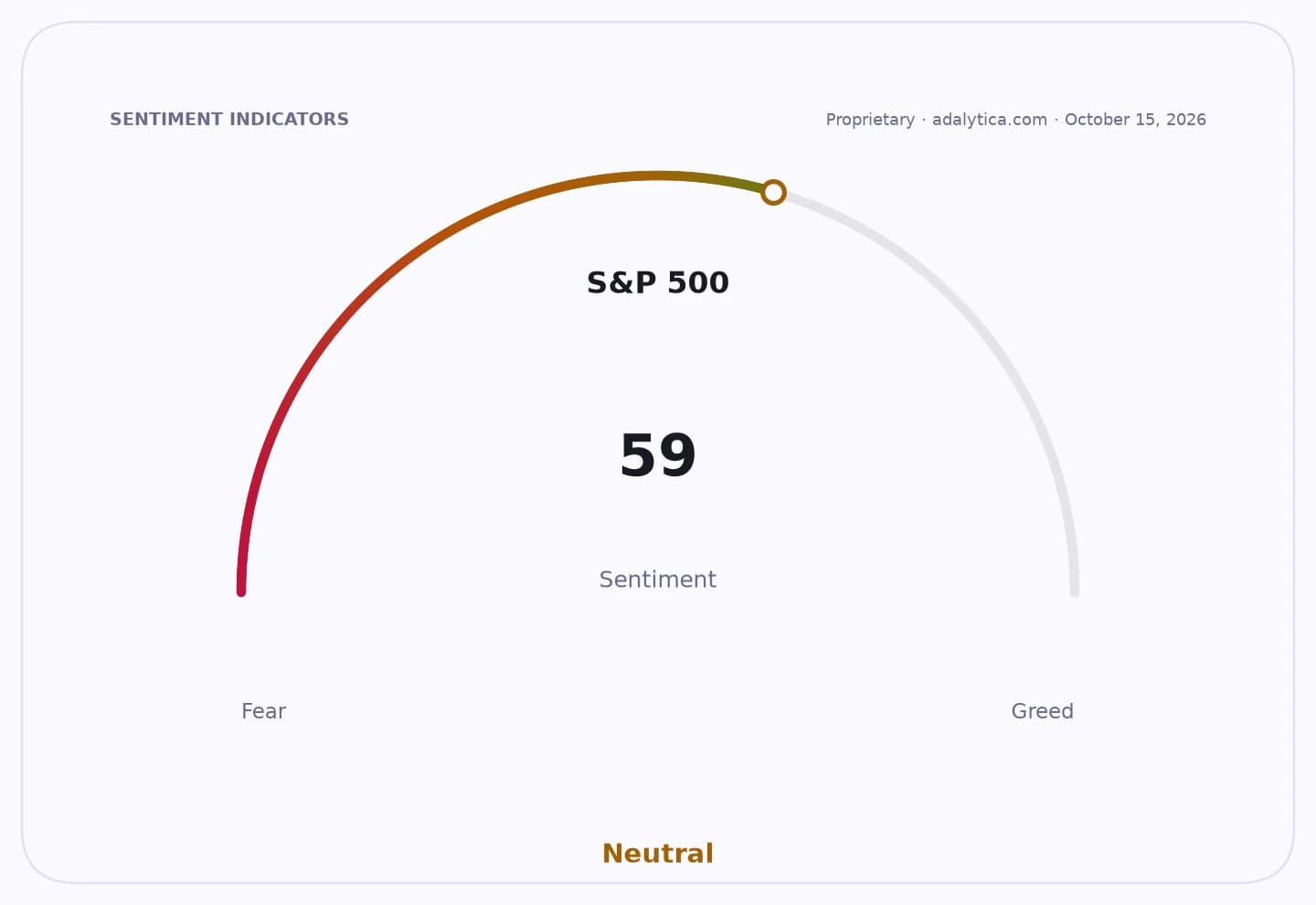
Bitcoin’s sharpest slide since early 2025 is doing more than wiping out leverage — it is reviving the case for privacy coins as one of crypto’s most durable themes when confidence breaks down. With BTC briefly tumbling below $78,000 and touching $74,600 before a weak rebound, traders have been forced to ask a simple question: in a market defined by surveillance, regulation and panic selling, which tokens can still attract capital?
Bitcoin Slide Lifts Privacy Coins on Relative Strength
That is where privacy coins are gaining an edge. Bitcoin’s selloff has dragged Ethereum, Solana and most speculative altcoins lower, but privacy-focused names have held up far better, and in some cases are even eking out gains. In a market where the fear gauge has flashed extreme stress and liquidations have cascaded through AI and meme coins, investors are rotating toward assets that promise anonymity and resilience rather than pure beta.
Sentiment IndicatorsⓘProprietary · adalytica.com · October 24, 2026
This is a snapshot — live sentiment, awareness and momentum for 130+ markets update continuously in the dashboard.Open AlphaPulse
The economics behind that rotation matter. Privacy coins are not just a niche trade; they are a response to a broader shift in crypto’s risk profile. As governments tighten rules and on-chain activity becomes easier to trace, demand can grow for digital assets that preserve fungibility and transaction privacy. In other words, when traders become more cautious, the market often starts rewarding coins that offer a clearer use case than speculation alone.
Monero remains the clearest example. The privacy-focused token has fallen back from a January surge near $800 to around $430, but it is still the benchmark asset for the category and continues to show strong on-chain activity and whale accumulation. That gives long-term investors something important to watch: even after a violent correction, the core privacy thesis has not disappeared. If Monero can hold the $388 to $415 support band, the market may treat the pullback as a reset rather than a broken trend.
Zcash is offering a similar lesson, though with more governance risk. The token has been volatile around $305 after a sharp slide from earlier highs, but the protocol’s roadmap — including a move toward institutional-grade privacy — keeps it relevant for investors looking beyond the latest market mood. The bigger point is that privacy coins are no longer being valued solely on hype. They are being judged on whether they can deliver privacy that is technically credible and, eventually, acceptable to more regulated capital.
Chainlink, Canton and Litecoin show how selective this market has become. LINK is deeply oversold after a 22% retracement, yet its new U.S. equity streams and reserve accumulation suggest that fundamentals can still matter when prices are weak. Canton is standing out as the institutional outlier, with regulated digital-money integrations and validator support helping it rally while the broader market falls. Litecoin, meanwhile, is trying to turn an oversold setup into a programmable-payments story as it approaches its LitVM testnet launch.
For investors, the message is not to chase every token that mentions privacy. It is to recognize which projects have staying power when the market is under pressure. Bitcoin’s slump has reminded crypto holders that liquidity can vanish quickly, but it has also highlighted the kinds of assets that may recover fastest when confidence returns: coins with a clear role, a committed user base and a narrative that fits the next phase of regulation.
If you are building a long-term crypto portfolio, privacy coins are worth watching, not because they always outperform, but because they tend to matter most when the market becomes uneasy. In a space where speculation dominates until it doesn’t, that kind of resilience can be a powerful compounding advantage over a full cycle.
| Entity | Gains | Losses |
|---|---|---|
| Privacy coins | ▲Safe-haven narrative | ▼Breakout-chasing altcoins |
| Monero and Zcash | ▲Renewed investor attention | ▼Momentum shorts |
| Bitcoin and large caps | ▲— | ▼Confidence and liquidity |
| Regulated/institutional tokens | ▲Relative resilience | ▼High-beta meme and AI coins |