Securitize’s plan to tokenize shares of 12 major U.S. companies on Solana is a bigger step for digital asset markets than another product launch: it pushes blockchain infrastructure closer to regulated equity trading just as investors are again paying attention to tokenized real-world assets.
Securitize Plans Tokenized U.S. Stocks on Solana

The company said each token will be backed one-for-one by the underlying shares and preserve shareholder rights, including dividends and voting, a structure designed to address one of the main objections to tokenized stocks. Trading will begin on Securitize’s own platform, with Jump Trading providing liquidity and settlement in USDC, while a future expansion to the New York Stock Exchange’s planned digital trading platform and the OKX-ICE venue could widen distribution if regulators approve.
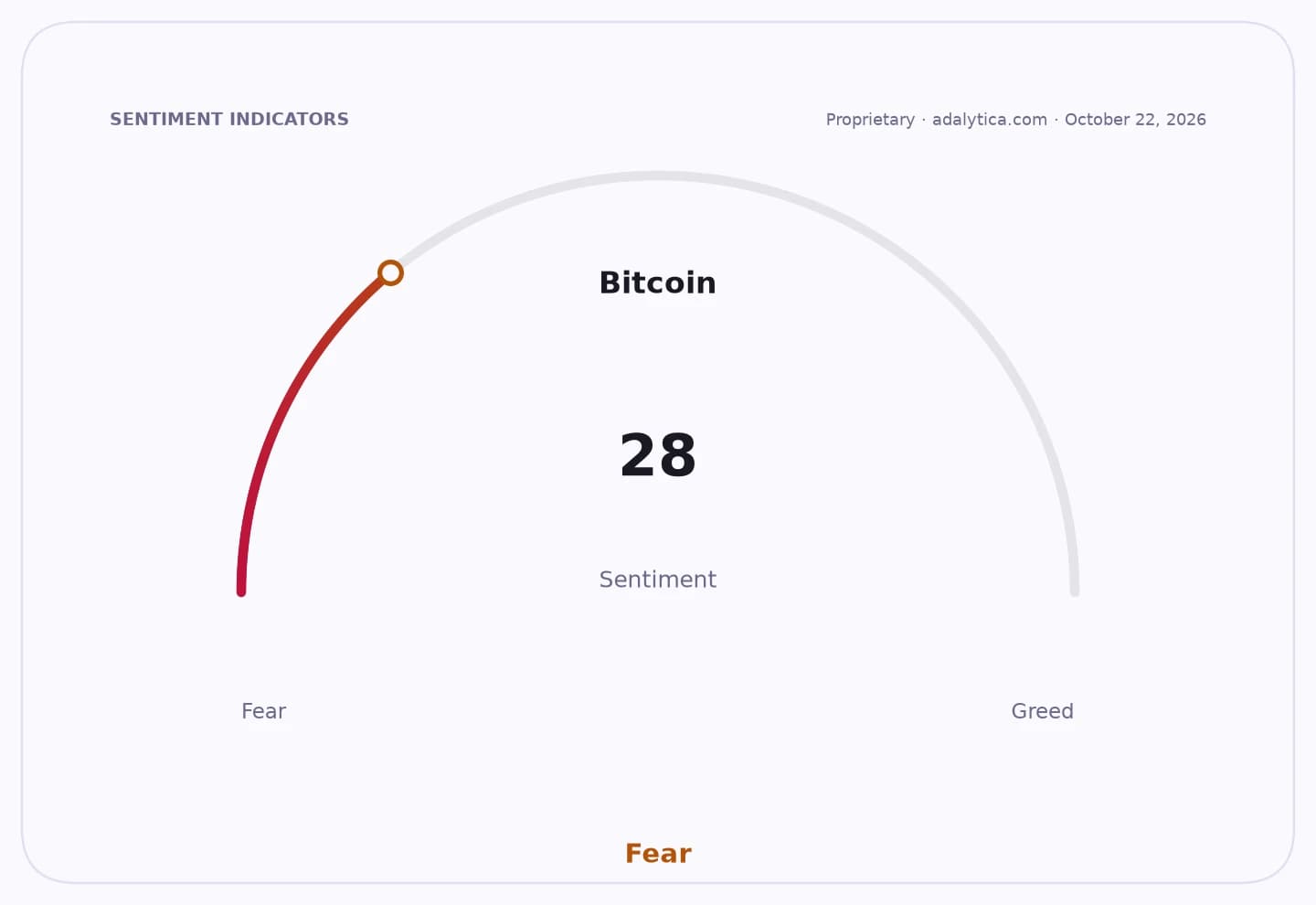
Sentiment IndicatorsⓘProprietary · adalytica.com · October 24, 2026
This is a snapshot — live sentiment, awareness and momentum for 130+ markets update continuously in the dashboard.Open AlphaPulse

That matters because tokenized equities have long been pitched as a way to make traditional securities easier to trade, settle and move across markets, but adoption has been held back by legal uncertainty and thin liquidity. By pairing names such as Apple, Nvidia, Tesla and Microsoft with a major blockchain network and an institutional market maker, Securitize is trying to give the market a blueprint that looks closer to conventional finance than the speculative crypto products that dominated earlier cycles.
The timing is also notable. The CoinDesk 20 Index surged 52.7% in the third quarter, while bitcoin rose 42.7%, outpacing the S&P 500, Nasdaq and gold. U.S. spot bitcoin ETFs attracted $6.36 billion of net inflows in the quarter, helping revive risk appetite after a difficult second quarter. That rebound has been uneven, though: bitcoin sentiment has recently weakened sharply, with Adalytica’s Bitcoin Fear & Greed Index at 16, or “Fear,” while spot bitcoin ETF flows turned negative again in early October.

For investors, the Securitize announcement is important for two reasons. First, it broadens the investable surface area of crypto beyond bitcoin and ether into an area that traditional portfolio managers understand immediately: listed U.S. equities. Second, it reinforces Solana’s pitch as a fast, lower-cost settlement layer for financial applications at a time when institutional players are looking for real use cases rather than narrative-driven speculation.
The bullish case is that tokenized equities could eventually widen access, reduce settlement frictions and create a new channel for trading around the clock. The bearish case is that the market remains dependent on regulators, custodians and liquidity providers, and that tokenized shares will stay niche unless they can clear the same compliance and investor-protection hurdles as ordinary brokered stocks. That tension is why the most important part of the story is not the list of companies, but whether the structure can scale.
If Securitize can get beyond a controlled launch and move toward broader venue support, tokenized stocks could become one of the clearest bridges between crypto infrastructure and mainstream capital markets. If it cannot, the project risks joining a long list of blockchain ideas that looked persuasive in theory but never escaped a small, permissioned market.
| Entity | Gains | Losses |
|---|---|---|
| Securitize | ▲Product traction | ▼Execution risk |
| Solana | ▲Institutional credibility | ▼Pressure to prove scale |
| Jump Trading | ▲New liquidity role | ▼Exposure to thin demand |
| Traditional brokers/exchanges | ▲Potential new flow | ▼Share of tokenized trading |