Bitcoin’s rebound to about $85,000 is powering a fresh wave of dealmaking and positioning in Singapore this week, but traders and executives say the bigger bet is no longer just on price — it is on whether crypto can embed itself deeper in mainstream finance through tokenized assets, stablecoins and AI-driven payments.
Bitcoin Rebounds to $85,000 at Token2049 Singapore

The gathering at Token2049, which is expected to draw about 25,000 investors, founders and executives alongside more than 500 exhibitors, comes as the largest cryptocurrency has recovered sharply from roughly $58,000 in late June. That 43% jump in the quarter ended September has revived talk of a new bull cycle, even as Bitcoin remains well below its 2025 peak above $126,000 and still struggles to reclaim the $87,000 area.
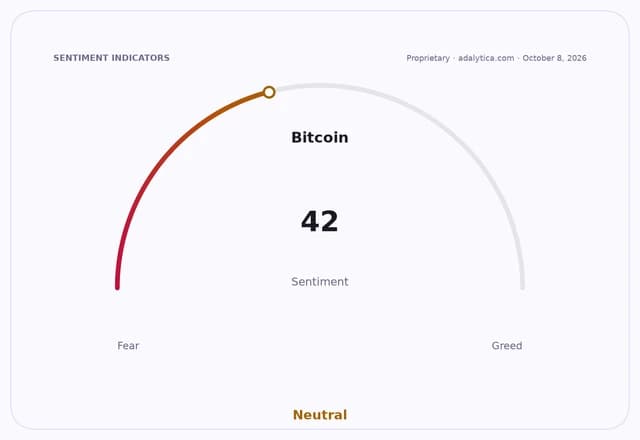
Sentiment IndicatorsⓘProprietary · adalytica.com · October 8, 2026
This is a snapshot — live sentiment, awareness and momentum for 130+ markets update continuously in the dashboard.Open AlphaPulse

For investors, the significance is twofold: the market has shown it can absorb setbacks such as the U.S. Senate’s failure to advance the Clarity Act, and institutional participation is helping to offset the stop-start retail mood that has defined much of the year. But the rebound is also fragile. Higher U.S. Treasury yields are weighing on risk assets, and the Bitcoin Fear & Greed gauge tracked by Adalytica.com is still neutral at 42, underscoring that the market is recovering without returning to euphoria.
Singapore has become the industry’s preferred staging ground for that shift. Crypto activity in the city-state reached $284 billion between July 2025 and June 2026, up 55.4% from a year earlier, according to Chainalysis, reinforcing its role as a hub where exchanges, funds, stablecoin issuers and traditional finance firms now overlap.
That convergence is the dominant theme at the conference. Tokenized real-world assets, including bonds, commodities and equities, topped $38 billion at the end of September, according to RWA.xyz, and the attendee list reflects how quickly the sector is moving beyond native crypto trading. Nasdaq chair and CEO Adena Friedman and Franklin Templeton chief executive Jenny Johnson are among the executives joining crypto founders on stage, a sign that traditional finance is increasingly treating blockchain infrastructure as a distribution channel rather than a side bet.
The agenda also shows where the next capital is likely to go. Panels on “agentic payments,” where AI systems make transactions autonomously, are drawing attention from venture firms hunting for the next use case that could generate volume beyond speculation. At the same time, security remains a live risk after the $388 million theft from Bitget two weeks ago, a reminder that adoption still depends on trust, controls and regulatory clarity.
Bitcoin itself is the immediate trade, but the broader narrative in Singapore is that the industry is trying to move from cyclical rallies to structural utility. If tokenized assets, stablecoins and AI-linked payments keep gaining traction, the current rebound may end up mattering less as a price move than as the point when crypto markets started to look like part of the financial system instead of a parallel one.
| Entity | Gains | Losses |
|---|---|---|
| Bitcoin bulls | ▲Momentum and renewed cycle hopes | ▼Need a break above $87,000 |
| Tokenization platforms | ▲More institutional attention | ▼Face execution and regulation risk |
| Traditional finance firms | ▲New blockchain distribution channels | ▼Lose exclusivity over market rails |
| Short sellers | ▲Volatility if rally extends | ▼Risk squeeze on another upside leg |