Brazil’s central bank chief Gabriel Galípolo said there is no debate inside the government about changing the country’s 3% inflation target, pushing back on market chatter that the policy framework could be loosened.
Brazil Central Bank Denies Inflation Target Change

The comment matters because any move to raise or rethink the target would reshape the central bank’s room to cut rates, alter borrowing costs across the economy and change the trajectory for the real, government debt and inflation-linked assets. By insisting the issue is off the table, Galípolo is signaling continuity at a time when investors are already parsing Brazil’s disinflation path and the durability of its monetary regime.
Sentiment Indicators

“Within the government there is no debate about changing the target, changing the system. Zero, zero,” Galípolo said at Itaú BBA’s Macro Vision 2026 panel. He added that the public discussion may have “thinned” the topic, and said he sees no one in government discussing the issue.
The message is particularly relevant for fixed-income markets, where expectations around the inflation target feed directly into pricing for Selic-rate policy, term premium and the real. The Brazilian currency was already under scrutiny, with BRL/USD trading around 5.74 after a sharp late-November rebound from 4.96 in October, while the market’s conventional technical indicators still show elevated momentum in the exchange rate.
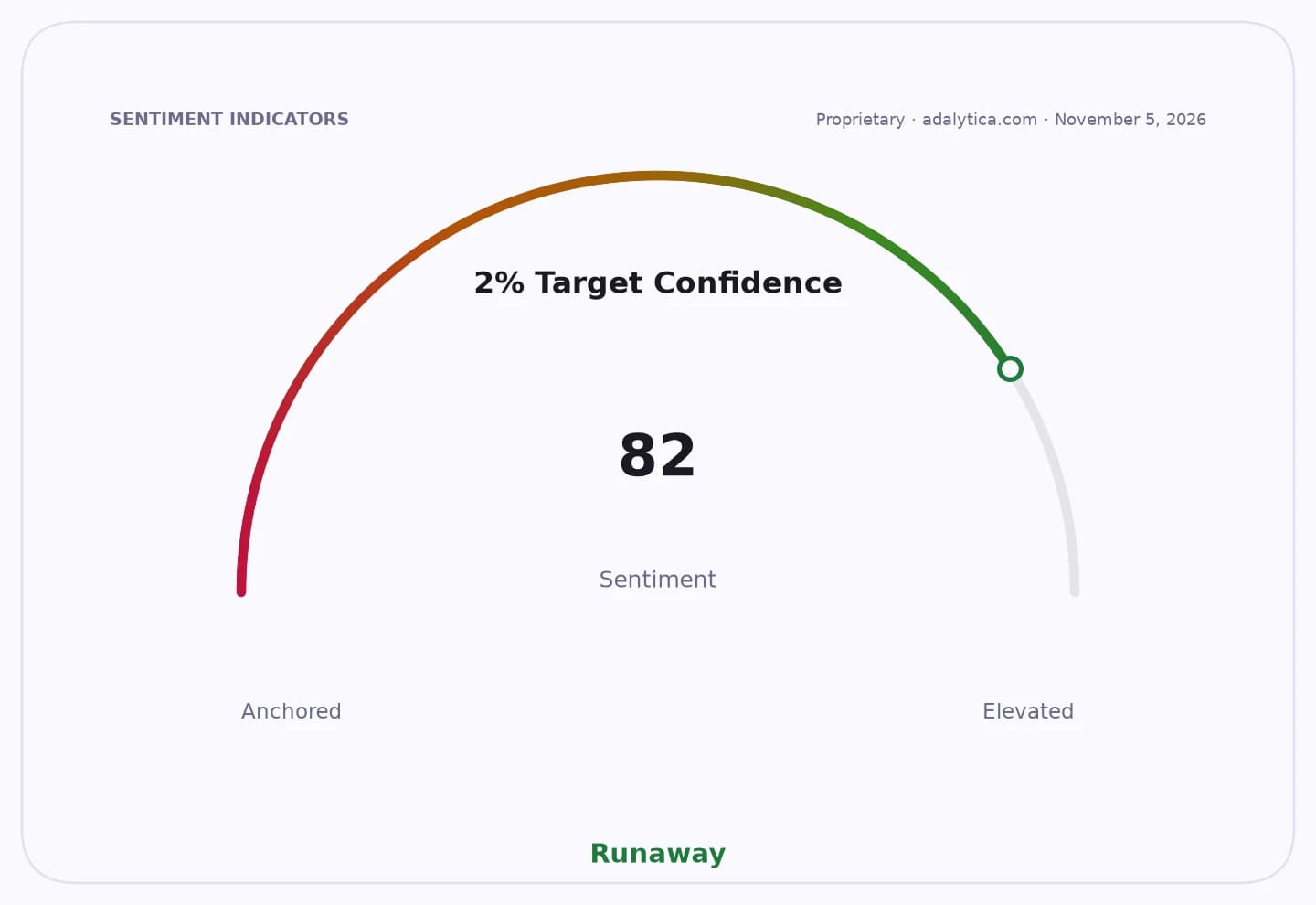
2% Target Confidence — 30-day sentimentadalytica.com
Explore this data interactively — full history, time series and cross-market comparisons.
2% Target Confidence
Inflation positioning has also become more sensitive globally as investors reassess whether central banks can hold or hit target without tightening growth too hard. Adalytica’s gauge for confidence in the Fed’s 2% inflation target is in “Extreme Fear” territory, underscoring how quickly credibility questions can move markets even when officials deny any policy change.
For Brazil, the near-term focus now shifts back to incoming inflation data and the central bank’s next communication, with investors looking for confirmation that the 3% target remains intact and that rate-setting will continue to be driven by the existing framework rather than political pressure.
| Entity | Gains | Losses |
|---|---|---|
| Brazilian central bank | ▲Policy credibility | ▼Debate over target change |
| Bond investors | ▲More policy clarity | ▼Higher uncertainty premium |
| Brazilian real | ▲Support from stability | ▼Pressure from policy doubt |
| Inflation-target skeptics | ▲Less traction | ▼Expectation of reform |