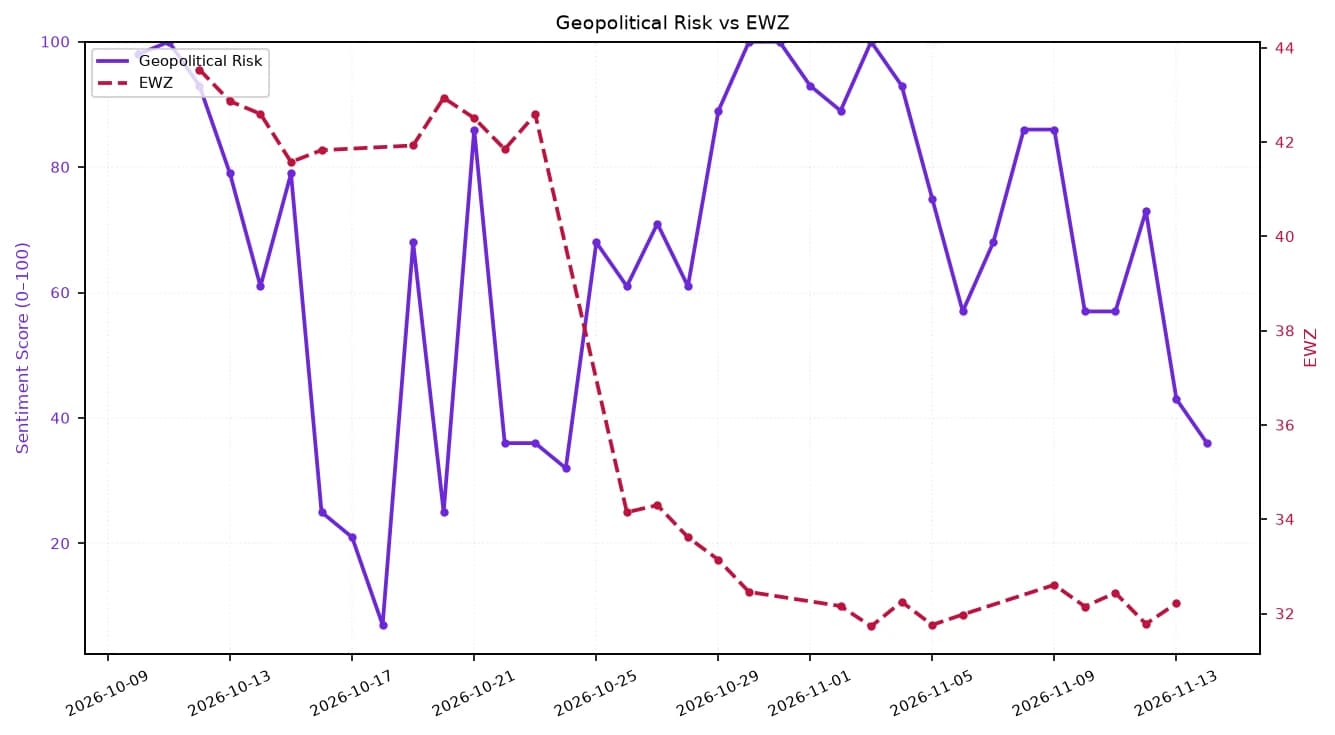
President Luiz Inácio Lula da Silva’s accusation that big tech platforms interfered in Brazil’s electoral process matters because it pushes the country’s biggest digital policy battle from rhetoric into the center of government power, with potentially far-reaching consequences for how U.S. technology companies operate in Latin America’s largest market.
Brazil Lula Accuses Big Tech of Election Interference

For investors, this is not just a political sound bite. It is another sign that the era of light-touch treatment for platform businesses is over in Brazil, where regulators are already weighing tougher rules on content moderation, artificial intelligence and digital competition. When a president says he will govern “for everyone” while accusing the largest online platforms of bias or interference, the message to markets is clear: Brasília is preparing to assert more control over the digital stack.
Sentiment Indicators
That matters economically because Brazil is one of the region’s most important consumer and advertising markets, and even modest changes in platform liability, moderation standards or election-related restrictions can alter costs and growth rates for companies that depend on user engagement and ad spending. Alphabet and Meta, in particular, face a policy environment where enforcement risk can quickly become a margin issue, while Amazon’s broader exposure to Brazil leaves it vulnerable if regulation spills into marketplace and cloud operations.
The stock market has already been reminding investors that megacap tech is not immune to policy risk. Meta shares closed at $641.69 on Nov. 13, down sharply from a peak above $760 in October, while Alphabet ended at $295.77, well below its recent levels. Amazon, by contrast, has held up better at $266.66, but the common thread is that valuations for the AI and platform complex are now sensitive to any new constraints on monetization, distribution or data use.
The broader narrative is that Latin America’s tech debate is moving in the same direction as Europe’s and the U.S.’s: more scrutiny, more legal exposure and more pressure on the largest platforms to prove they are serving public interests rather than shaping them. Lula’s comments may be aimed at domestic politics, but the investable takeaway is global — when governments decide that digital platforms are part of the electoral battlefield, regulation becomes a structural cost, not a one-off headline.
That creates a split for investors. The obvious losers are ad-heavy consumer platforms and any company exposed to content liability. The winners are firms that help governments enforce rules, manage identity, monitor content and secure digital infrastructure. In other words, the next trade is not just in the apps that capture attention, but in the compliance, cloud and cybersecurity layers that sit underneath them.
For now, Brazil is signaling that big tech’s political influence will be contested, not tolerated. Investors should treat that as an early warning that the next phase of digital growth will be shaped as much by regulation as by product innovation.
| Entity | Gains | Losses |
|---|---|---|
| Brazilian government | ▲More control over digital rules | ▼Higher friction with U.S. tech firms |
| Meta and Alphabet | ▲None from tighter scrutiny | ▼Higher compliance and moderation risk |
| Amazon | ▲Less direct exposure than ad peers | ▼Spillover regulatory risk in Brazil |
| Cybersecurity and compliance vendors | ▲More demand for controls | ▼None from stricter oversight |