Brazil is heading toward a bigger minimum-wage hike in 2027, and that matters because it would lift household income, pressure payrolls across the economy and add a new layer of uncertainty to the country’s inflation and rate outlook.
Brazil Minimum Wage Hike Forecast for 2027

The forecast points to an increase of about R$120 from the current floor, a move that would ripple far beyond low-income workers. In Brazil, the minimum wage is a political and macroeconomic anchor: it feeds pensions, social benefits and a wide range of labor-linked contracts, which means a seemingly narrow adjustment can fan demand at the same time it raises costs for employers and the public sector.
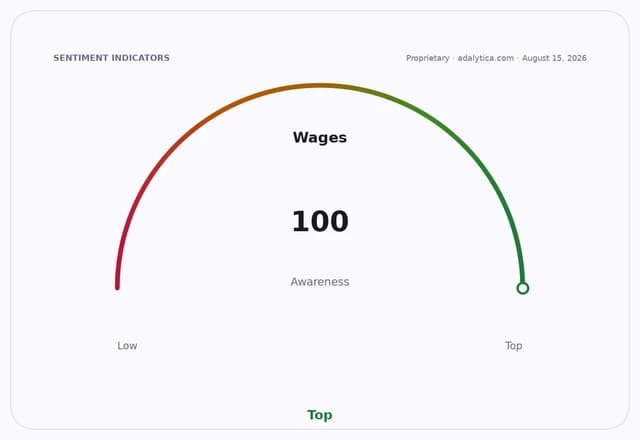
Sentiment IndicatorsⓘProprietary · adalytica.com · August 15, 2026
This is a snapshot — live sentiment, awareness and momentum for 130+ markets update continuously in the dashboard.Open AlphaPulse
That is why investors should pay attention. A larger wage floor can support consumption in the near term, but it also risks keeping service inflation sticky and limiting the room for the central bank to ease policy aggressively. For equities, the consequences split cleanly: consumer-facing names and banks with exposed retail loan books can benefit from stronger disposable income, while labor-intensive businesses, municipalities and fiscally stretched policymakers face higher expense pressure.
The market backdrop suggests wages are already back on investors’ radar. Adalytica’s wage-inflation gauge is in “Greed” with “Extreme Greed” awareness, while CPI awareness is also at “Extreme Greed,” underscoring how sensitive the market has become to any policy that can feed prices or alter real incomes. In that environment, a minimum-wage increase is not just a social policy headline — it is a macro catalyst.
For Brazil’s asset market, that means the trade is increasingly about second-order effects. Higher wages can underpin domestic demand and support Brazil-focused assets such as the EWZ ETF and lenders like Banco do Brasil, but they also complicate the backdrop for rate-sensitive sectors and any company reliant on low-cost labor. The right way to position is not to chase the headline, but to own the beneficiaries of stronger wage-led consumption while staying cautious on names most exposed to margin compression.
The bigger question now is whether the government can deliver the increase without reigniting inflation and fiscal concerns. If the forecast becomes policy, the winning investors will be those already positioned for a Brazil where wages, prices and policy are once again moving in the same direction.
| Entity | Gains | Losses |
|---|---|---|
| Low-income workers | ▲Higher purchasing power | ▼— |
| Consumer lenders / banks | ▲Stronger loan demand | ▼Higher credit risk |
| Labor-intensive employers | ▲— | ▼Wage cost pressure |
| Brazil equity bulls | ▲Domestic-demand tailwind | ▼Inflation and rate uncertainty |