Brazilian assets are ripping higher as investors bet the first round of the presidential election has improved the odds of policy continuity, sending the real back to R$5 per dollar and driving the EWZ ETF to a record high.
Brazil Real Rallies, EWZ Hits Record High

That move matters because Brazil is one of the world’s most tradable macro trades: when the currency strengthens, imported inflation eases, local rates become easier to manage and foreign capital usually has more room to chase equities. When the currency breaks lower, the opposite happens fast. So a sudden rally in the real is not just a political headline — it is a potential inflection point for Brazil’s inflation path, central-bank flexibility and the discount rate applied to everything from banks to commodity exporters.
Sentiment IndicatorsⓘProprietary · adalytica.com · October 6, 2026
This is a snapshot — live sentiment, awareness and momentum for 130+ markets update continuously in the dashboard.Open AlphaPulse
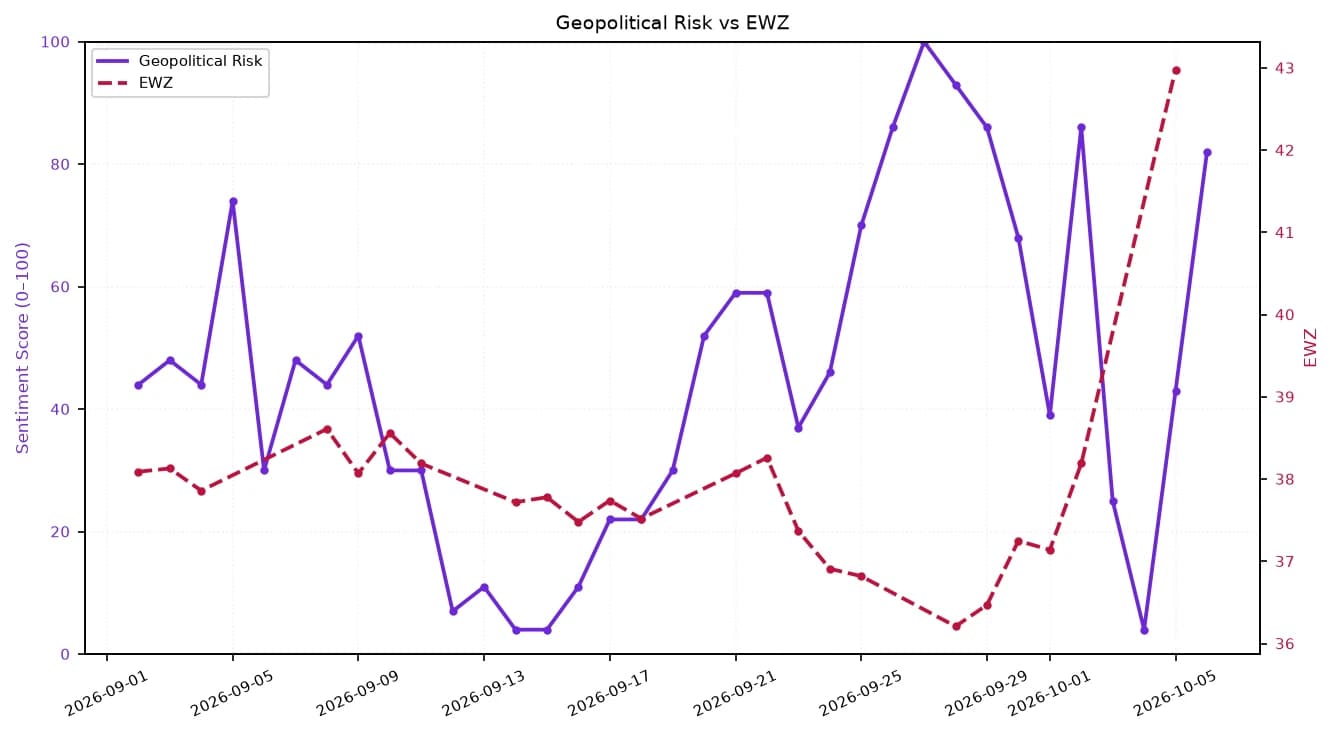
EWZ closed at $42.98 on Oct. 5, up sharply from $38.19 two sessions earlier and well above its 50-day moving average of $36.49 and 200-day average of $36.22. The ETF’s relative strength index at 74.6 shows the market is already stretched, but the technical breakout underscores how aggressively investors are repositioning around the election outcome. The move came with heavy volume of 190.6 million shares, a sign this was not a thin squeeze but a broad-based rush into Brazilian risk.
The currency move is just as important. The dollar fell to R$5.00 on Oct. 6 from R$5.22 the day before, its strongest level in months and a psychological line in the sand for local markets. Even after the drop, the pair remains near its 50-day average of R$5.15, suggesting the market is testing whether this is the start of a more durable rerating rather than a one-day relief rally. Adalytica’s FX volatility signal also shows extreme fear in the market has collapsed over the past month, a setup that often precedes violent directional moves as positioning is unwound.
FX Vol Index vs EWZadalytica.com
Explore this data interactively — full history, time series and cross-market comparisons.Open AlphaPulse
For investors, the immediate trade is not just “Brazil up.” It is a rotation toward the beneficiaries of a stronger real and a more market-friendly political backdrop. Domestic banks, retailers and rate-sensitive equities typically gain when inflation pressure eases and capital inflows return. Exporters and dollar earners can lag in the short term if the real keeps firming, but the broader index can still rally if lower risk premiums pull valuation multiples higher.
The larger narrative is that Brazil may be repricing from crisis hedge to cyclical opportunity. If the first-round result is interpreted as reducing policy uncertainty, global money can come back quickly into a market that still trades at a discount to developed peers and offers leverage to both domestic demand and commodity cycles. That combination is exactly what hedge funds and emerging-market allocators look for when they want asymmetric upside.
The market’s next test will be whether the real can hold above R$5 and whether the post-election rally broadens beyond a short-covering squeeze. If it does, Brazil could be one of the few large emerging markets where political clarity, currency strength and equity momentum reinforce each other. For investors, the message is simple: do not chase blindly after one day of euphoria, but do not dismiss it either — this is the kind of macro break that can reset a whole country trade.
| Entity | Gains | Losses |
|---|---|---|
| Brazil equities / EWZ | ▲Record breakout, foreign inflows | ▼Late shorts, underweight managers |
| Brazilian real | ▲Stronger currency, lower import pressure | ▼Dollar bulls, hedged importers |
| Domestic banks and retailers | ▲Easier rates, better sentiment | ▼Exporters exposed to a firmer real |
| Lula continuity trade | ▲Lower policy uncertainty premium | ▼Reform skeptics, volatility traders |