California is moving from health-cost rhetoric to enforcement, and that is the development investors in hospitals, insurers and managed-care names cannot ignore. The state’s Office of Health Care Affordability has adopted some of the nation’s toughest penalty rules, giving regulators the power to fine hospitals, physician groups and insurers that breach spending caps by as much as 125% of the overage.
California health spending caps and hospital fines

That matters because healthcare inflation has been eroding wages, premiums and household budgets for years, and California is now trying to force the industry to slow spending growth below the pace at which it has historically expanded. The state’s benchmark is 3.5% annual growth, falling to 3% in 2029, versus roughly 6% average annual growth over the past decade. For a sector built on steady price increases and reimbursement leverage, that is a meaningful policy shock.
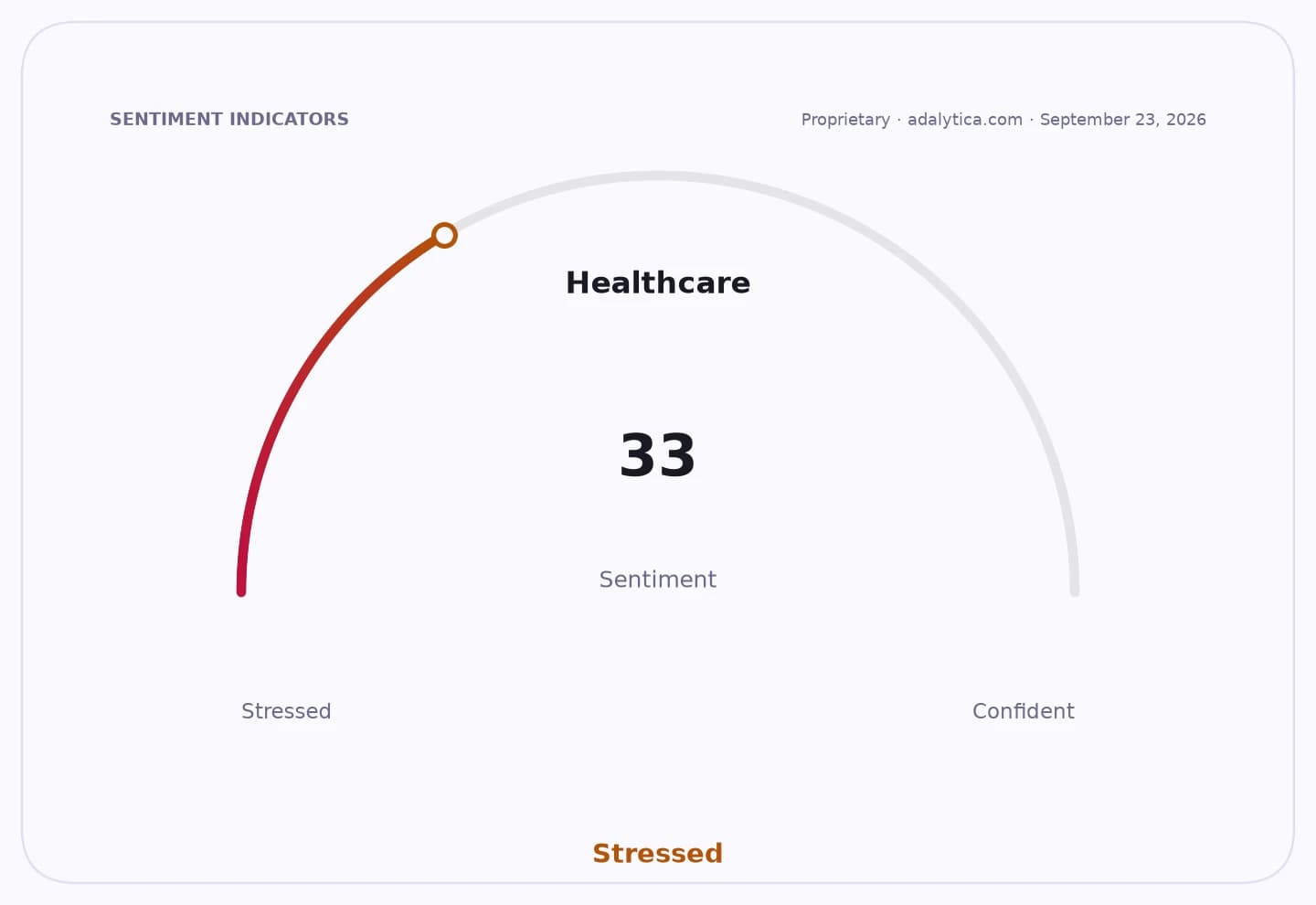
Sentiment IndicatorsⓘProprietary · adalytica.com · September 6, 2026
This is a snapshot — live sentiment, awareness and momentum for 130+ markets update continuously in the dashboard.Open AlphaPulse

Hospitals are in the crosshairs because they account for about a third of healthcare spending and are the most visible cost center in the system. The Office of Health Care Affordability has already singled out seven hospitals as “high cost,” putting them under even tighter annual limits of 1.8%, dropping to 1.6% by 2029. The earliest fines can be imposed is 2028, but the market is already being told to price in a more aggressive regulatory regime.
For investors, the key question is not whether California can instantly lower costs — it cannot — but whether this becomes a template for other states and payers. That is where the asymmetric risk sits. If the penalties are enforced, hospital margins face a new cap on pricing power at a time when labor, construction and pharmaceuticals are still pressuring expenses. If enforcement is weak, the policy becomes noise. Either way, the direction of travel is clear: the state wants to take away one of healthcare’s most reliable tailwinds, and that changes the calculus for capital allocation.
The implications extend beyond hospitals. Insurers may try to anchor reimbursement negotiations to the spending caps, which would pressure provider rates even before penalties arrive. Consumer groups want tough enforcement, arguing that large health systems and insurers should be forced to absorb the restraint. Providers, meanwhile, say the rules could lead to service cuts and narrower access, especially if federal policy changes increase uncompensated care and push more uninsured patients into emergency rooms.
That is why the first-order trade here is between pricing power and policy discipline. Hospitals and insurers lose if California proves willing to police affordability with real financial punishment. Employers, unions and consumers gain if the state can bend premium growth and free up room for wages. For public-market investors, the biggest risk is not the immediate fine bill — it is the longer-cycle repricing of California healthcare assets around slower reimbursement growth, tighter oversight and lower returns on expansion.
The best thesis from here is to stay selective. The market underestimates how quickly cost-containment policy can move from headline risk to earnings risk, especially for providers with heavy California exposure. At the same time, the companies that help systems manage utilization, shift care more efficiently or sell cost discipline as a service could be the hidden winners of this inflection point. In healthcare, regulation is often treated as a headwind; this time, it may be the catalyst that separates defensives from dead money.
| Entity | Gains | Losses |
|---|---|---|
| California consumers | ▲Slower premium growth | ▼Less provider pricing power |
| Large hospital systems | ▲Technical assistance first | ▼Fine risk and margin pressure |
| Insurers | ▲Reimbursement leverage | ▼Higher scrutiny on spending |
| Healthcare cost-control vendors | ▲More demand for efficiency tools | ▼Less demand for unchecked expansion |