China’s new April 2026 regulations give authorities sweeping powers to investigate foreign companies, seize records and impose exit bans on executives, sharpening the risk that doing business in the world’s second-largest economy can become a legal and operational trap.
China April 2026 rules raise foreign company risk

The move matters because it turns supply-chain policy into a national-security tool at a time when Beijing is trying to slow capital and manufacturing outflows. For multinationals already weighing “China Plus One” strategies, the decree raises the cost of moving production, sharing data or restructuring supply chains away from China.
Sentiment IndicatorsⓘProprietary · adalytica.com · September 28, 2026
This is a snapshot — live sentiment, awareness and momentum for 130+ markets update continuously in the dashboard.Open AlphaPulse

Premier Li Qiang signed the 18-article regulations in early April, and they took effect on April 7. The rules allow Chinese authorities to question employees, review corporate files and target firms suspected of undermining China’s “industrial and supply chain security,” while a companion decree targets entities seen as promoting foreign sanctions.
For investors, the immediate implication is higher regulatory risk for companies with large China exposure, especially in semiconductors, autos, industrials and consumer technology. Firms with sensitive intellectual property or cross-border data flows face the greatest exposure, while suppliers tied to China’s export machine may benefit in the short term from a government push to keep production local.
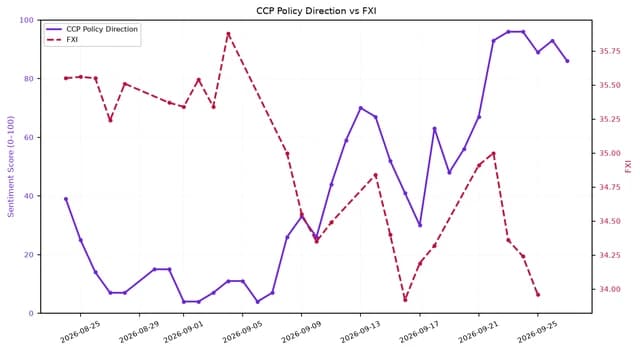
The policy shift lands against a fragile economic backdrop. China’s property slump remains a major drag, exports have become the main growth engine and Beijing is leaning harder on subsidies to support industries such as electric vehicles and steel. That combination is intensifying trade friction with the U.S. and Europe, which are already responding with tariffs, mineral stockpiles and faster diversification away from Chinese supply chains.
The market backdrop reflects that tension. FXI, the iShares China Large-Cap ETF, has fallen to $33.96 from $39.76 in late October and sits below both its 50-day and 200-day moving averages, while YINN, the leveraged China bull ETF, has dropped to $24.89 from $49.00 over the same period. Both moves point to rising investor caution on China exposure as policy risk and growth concerns deepen.
Adalytica’s China CCP Policy Direction Sentiment gauge shows “Extreme Greed” at 86, with awareness at 100, underscoring how aggressively Beijing is being perceived to be moving on policy. For global CEOs, the message is that exit plans from China may now face retaliation, while staying may increasingly mean accepting a higher risk of detentions, investigations and lost control over assets.
| Entity | Gains | Losses |
|---|---|---|
| Chinese authorities | ▲More leverage over foreign firms | ▼Confidence from multinationals |
| Domestic manufacturers | ▲Sticky capital and supply chains | ▼Foreign rivals exiting |
| Foreign multinationals | ▲Little in the short term | ▼Higher legal and operational risk |
| FXI / YINN bulls | ▲— | ▼China equity sentiment and pricing |