China’s medal haul at the Asian Games remains dominant, but its weakness in team sports has become the clearest sign that the country’s sporting machine still has blind spots that matter beyond the podium.
China Asian Games Team Sports Gap
The issue is not whether China can win medals. It can, and often does, across individual events where discipline, technical repetition and centralized training are enough to produce results. The problem is that in the sports that require fast tactical adaptation, deeper competitive ecosystems and sustained team chemistry — football, basketball, volleyball and other ball games — China is still losing ground to Japan and South Korea.
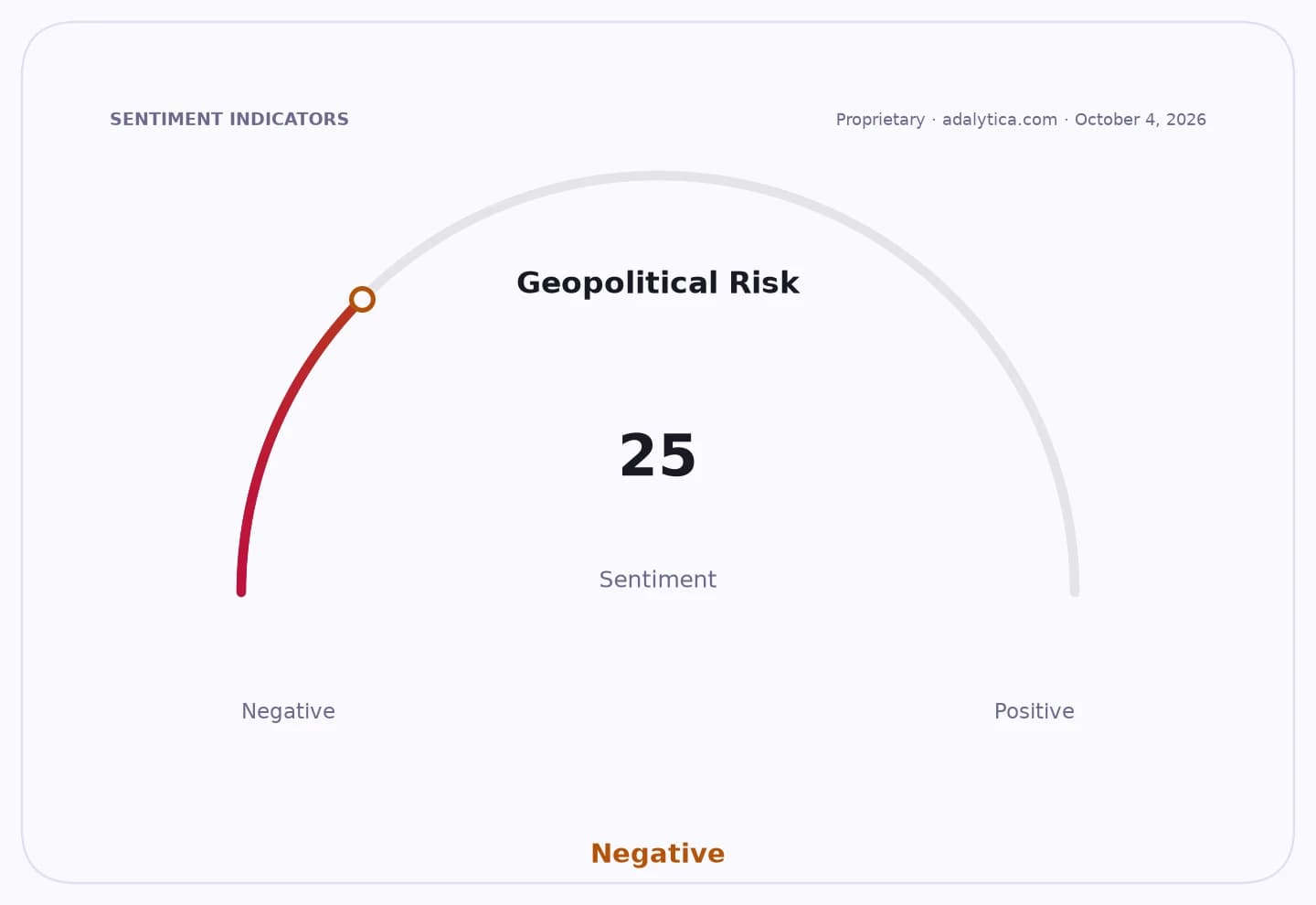
Sentiment IndicatorsⓘProprietary · adalytica.com · October 4, 2026
This is a snapshot — live sentiment, awareness and momentum for 130+ markets update continuously in the dashboard.Open AlphaPulse
That matters economically because elite sport in China is not just a matter of national pride. It is tied to public spending priorities, state-backed training systems, sponsorship economics and the long-term commercial value of leagues, clubs and youth development pipelines. In team sports, success tends to be self-reinforcing: better competition produces better players, better players draw audiences, and larger audiences support more private capital. China’s underperformance in those disciplines suggests its sports ecosystem is still producing more isolated excellence than broad-based depth.
The numbers from the Asian Games underline the gap. In the 12 team-ball events, China won just one gold, one silver and three bronzes, a gold conversion rate of 8.3%. South Korea took six golds in those same events, while Japan won three golds and medaled in 11 of 12 disciplines. For China, the lone gold came in women’s volleyball, while the men’s football team managed only bronze after beating Uzbekistan on penalties. Basketball, once a sport where China could lean on size alone, ended without a gold as Japan and South Korea matched physicality with more modern systems and wider international exposure.
That is what makes the story larger than one tournament. China has long excelled in sports that reward precision and repetition, but team games expose the limits of a talent model built around centralized preparation rather than open competition and tactical diversity. Japanese teams increasingly draw on players developed in U.S. college systems, while South Korea continues to build strong pipelines across football and baseball. Those countries are exporting more adaptable athletes; China is still trying to catch up.
For investors, the implications are mostly indirect but real. The commercial upside of Chinese sports is increasingly concentrated in sectors linked to consumption, media rights, equipment, advertising and esports-like fan engagement, not necessarily in national-team success. A persistent gap in team sports can temper enthusiasm around domestic leagues, youth academies and sports branding tied to mass-market ball games. It also reinforces the view that Chinese households and sponsors are more likely to rally behind individual stars and Olympic-style events than to generate the kind of deep, recurring engagement that drives premium sports franchises elsewhere.
The broader narrative is one of scale versus sophistication. China’s system still produces medals in abundance, but the Asian Games are again showing that dominance in individual events does not automatically translate into team-sport competitiveness. Unless China closes that gap, its sporting model may continue to deliver headline success while leaving the more commercially valuable, globally visible team disciplines to its rivals.
| Entity | Gains | Losses |
|---|---|---|
| China individual-sport system | ▲Medal efficiency | ▼Team-sport credibility |
| Japan and South Korea | ▲Team-sport prestige | ▼None material |
| Sports sponsors and broadcasters | ▲Stronger rival storylines | ▼China-led team-sport dominance |
| Youth academies and league builders | ▲Pressure to modernize | ▼Comfort from legacy systems |