China’s growth is set to lose momentum even as the global economy stays resilient, with a US think tank warning that weak domestic demand and fading export support are leaving Beijing with fewer easy levers to offset its property downturn.
China Growth Slows as Property Slump Deepens

The Peterson Institute for International Economics said overcapacity and the prolonged property slump are weighing on consumption and investment, while the export engine that helped stabilize activity is expected to cool. That matters because China remains a key marginal driver for commodities, Asian supply chains and global trade flows; a softer Chinese expansion would ripple through industrial demand, pricing power and earnings across multinationals exposed to the market.
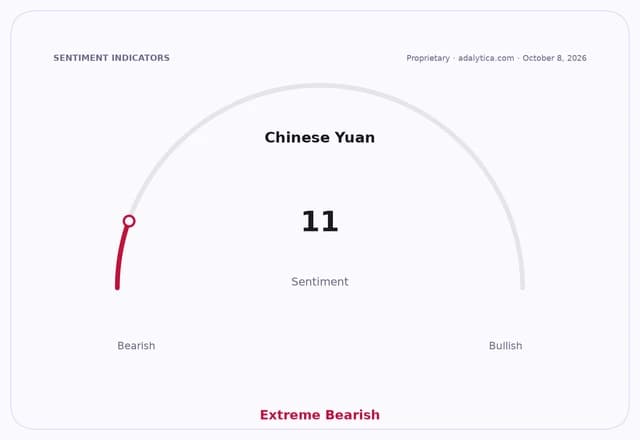
Sentiment IndicatorsⓘProprietary · adalytica.com · October 8, 2026
This is a snapshot — live sentiment, awareness and momentum for 130+ markets update continuously in the dashboard.Open AlphaPulse
The report’s message is that China’s slowdown is no longer just a cyclical pause but a more structural adjustment. Heavy industry has been running ahead of final demand for much of the post-pandemic period, leaving excess capacity in areas from manufacturing to parts of the clean-tech supply chain. At the same time, the housing slump continues to drain household confidence and local-government revenue, limiting Beijing’s ability to engineer a broad-based rebound through the old playbook of construction-led stimulus.
That combination is particularly relevant for investors because it changes where growth and profit pools are likely to emerge. A weaker China typically pressures commodity exporters, luxury brands, automakers and consumer staples with large mainland exposure, while supporting relative outperformance in markets and sectors less dependent on Chinese demand. Recent earnings updates have already shown the strain: Nike disclosed a sharp decline in Greater China revenue in its latest quarter, underscoring how macro weakness is translating into corporate results.
Chinese Yuan — 30-day sentimentadalytica.com
Explore this data interactively — full history, time series and cross-market comparisons.Open AlphaPulse

The foreign-exchange backdrop reinforces the caution. Adalytica’s Chinese yuan trade signals show “Extreme Fear,” while the yuan’s sentiment and awareness readings have deteriorated sharply over the past month, suggesting a market still pricing growth risks and policy uncertainty. Chinese equity proxies have also lost ground: the FXI China ETF has slipped to about $33.77, below both its 50-day moving average of $35.09 and 200-day average of $36.03, a technical backdrop that points to fading near-term momentum. The MCHI China ETF has similarly weakened, trading at $52.22 versus a 50-day average of $54.23 and a 200-day average of $56.50.
For now, the key narrative is that global growth may be holding up better than many feared, but China is moving in the opposite direction, and that divergence matters for asset allocation. If Beijing leans harder on targeted stimulus, investors may get tradeable relief rallies in China-linked equities and the yuan. But unless property demand stabilizes and excess capacity is absorbed, any recovery is likely to be uneven, keeping pressure on earnings expectations and on the sectors most exposed to Chinese end demand.
| Entity | Gains | Losses |
|---|---|---|
| Global exporters | ▲Stable external demand | ▼China-linked volume growth |
| Chinese policymakers | ▲Scope for targeted stimulus | ▼Need for broader reflation |
| Commodity producers | ▲Global growth resilience | ▼Softer Chinese industrial demand |
| China ETFs (FXI, MCHI) | ▲Policy-driven rebounds | ▼Weak earnings momentum |