China is no longer just exporting low-cost manufacturing; it is scaling the technologies that will define the next industrial cycle, and that shift is creating a new investable map for global markets.
China Manufacturing Output Rises in High-Tech Sectors

What matters economically is not the optics of a trade fair in Hefei, but the evidence that China’s industrial base is moving up the value chain fast enough to challenge the assumption that innovation is still a Western monopoly. The World Manufacturing Convention in Anhui showcased humanoid robots, next-generation memory chips, advanced batteries, quantum computing and biotech, while Beijing has simultaneously elevated advanced manufacturing to a national priority. That combination matters because it means China is trying to convert scale into technological self-sufficiency, then push those gains into exportable products at industrial volume.
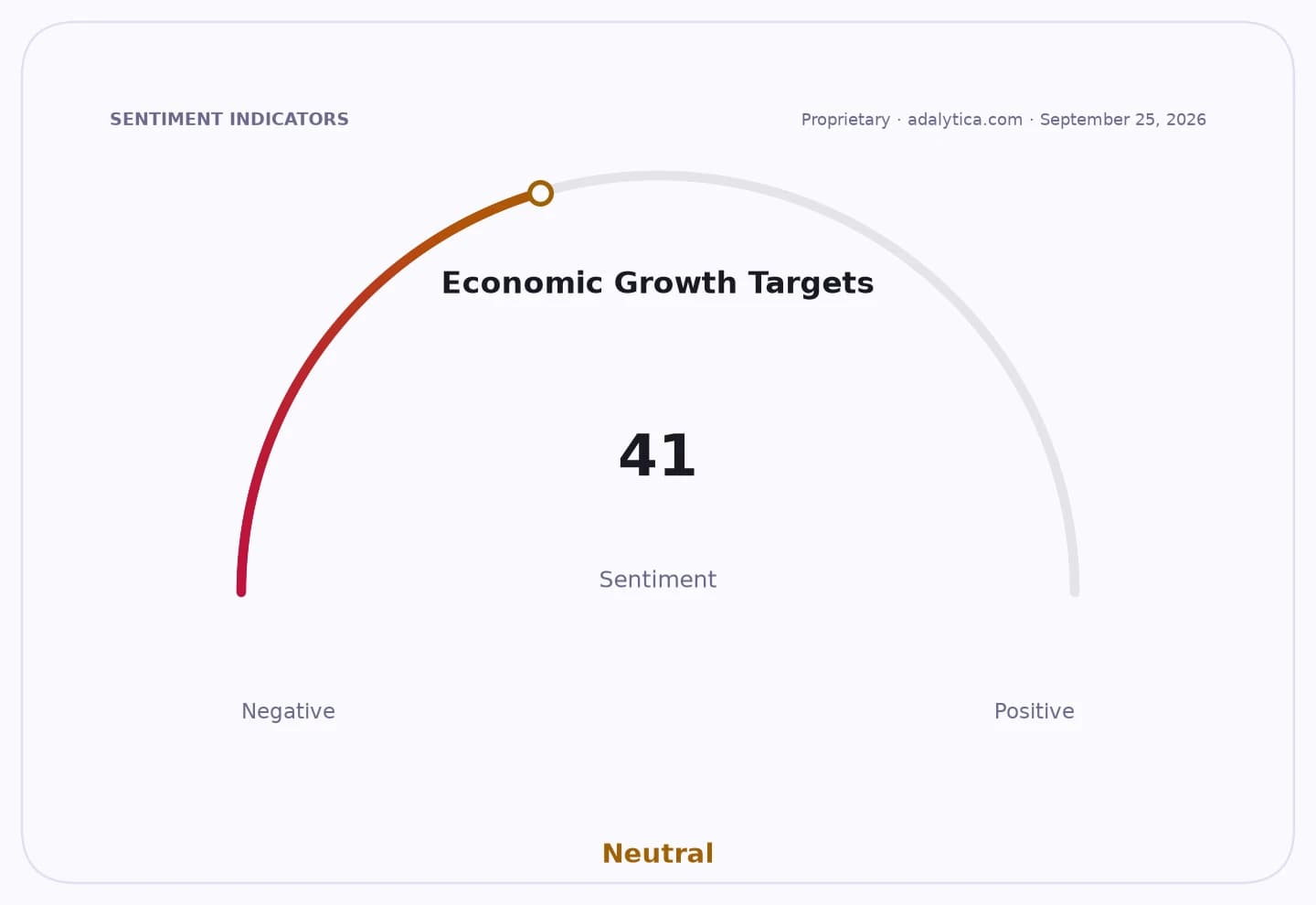
Sentiment IndicatorsⓘProprietary · adalytica.com · September 23, 2026
This is a snapshot — live sentiment, awareness and momentum for 130+ markets update continuously in the dashboard.Open AlphaPulse

The numbers show the pivot is already well under way. High-tech industrial output rose 16.7% in August from a year earlier, equipment manufacturing climbed 12.1%, industrial robot production surged 34.6% and lithium-ion battery output jumped 57.2%. This is the sort of acceleration that changes supply chains, pricing power and capital allocation. When a country can grow robots and batteries at those rates while also pushing deeper into semiconductors and AI-adjacent hardware, it stops being a mere manufacturing hub and becomes a competitor in the global innovation stack.
For investors, that means the market still underestimates second-order winners and losers. The headline risk for U.S. policymakers has long been China’s manufacturing dominance; the deeper risk now is that Chinese firms are learning to capture more of the margin pool in memory, batteries, robotics and intelligent vehicles. ChangXin Memory Technologies said it has begun mass production of its fifth-generation DRAM platform, lifting wafer output by at least 50% versus the prior generation. Gotion High-Tech unveiled a battery it says can deliver more than 1,000 kilometers of range and recover 500 kilometers of charge in nine minutes. Whether every specification proves durable in the field is almost beside the point: the direction of travel is unmistakable. China is moving from assembly to architecture.
That creates a powerful investment thesis around the picks-and-shovels of Chinese innovation, but also around the global companies forced to compete with it. The U.S. and Europe still dominate premium AI chips, software and industrial automation, yet China’s push into memory, EV batteries and robotics threatens to compress margins and accelerate product cycles across those markets. Suppliers that can sell into this buildout may see fresh demand, but incumbent manufacturers outside China face a more intense competitive environment and a faster race to cut costs.
The market is already hinting at the split. The FXI China ETF remains below its 200-day moving average, while KWEB is also trading well beneath that level, suggesting broad skepticism is still priced in despite the industrial evidence. That gap between perception and industrial reality is where the opportunity sits. If China’s manufacturing transition continues, investors should focus less on country-level narratives and more on the specific platforms tied to advanced hardware, EV ecosystems, automation and industrial intelligence.
The next catalyst will come from whether this innovation wave translates into export share, profit growth and international capital. Foreign delegates in Hefei are already signaling interest in cooperation, not just competition, and that is how these shifts compound: first through supply chains, then through standards, then through pricing power. In our view, the market is still treating China as a cyclical trade when it is increasingly a secular technology story. The right response is to position for the companies, ETFs and infrastructure suppliers that benefit from a more advanced Chinese industrial economy — before that rerating becomes obvious.
| Entity | Gains | Losses |
|---|---|---|
| Chinese tech manufacturers | ▲Scale, margins, export potential | ▼ |
| Foreign industrial rivals | ▲ | ▼Pricing power, market share |
| FXI / KWEB buyers | ▲Valuation upside if rerating starts | ▼ |
| U.S. and European suppliers | ▲China demand for inputs | ▼Domestic competitors to Chinese innovation |