China says relations with India will improve as President Xi Jinping heads to New Delhi for the first time in nearly seven years, a sign that the two Asian powers are trying to stabilize ties even as border tensions and wider geopolitical strains keep investors cautious.
China India Relations Improve Ahead of Modi-Xi Meeting

The immediate economic significance is not that Beijing has delivered a concrete policy shift, but that both sides are again signaling they want to manage disputes rather than let them dominate the relationship. That matters for trade flows, supply-chain planning and regional risk pricing, especially with India seeking to keep investment momentum intact while China looks to preserve influence across Asia and the broader Global South.
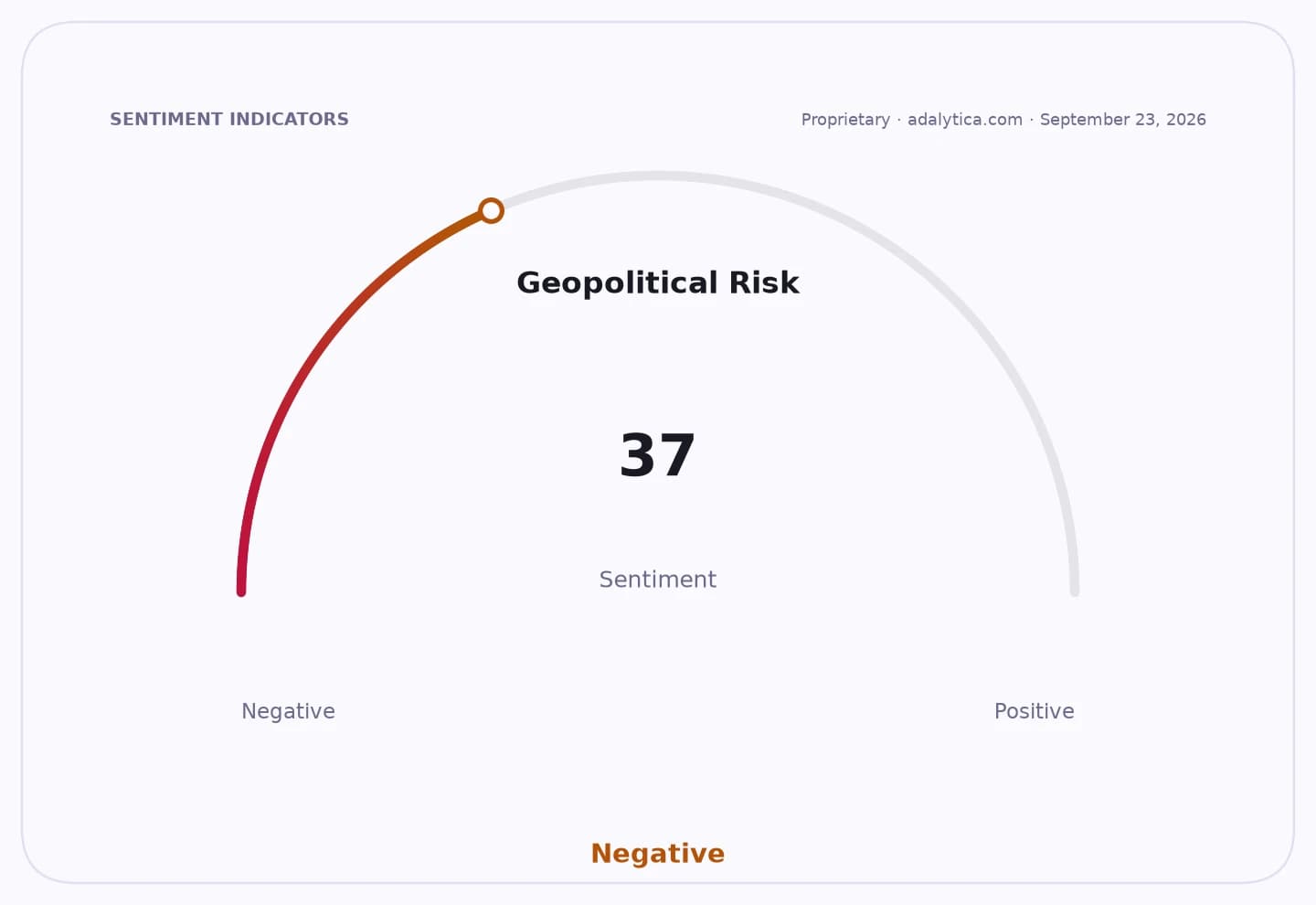
Sentiment IndicatorsⓘProprietary · adalytica.com · September 13, 2026
This is a snapshot — live sentiment, awareness and momentum for 130+ markets update continuously in the dashboard.Open AlphaPulse
Foreign Ministry spokesperson Mao Ning said in a briefing that after the leaders’ meetings in Kazan and Tianjin, this will be the third consecutive year that Narendra Modi and Xi meet. She said China will work with India in line with the leaders’ strategic guidance, strengthen dialogue and cooperation and resolve differences “properly” from a strategic and long-term perspective.
Xi is due to arrive in India on Saturday for the BRICS summit and a bilateral meeting with Modi on the sidelines. The visit would be his first to India since 2019, when he met Modi in Mamallapuram near Chennai in an informal summit that also aimed to ease bilateral frictions.
Geopolitical Risk vs INDAadalytica.com
Explore this data interactively — full history, time series and cross-market comparisons.Open AlphaPulse
For investors, a warmer tone lowers the risk of another escalation between two of the world’s biggest emerging markets, even if it does not erase structural competition. Indian assets and exchange-traded funds with China exposure were little changed in the latest session, with the India ETF INDA at $48.57, below its 50-day moving average of $49.38, while the China ETF FXI traded at $34.49, also under its 50-day average of $34.99, reflecting a market that has yet to price in a lasting diplomatic reset.
The broader backdrop is one of rising geopolitical sensitivity. China cast BRICS as a platform for the “Global South,” while saying the bloc should help resolve disputes through dialogue and contribute to peace and stability. With the summit taking place against the wars in Ukraine and tensions involving Iran and the U.S., the message from Beijing is that it wants BRICS to look constructive rather than confrontational.
That leaves the market with a familiar setup: improved diplomatic language, but few hard commitments. Any follow-through on trade, border management or investment will matter more than the rhetoric, and traders will watch whether the Modi-Xi meeting produces practical steps that can support sentiment across Indian equities, China proxies and the wider Asia trade.
| Entity | Gains | Losses |
|---|---|---|
| India | ▲Lower geopolitical risk | ▼Pressure to compromise |
| China | ▲Regional influence, BRICS standing | ▼Harder stance on disputes |
| INDA holders | ▲Stabilization premium | ▼Volatility if talks stall |
| FXI holders | ▲Better diplomatic backdrop | ▼Limited upside without policy action |