Xi Jinping’s sweeping disciplinary purge of 33 senior officials, including a top military figure, underscores both his grip on the Communist Party and the unresolved governance strains that could slow China’s effort to revive growth.
China purge, policy risk weigh on FXI and MCHI
Geopolitical Risk
The most immediate economic implication is not political drama but policy execution. Beijing is trying to shore up consumption, stabilize property and restore private-sector confidence at a time when growth sentiment remains weak and investors are still cautious on China assets. A party apparatus preoccupied with discipline and loyalty can enforce central control, but it can also make local and midlevel officials more risk-averse, delaying the experimentation and course correction China needs to turn policy into results.
Sentiment Indicators
The Communist Party’s latest closed-door plenum ratified the expulsion of 33 cadres, according to the source material, while reinforcing Xi’s authority rather than loosening it. That included a sharp reduction in the top military body, with the Central Military Commission effectively pared back to Xi and Zhang Shengmin, the anti-corruption official now also elevated to the Politburo. The scale of the purge cuts two ways for markets: it shows Xi can still impose discipline at the highest levels, but it also suggests the anti-corruption campaign is far from complete, even after years of cleanup efforts.
For investors, that matters because China’s equity story increasingly depends on whether Beijing can convert central control into credible growth support. FXI, the iShares China Large-Cap ETF, has fallen to around $33.19 from above $40 earlier in the period tracked, while MCHI has slipped to about $49.40 from a recent peak near $63.84. The technical picture has weakened too, with both ETFs trading below their 200-day moving averages and MCHI’s RSI hovering in deeply oversold territory before a modest rebound. That does not by itself prove a political selloff, but it is consistent with a market that remains skeptical of China policy follow-through.
The purges also carry a message for state-owned enterprises, local governments and the military establishment: no position appears fully protected. In the near term, that may tighten compliance and deter outright corruption. Over time, however, it can also deepen the “fear of making mistakes” problem that often accompanies intensive discipline drives, making officials less willing to approve spending, take credit risk or push unconventional reforms. That is a problem for an economy that still needs stronger household demand, more effective debt management and a repair of confidence in the property sector.
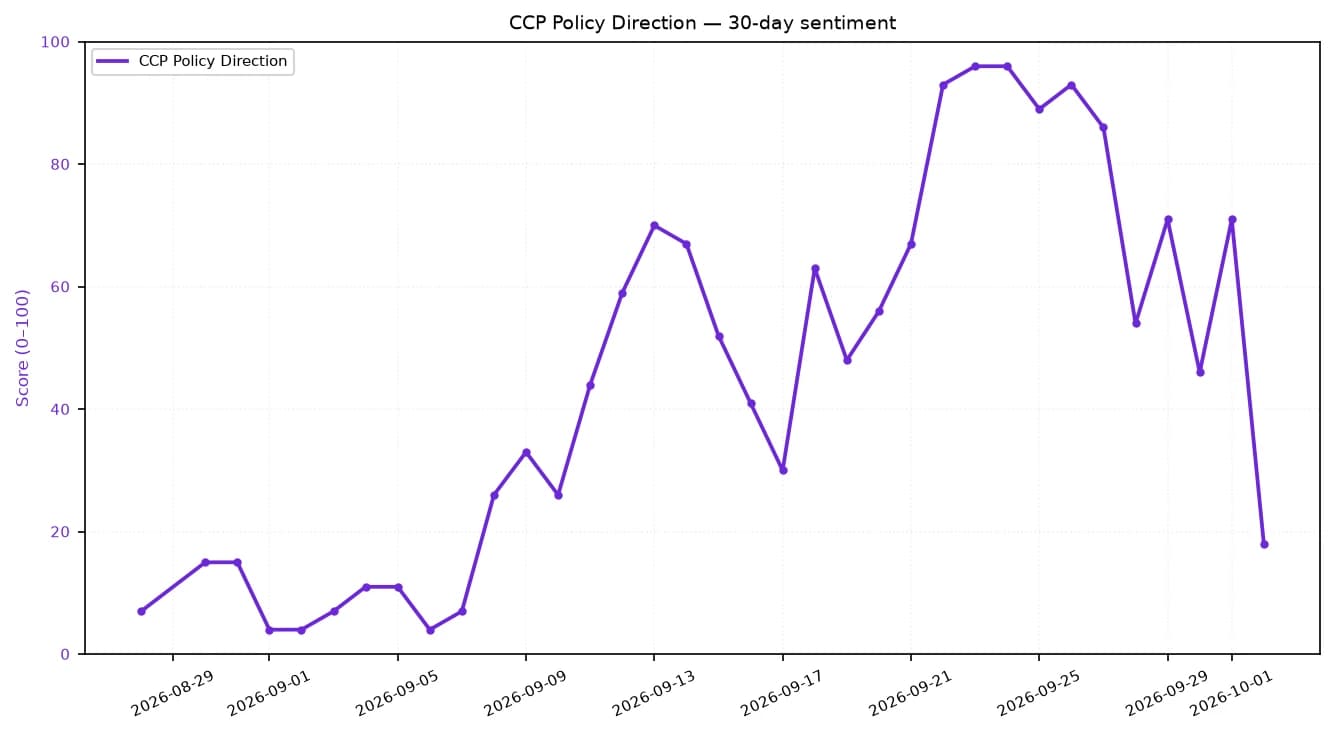
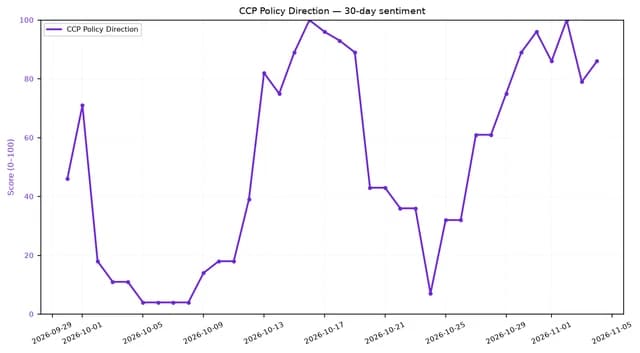
Adalytica’s China Communist Party policy-direction sentiment is still flashing “Extreme Greed,” reflecting confidence in the leadership’s ability to maintain control, while its China growth-target sentiment sits in “Extreme Fear,” highlighting the market’s concern that control is not the same as growth. That divergence captures the central tension in Xi’s model: political order can be tightened quickly, but economic confidence is harder to rebuild.
The next critical test comes ahead of the 2027 Party Congress, when Xi is expected to seek another five-year mandate. Between now and then, investors will be watching whether the leadership can show that the latest purge strengthens governance without further paralyzing policy implementation. If Beijing can combine discipline with clearer economic support, Chinese assets could recover lost ground. If not, the market may continue to price a system that is powerful on control but slow on reform.
| Entity | Gains | Losses |
|---|---|---|
| Xi Jinping / central leadership | ▲tighter control | ▼policy flexibility |
| Anti-corruption apparatus | ▲expanded authority | ▼credibility if scandals persist |
| Chinese equities (FXI, MCHI) bulls | ▲eventual policy support | ▼near-term confidence |
| Local officials / bureaucrats | ▲compliance cover | ▼room to experiment |