China’s next growth engine is looking less like mass manufacturing and more like a service-led innovation machine, and that shift matters because it can keep Chinese companies relevant well beyond the country’s factory floor. At the Canton Fair, Beijing is showcasing a model built on faster product cycles, smarter services and deeper overseas partnerships — a combination that could reshape trade, pressure global competitors and create new opportunities for investors willing to think in years, not weeks.
China's Service-Led Growth and FXI, KWEB Outlook
The big economic story is not simply that China still exports a lot. It is that Chinese firms are increasingly trying to sell solutions, platforms and service bundles alongside hardware, from e-commerce and logistics to technology-enabled consumer offerings. That matters because services usually carry higher margins, stronger customer stickiness and more recurring revenue than one-off product sales. For China, it is also a way to defend growth as property, credit and consumer sentiment remain uneven.
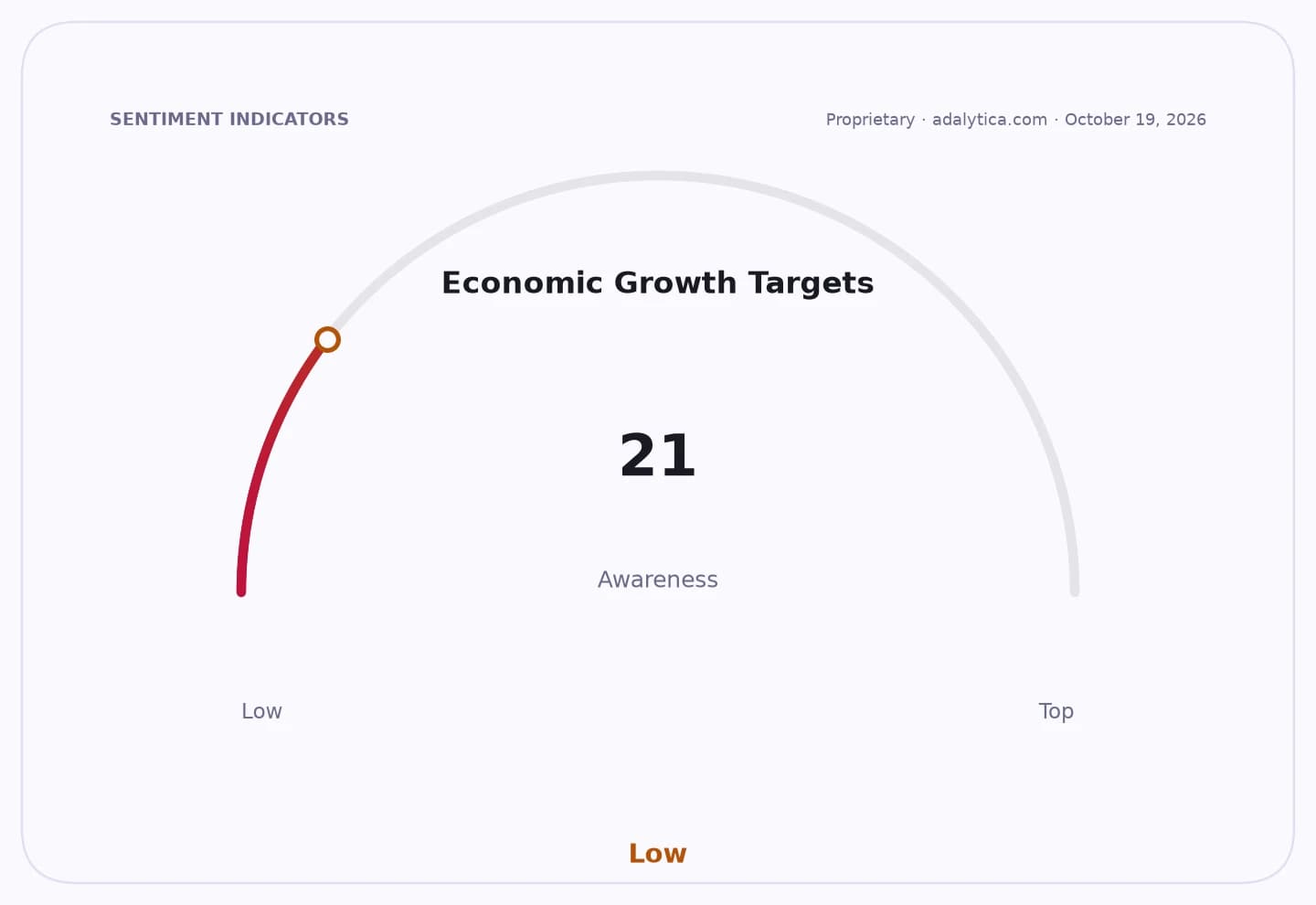
Sentiment IndicatorsⓘProprietary · adalytica.com · October 19, 2026
This is a snapshot — live sentiment, awareness and momentum for 130+ markets update continuously in the dashboard.Open AlphaPulse
The market backdrop helps explain why this theme is getting attention. The iShares China Large-Cap ETF, FXI, has slipped to about 33.84, below its 50-day moving average of 34.72 and its 200-day moving average of 35.85, showing investors are still skeptical about the durability of the rally. The KraneShares CSI China Internet ETF, KWEB, is trading around 24.41, also below both its 50-day and 200-day moving averages. That tells you the market has yet to fully price in a cleaner China recovery, even as the innovation narrative strengthens.
At the same time, the underlying story is not one of broad disruption, but of adaptation. China’s domestic competition has forced companies to iterate quickly, and that speed is now spilling into international markets. Foreign firms are still expanding in China to tap that ecosystem, while Chinese groups are building relationships abroad, including in the Middle East, Egypt and Indonesia. For multinational companies, the question is no longer whether China can make things cheaply. It is whether Chinese firms can increasingly compete on software, service quality and speed of execution.
Economic Growth Targets — 30-day sentimentadalytica.com
Explore this data interactively — full history, time series and cross-market comparisons.Open AlphaPulse
That has clear implications for investors. Alibaba Group, JD.com and PDD Holdings sit at the center of this evolution because they are not just retailers anymore; they are infrastructure for commerce, payments, logistics and digital services. If Chinese innovation keeps moving up the value chain, the winners may be the businesses that can turn scale into recurring cash flow, not just revenue growth. That is exactly the kind of shift long-term investors should watch closely.
There is still plenty of risk. China’s growth outlook remains uneven, and foreign policy tensions can quickly hit sentiment toward Chinese assets. But the broader lesson for investors is that China is trying to export more than products. It is exporting a business model built on rapid innovation, service upgrades and ecosystem thinking. If that strategy keeps gaining traction, it could help Chinese companies compound value for much longer than the market currently expects.
For patient investors, that makes China worth watching rather than writing off. The best way to play the theme is not by chasing every headline, but by looking for durable franchises with real pricing power, international reach and the ability to monetize services over time.
| Entity | Gains | Losses |
|---|---|---|
| Chinese innovators | ▲Higher margins, recurring revenue | ▼Legacy product-only model |
| Global partners | ▲Cheaper access to new solutions | ▼Dependence on Chinese competition |
| FXI / KWEB investors | ▲Potential rerating from services growth | ▼Near-term skepticism, volatility |
| Western brands | ▲Innovation pressure in China | ▼Pricing power and market share |