China is pulling so far ahead in sodium-ion batteries that the rest of the world risks turning a promising energy technology into another strategic dependency.
China sodium-ion battery capacity leads global market
That matters because sodium-ion cells could help make electric vehicles, grid storage and even data-center backup cheaper, safer and less reliant on scarce materials such as lithium, nickel, cobalt and graphite. In other words, this is not just a battery story — it is a contest over who controls the next industrial platform in clean energy.
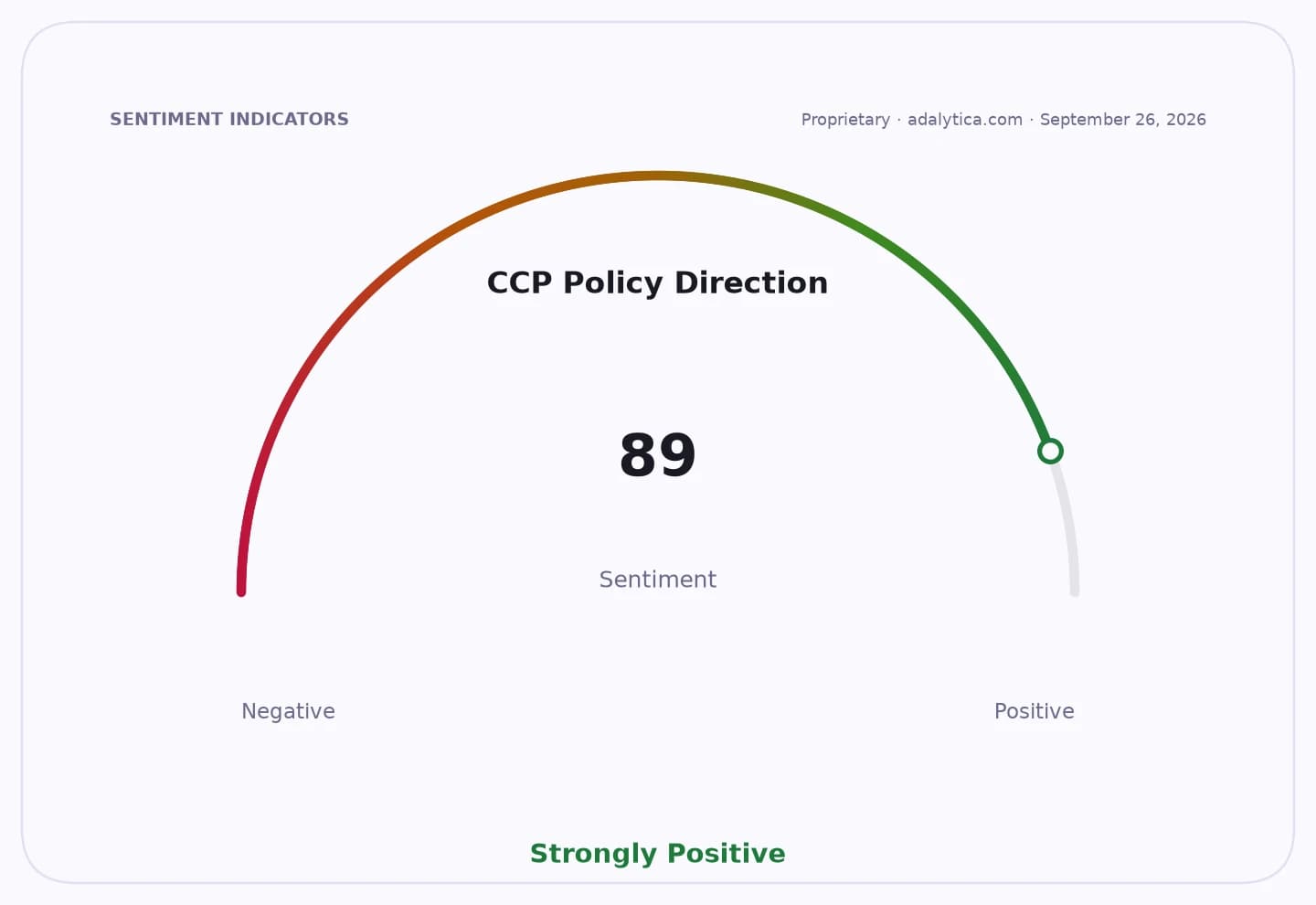
Sentiment IndicatorsⓘProprietary · adalytica.com · September 26, 2026
This is a snapshot — live sentiment, awareness and momentum for 130+ markets update continuously in the dashboard.Open AlphaPulse
The numbers are already lopsided. China has more than 400 gigawatt-hours of operating and planned sodium-ion gigafactory capacity, compared with just 11 GWh in the rest of the world combined, according to CRU. It accounts for roughly 98% of announced cell capacity and more than 99% of cathode-material capacity, and the International Energy Agency expects China to control more than 95% of global sodium-ion manufacturing capacity by 2030.
For investors, that concentration has two very different implications. The first is opportunity: companies with access to China’s supply chain, cell manufacturing and downstream scale could benefit as sodium-ion moves from pilot projects to commercial production. The second is risk: Western battery hopefuls may find that capital, patents and manufacturing know-how are no longer enough if they cannot match China’s cost discipline and pace of execution.
That is exactly where the West is stalling. California-based Natron Energy collapsed after its planned $1.4 billion North Carolina plant ran out of funding, while Stanford spin-out Bedrock Materials shut down. Smaller names such as Peak Energy, Alsym Energy, Moll Batterien and Tiamat Energy are still active, but their combined announced capacity is tiny beside China’s industrial buildout.
China’s lead is not accidental. Its battery industry spent years mastering lithium-ion at global scale, then brought the same playbook to sodium-ion: heavy state support, tax incentives, venture backing, rapid iteration and tight supply-chain integration. CATL, the world’s biggest battery maker, has become the most active patent applicant in the field and is already pushing the chemistry into mass production.
That commercial push is the real milestone. Changan Nevo’s A06, fitted with CATL’s Naxtra sodium-ion cells, is positioned as the world’s first volume passenger EV using the chemistry, with deliveries targeted for mid-2026. CATL has also landed a three-year, 60 GWh supply deal with energy-storage integrator HyperStrong, showing that sodium-ion is moving beyond research labs and into actual demand.
The appeal is straightforward. Sodium is cheap and abundant, and the chemistry can use hard carbon made from biomass or industrial waste. It is also less prone to overheating than lithium-ion and can retain around 90% of usable capacity at temperatures as low as minus 40 degrees Celsius, making it attractive for cold-weather markets, low-cost city EVs, delivery fleets and stationary storage.
UBS thinks sodium-ion could undercut lithium-based prices by as much as 30% by 2030. If that proves even partly true, the winners will be the manufacturers that can scale quickly enough to convert lower costs into market share. China is already behaving like the front-runner that believes it has the answer.
For long-term investors, the lesson is simple: sodium-ion is becoming another chapter in China’s battery dominance, not a shared global race. That does not mean Western startups have no upside, but it does mean the burden of proof is now much higher. The most compelling opportunities are likely to be the companies that can actually mass-produce, not just patent, and that can profit from the chemistry’s lower cost rather than merely advertise it.
| Entity | Gains | Losses |
|---|---|---|
| China battery makers | ▲Scale, patents, market share | ▼Foreign rivals’ room to catch up |
| CATL | ▲Commercial orders, first-mover advantage | ▼Western challengers |
| Western startups | ▲Limited niche openings | ▼Funding access, scale, credibility |
| EV and storage buyers | ▲Lower costs, better cold-weather performance | ▼Dependence on China-led supply chains |