Colombia’s central bank is still fighting to convince households and markets that inflation will stay anchored, with a BanRep manager saying recent history has made it “very difficult to maintain strong credibility in the inflation target” even as policymakers hold rates elevated to keep price pressures contained.
Colombia Central Bank Credibility and Inflation Target
That matters because credibility is the cheapest inflation-fighting tool a central bank has. When investors, firms and workers believe inflation will return to target, wage demands, pricing decisions and bond yields tend to settle lower on their own. When they do not, the central bank has to keep policy tighter for longer, raising the cost to growth, credit and government financing.
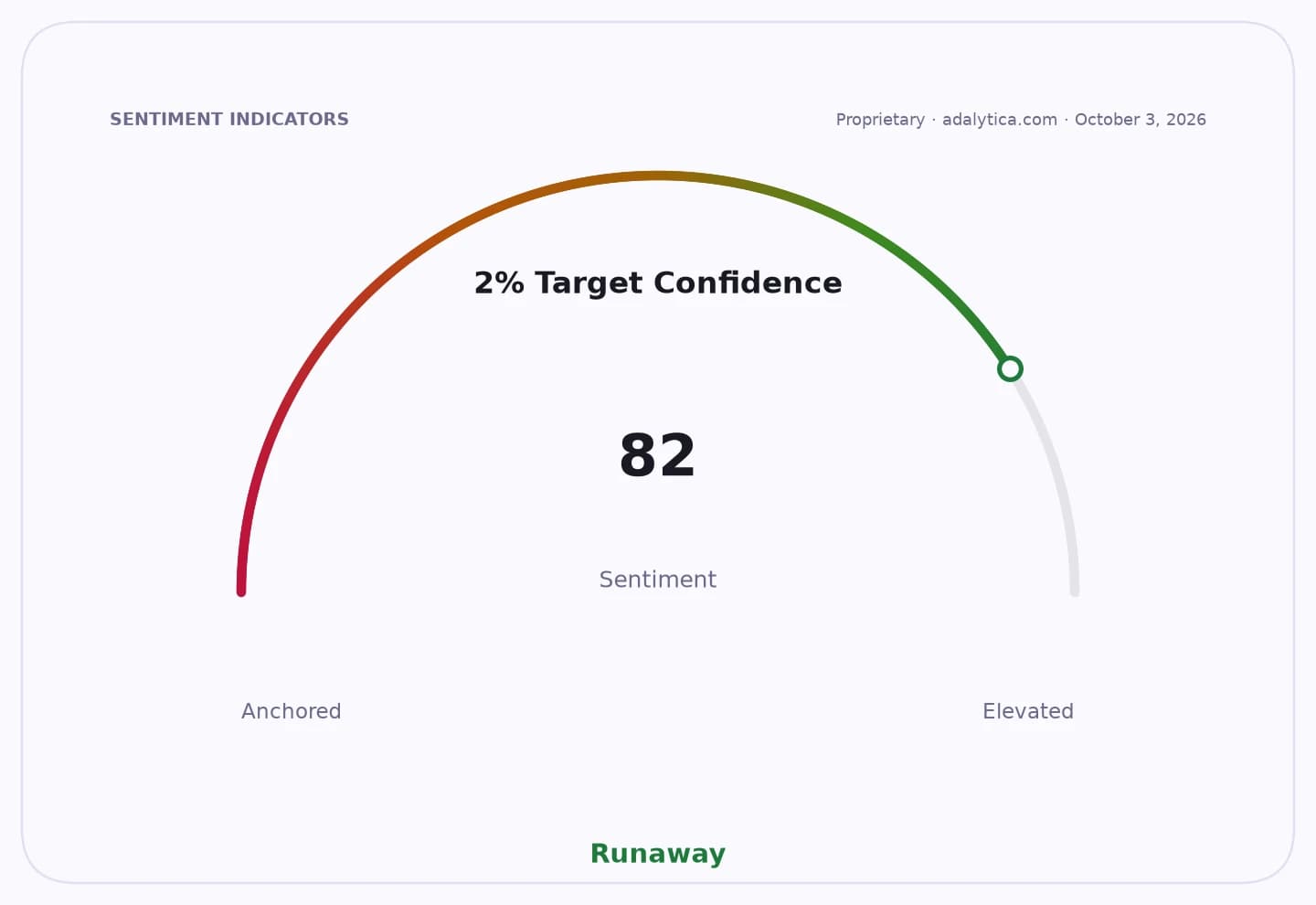
Sentiment IndicatorsⓘProprietary · adalytica.com · October 3, 2026
This is a snapshot — live sentiment, awareness and momentum for 130+ markets update continuously in the dashboard.Open AlphaPulse
The warning lands at a sensitive moment for Colombia and for emerging markets more broadly. Global central banks are still operating in an environment where inflation remains above target in many places, and policy mistakes in the past few years have left lasting scars. Adalytica’s gauge of confidence in the Fed’s 2% inflation target shows sentiment at 82, or “Greed,” even after volatile swings this year, underscoring how closely investors are watching whether central banks can preserve their anti-inflation credentials.
In Colombia’s case, the credibility problem is not just rhetorical. The central bank has had to manage a period in which inflation ran persistently above target, forcing tighter policy and leaving real rates high relative to the region. The immediate economic consequence is slower domestic demand, weaker credit creation and pressure on interest-sensitive sectors such as housing and consumer lending. The upside for the central bank is that a firm stance can eventually help re-anchor expectations; the downside is that the lag from tighter policy to lower inflation can deepen the slowdown before it shows up in the data.
That trade-off is exactly why investors care. If markets believe BanRep is losing control of expectations, Colombian government bonds would typically need to offer a higher premium, the peso could face renewed pressure and local borrowing costs would stay elevated. If, instead, inflation data and policy communication begin to rebuild confidence, duration assets could rally as investors price an earlier move toward easing.
Recent price trends suggest the battle is not over. U.S. CPI, while far from Colombia-specific, illustrates the broader global environment central banks are navigating: the index rose to 334.131 in August from 333.979 in May, a reminder that disinflation has been uneven rather than decisive. That backdrop makes credibility even more valuable, because central banks cannot assume a benign external setting will do the work for them.
For BanRep, the key issue now is whether restrictive policy can keep expectations from drifting without inflicting too much damage on activity. Bulls will argue that a clear, consistent anti-inflation message can eventually restore confidence and allow a smoother easing cycle. Bears will say credibility, once damaged, is hard to rebuild quickly, meaning Colombia may face a longer period of tight financial conditions than growth can comfortably absorb.
Investors should watch the next inflation prints, inflation expectations surveys and any shift in BanRep guidance. If credibility improves, the market can begin to price a lower terminal rate path and a stronger case for local bonds. If not, Colombia’s policy premium may remain one of the highest in the region.
| Entity | Gains | Losses |
|---|---|---|
| BanRep | ▲Re-anchored expectations | ▼Slower growth |
| Colombian bondholders | ▲Higher real returns | ▼Policy uncertainty |
| Borrowers | ▲Lower rates later, if credibility returns | ▼Higher financing costs now |
| Peso shorts | ▲Volatility and policy risk | ▼Potential squeeze if confidence improves |