Colombia’s next minimum wage is shaping up to rise by about 8% in 2027, a move that would lift the basic monthly pay to roughly 1.89 million pesos and push total cash income with transport aid to around 2.16 million pesos.
Colombia minimum wage seen rising 8% in 2027
That estimate matters because the government is signaling that it wants the wage-setting process to be framed as a technical exercise rather than a political one, even as the level under discussion remains high enough to feed through to labor costs, inflation and hiring decisions. For workers at the bottom of the income ladder, the increase would help offset projected price pressures; for employers, it would add another year of wage costs in an economy where informality is already above 54%.
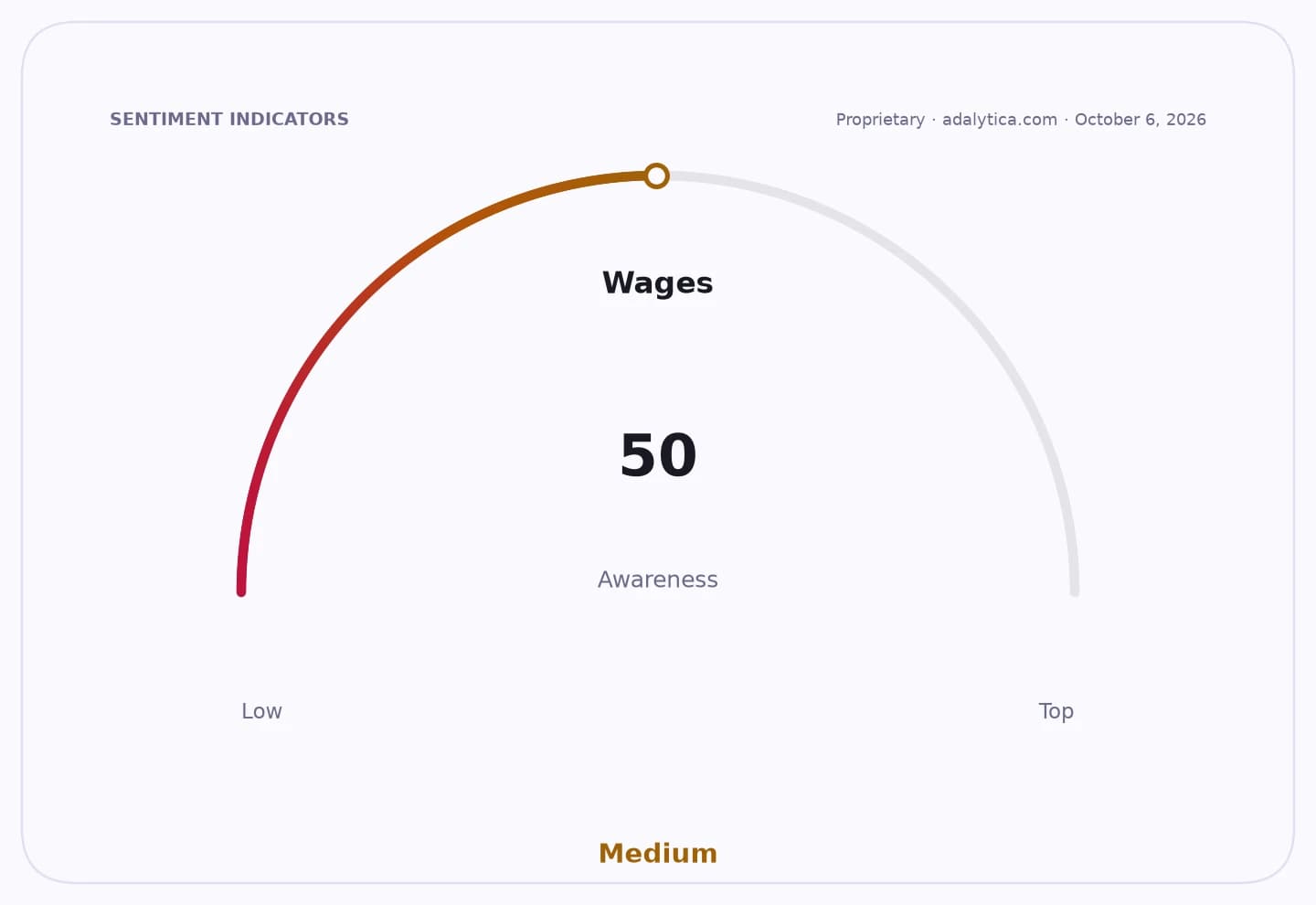
Sentiment IndicatorsⓘProprietary · adalytica.com · October 21, 2026
This is a snapshot — live sentiment, awareness and momentum for 130+ markets update continuously in the dashboard.Open AlphaPulse
The discussion has started earlier than usual, with the government bringing employers, unions and experts to the negotiating table well ahead of the formal decision. According to an analysis cited by JP Tactical, the increase would be driven by projected 2026 inflation of around 7% plus an additional point for productivity, a formula that would take the monthly base wage from 1,750,905 pesos to about 1,890,977 pesos.
That detail is important for investors because Colombia’s minimum wage does more than determine pay for low-income workers. It also influences pension contributions, severance costs, service contracts and price-setting across the formal economy. In a labor market where a large share of workers remain outside formal payrolls, a sharp adjustment can also widen the gap between protected and informal jobs rather than narrowing it.
The central bank has already argued that last year’s outsized wage hike helped keep inflation more elevated than expected this year. That puts the monetary authority on a collision course, at least in principle, with any government desire to protect purchasing power aggressively. If the wage settlement comes in above productivity and inflation fundamentals, the risk is a second-round effect on prices; if it comes in too low, consumer spending could weaken and households at the bottom of the income distribution would lose ground in real terms.
The market implication is less about one wage number than about the broader policy regime. A formula anchored to inflation and productivity would be read as a sign of discipline and could ease fears of a wage-price spiral. But if negotiations drift toward a larger political adjustment, investors would likely see higher labor costs, weaker hiring incentives and more pressure on small businesses already operating on thin margins.
For now, the government’s message is that the decision should be “technical.” The next step is whether that stance survives bargaining with unions and employers and whether the final number stays close to the projected 8% path. If it does, Colombia gets a more predictable wage framework; if it does not, the debate over inflation, competitiveness and informality will only intensify into 2027.
| Entity | Gains | Losses |
|---|---|---|
| Low-wage workers | ▲Higher nominal income | ▼Still exposed to inflation |
| Employers | ▲More predictable wage path | ▼Higher payroll costs |
| Colombian central bank | ▲Support for anti-inflation stance | ▼Less room if wage hikes overshoot |
| Informal sector workers | ▲Some relative wage pressure easing | ▼Risk of wider formal-informal gap |