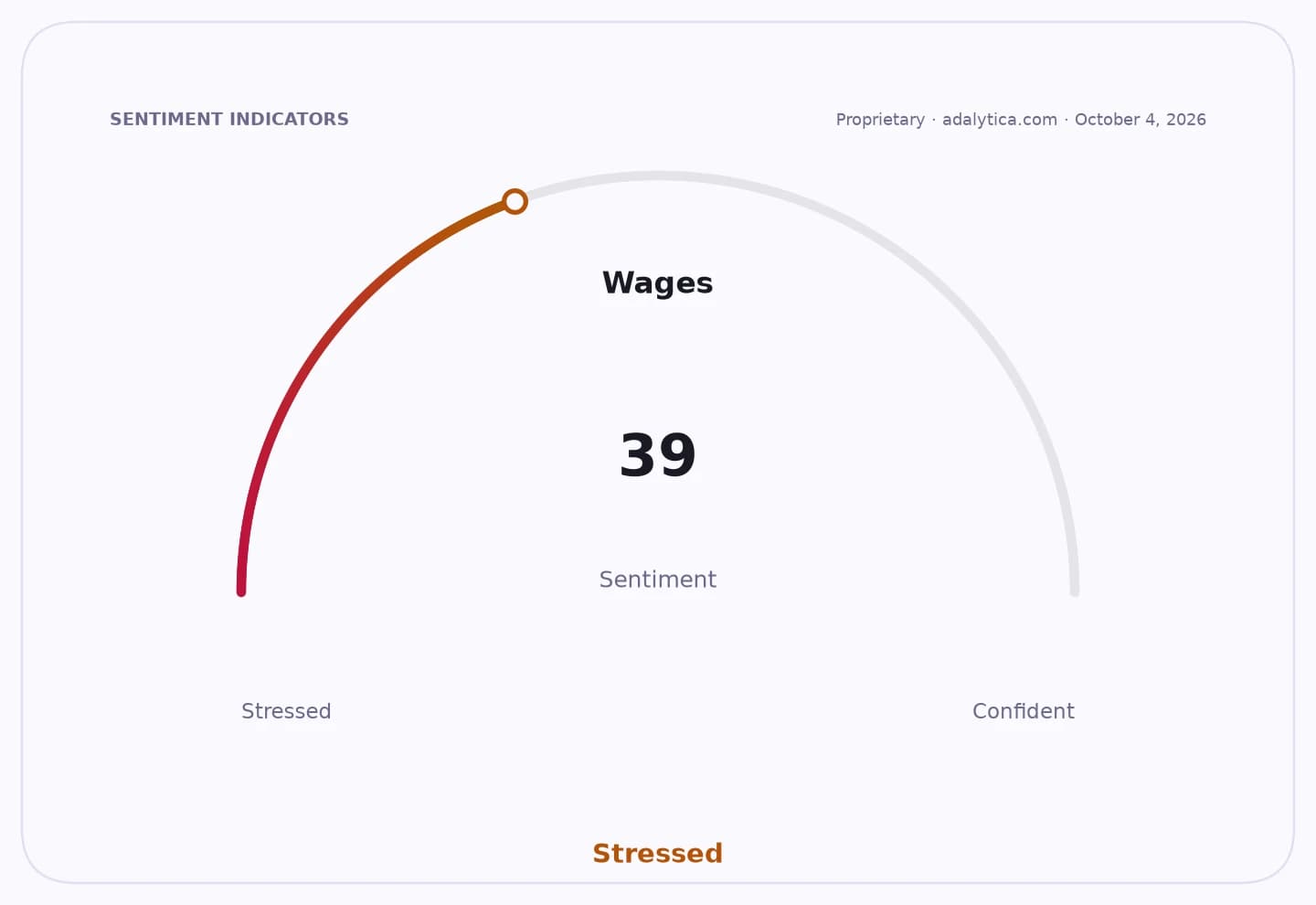
Colombia’s departmental governors are warning that this year’s 23% increase in the minimum wage has distorted the way provinces are classified for fiscal purposes, adding pressure to revise a 25-year-old system that governs spending limits and administrative rules.
Colombia departments face fiscal rule pressure after wage hike
The National Federation of Departments, or FND, said the wage hike pushed up the peso thresholds used to define departmental tax categories, even though the underlying law remains pegged to multiples of the minimum wage. For first-category departments, the cutoff rose to about 297.656 billion pesos from roughly 242 billion pesos, a jump of 55.659 billion pesos tied not to local economic performance but to a national wage decision. Similar shifts lifted the special-category threshold above 1.05 trillion pesos, while second- and third-category limits climbed to about 213.612 billion pesos and 105.056 billion pesos, respectively.
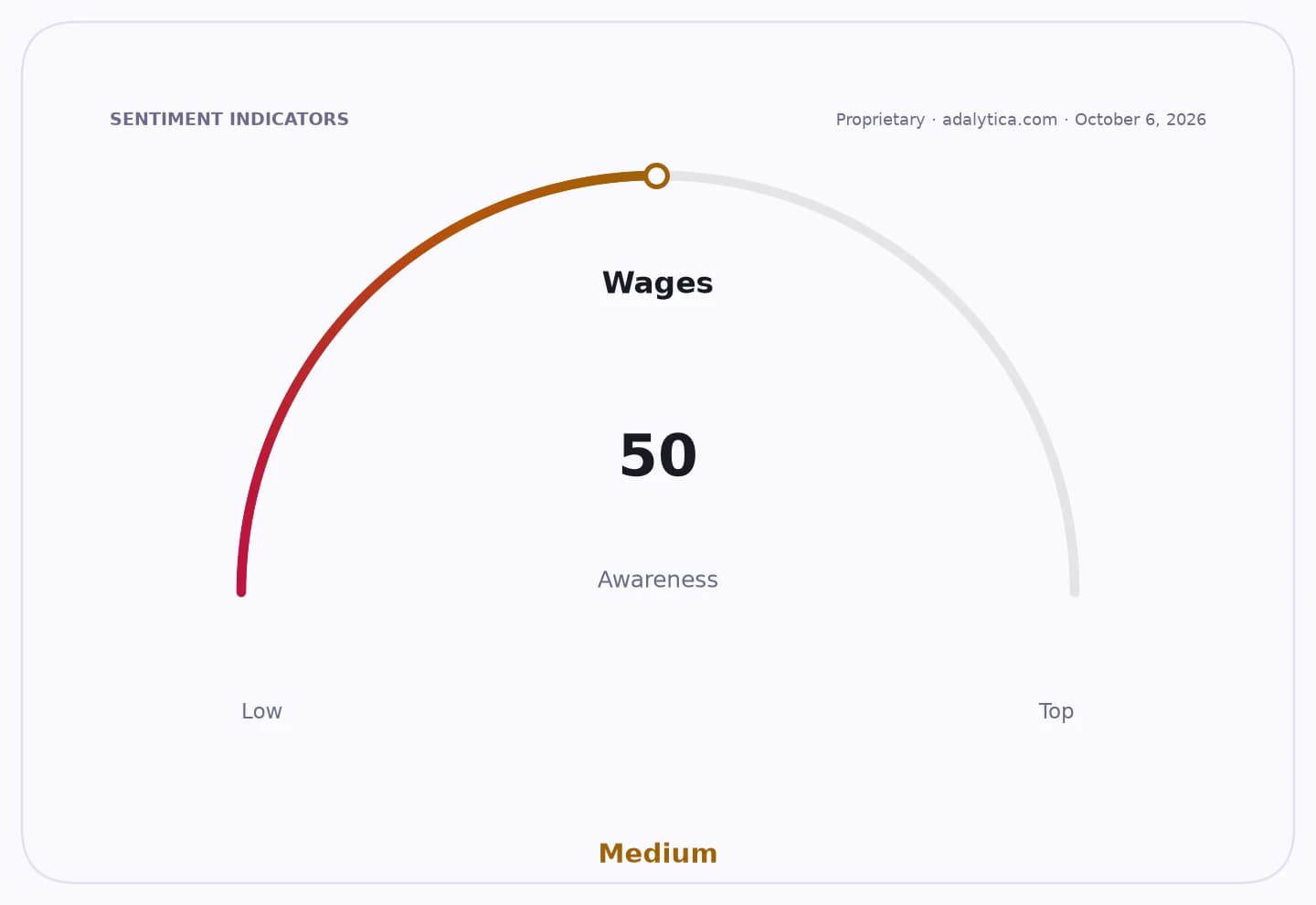
Sentiment IndicatorsⓘProprietary · adalytica.com · October 6, 2026
This is a snapshot — live sentiment, awareness and momentum for 130+ markets update continuously in the dashboard.Open AlphaPulse
That matters because the classification system under Law 617 of 2000 is not just a label. It affects budget rules, operating-expense caps and the room departments have to manage payroll and administration. The FND argues that tying the brackets to the minimum wage creates a mechanical distortion: a department can raise its own free-disposal current revenue, or Icld, yet still lose standing in minimum-wage terms if local revenue grows more slowly than the national wage floor.
The federation said a 10% increase in Icld against a 23% rise in the minimum wage would translate into an approximate 10.57% drop in that revenue when measured in minimum-wage units. In practice, that means a stronger fiscal position on the ground could still look weaker on paper. For local governments, that is more than an accounting nuisance. It can constrain public spending at a time when inflation, wage costs and public-service demands are still elevated.
Didier Tavera, the FND’s executive director, said the system should be reassessed after more than 25 years to determine whether it remains the best measure of the fiscal capacity of departments with very different economic realities. The group wants variables added that reflect each territory’s characteristics and capacity, not just income and population. It said the proposal has already appeared in its White Paper and in the bill on competences, while the decentralization mission has also called for a review.
For investors and credit watchers, the issue is less about the classification labels themselves than about what they imply for local fiscal flexibility. If the wage benchmark keeps rising faster than regional revenues, departments may face tighter operating constraints even without a deterioration in underlying collections. That raises the risk of pressure on local balance sheets, procurement, and wage bills, especially in lower-capacity regions that rely more heavily on central rules than on autonomous fiscal growth.
There is also a broader political economy angle. The minimum-wage increase is being sold as a social-policy win, but it has spillovers into tax administration and the fiscal framework for subnational governments. That makes the debate a test of whether Colombia can preserve fiscal discipline while loosening rules that are increasingly detached from territorial realities. The FND’s push suggests the current formula may be becoming harder to defend as wage policy, inflation and regional divergence continue to move in different directions.
| Entity | Gains | Losses |
|---|---|---|
| Minimum-wage workers | ▲Higher pay floor | ▼Higher tax and compliance burden |
| Departmental governments | ▲Potentially revised fiscal rules | ▼Tighter operating caps under current system |
| Central government reformers | ▲Chance to modernize law | ▼Pressure to balance wages and decentralization |
| Employers | ▲Delayed pressure if rules change | ▼Higher labor costs if wage floor rises |