CoreWeave’s violent reversal is turning the market’s favorite AI infrastructure trade into a financing story, and that is the real danger for shareholders. After surging as high as 137.98 in May, the stock has collapsed to 60.77, even after a sharp bounce this week, as investors begin to price in the cost of funding an aggressive expansion with increasingly fragile capital structure choices.
CoreWeave Falls as Financing Risks Rise
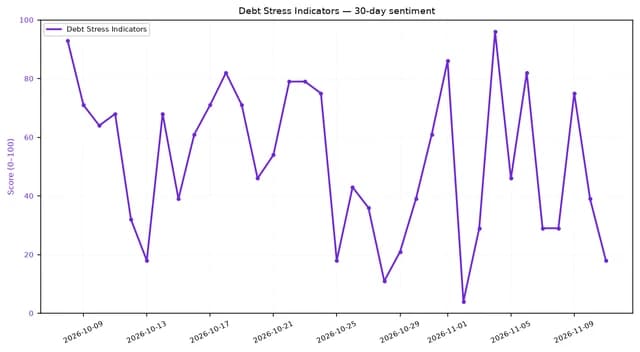
Debt Stress Indicators
That matters because CoreWeave is not just another high-beta AI name. It sits at the center of the build-out in GPU capacity, where demand is still strong but the business model depends on constant access to debt markets, favorable refinancing and customer concentration that can support heavy capex. When the equity price halves in months, the cost of capital rises just as the company needs more of it. That is how a growth story starts to look like a debt spiral.
Sentiment Indicators
The warning signs are already visible in the tape. CoreWeave’s shares are still trading far below the 50-day moving average of 73.71 and the 200-day moving average of 89.47, a technical backdrop that confirms the trend has broken. The stock plunged to 48.73 on Nov. 10 before rebounding to 60.77 on Nov. 11, with volume exploding to 161.6 million shares, a sign of forced repositioning rather than stable accumulation. Even after the bounce, RSI readings remain volatile and the stock is still well below the levels that defined its earlier AI euphoria.
The funding side is where the story gets more consequential. CoreWeave disclosed in September that it intended to sell $3 billion of convertible senior notes due 2033, a move that underscored how reliant it has become on the capital markets to keep scaling. That is manageable when the equity is rising and lenders are enthusiastic. It becomes more punishing when the share price weakens, because convertibles, secured debt and asset-backed structures all become more expensive in a market that starts to question residual equity value. The “chip-backed” debt model can work in a boom. In a correction, it can trap management in a cycle of more borrowing to sustain growth, which in turn dilutes future equity upside and makes creditors more cautious.
The broader market context is not helping. Adalytica’s S&P 500 trade signals are in extreme greed, which suggests investors remain broadly risk-on even as a few speculative corners are breaking down. At the same time, its Household Debt Stress gauge is flashing fear and extreme fear, a reminder that leverage pressure is building across the system. That combination is dangerous for names like CoreWeave: when macro liquidity is abundant, leverage gets ignored; when stress rises, the market abruptly re-rates the borrower.
For investors, this is no longer simply a question of whether AI spending continues. It is a question of who controls the economics of that spending. Hyperscalers like Amazon and Microsoft can fund infrastructure through operating cash flow and balance-sheet strength. CoreWeave, by contrast, has to keep returning to the market. That makes it a pure-play on the most powerful part of the AI capex boom, but also one of the most exposed to a financing squeeze if lenders demand tighter terms or if equity volatility persists.
My view is that the market is underestimating the second-order effect here: once the stock breaks down, the debt itself becomes the story. The next catalyst is not another headline about GPU demand, but a test of whether CoreWeave can keep funding growth without destroying shareholder value. If it cannot, the winners are the capital providers, the GPU suppliers and the cash-rich hyperscalers. The losers are the common equity holders trying to own the upside without paying for the leverage already embedded in the model.
| Entity | Gains | Losses |
|---|---|---|
| CoreWeave creditors | ▲Higher spreads | ▼Equity dilution risk |
| GPU suppliers | ▲Steady demand | ▼Counterparty credit risk |
| Hyperscalers | ▲Financing edge | ▼Smaller rivals |
| CoreWeave shareholders | ▲Near-term volatility trades | ▼Debt spiral risk |