CoreWeave’s debt selloff has become a market-level stress test for the AI financing boom, forcing lenders and investors to confront how much leverage they are willing to extend against unproven cash flows, concentrated customer contracts and rapidly depreciating hardware.
CoreWeave debt selloff raises AI financing risk
The company’s bonds traded at distressed levels this week, with credit default swap protection rising to about 1,200 basis points and yields on some notes climbing to roughly 15% to 16%, a sharp repricing for one of the largest borrowers tied to the AI buildout. CoreWeave carries about $50 billion of debt, according to LSEG data, and has become a bellwether for how private credit is funding the infrastructure race behind artificial intelligence.
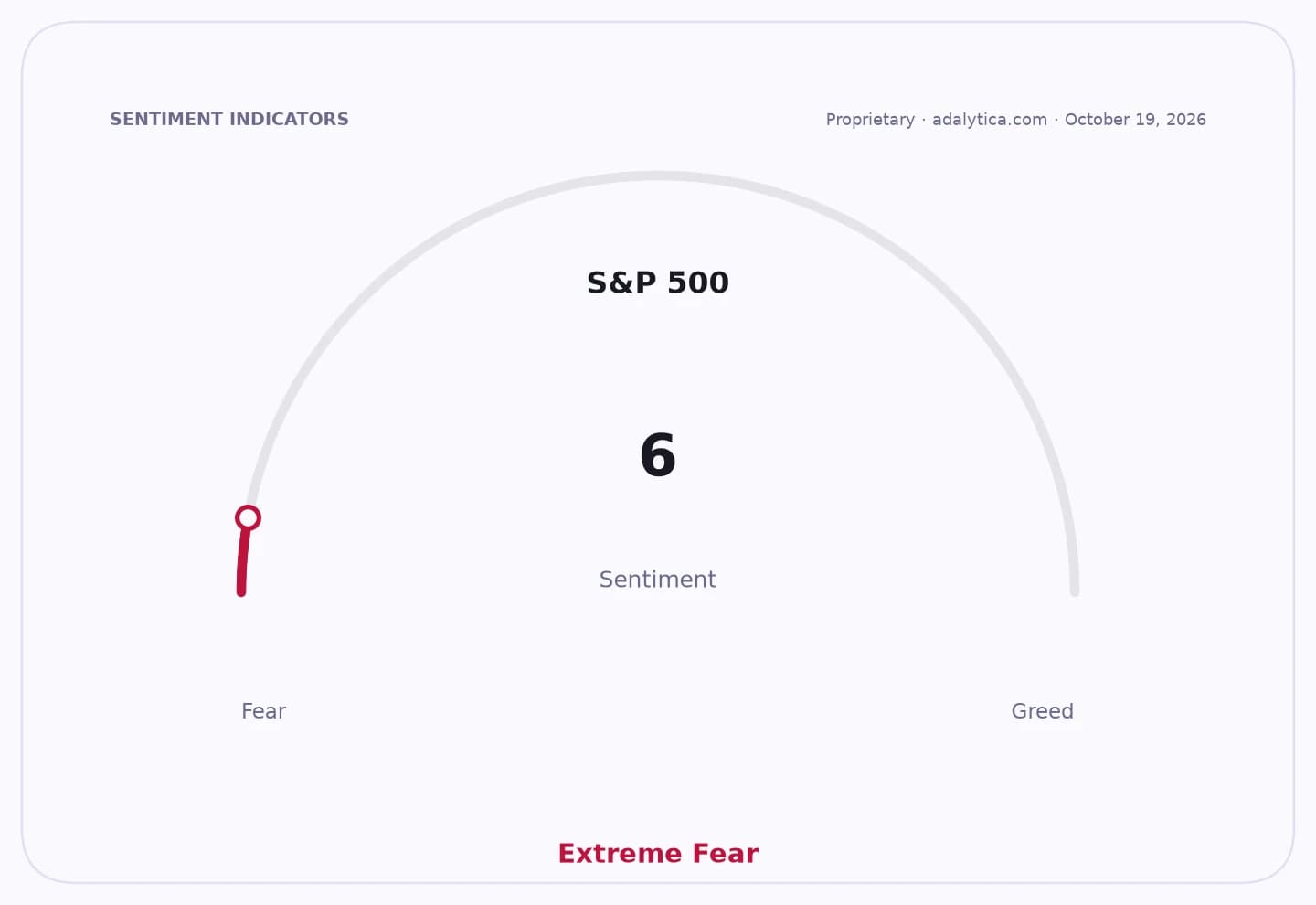
Sentiment IndicatorsⓘProprietary · adalytica.com · October 19, 2026
This is a snapshot — live sentiment, awareness and momentum for 130+ markets update continuously in the dashboard.Open AlphaPulse
That matters because the AI capex cycle is increasingly being financed not just by tech giants with fortress balance sheets, but by specialized lenders willing to underwrite data centers, GPUs and long-dated customer contracts. CoreWeave has tapped that market repeatedly, raising a $2.3 billion GPU-backed facility in 2023, a $7.5 billion financing in 2024 and an $8.5 billion facility in March anchored by Blackstone Credit & Insurance. The model depends on the assumption that demand for compute will stay strong enough to cover heavy debt loads before assets age or contracts roll off.
For investors, the selloff is a warning that private credit is not insulated from the same valuation and refinancing risks that have already shaken parts of the leveraged loan and high-yield markets. If funding costs stay elevated, lenders are likely to respond with wider spreads, lower leverage, tighter covenants and more scrutiny of customer concentration, particularly where repayment depends heavily on a few large counterparties such as Microsoft, OpenAI and Meta Platforms.
James Martin, senior US credit strategist at SMBC, said investors were still comfortable financing data-centre projects, but were favoring deals closer to completion and with fewer hurdles before service begins. That suggests capital is not disappearing from the sector; it is becoming more selective. Projects further from cash generation are likely to face steeper pricing, and the most speculative structures may have to absorb more equity or sponsor support.
The implications extend beyond CoreWeave. Carlyle said in an October paper that private credit could be called on to finance roughly $1 trillion of the AI-compute buildout, more than half the industry’s current assets under management, while warning that rapid lending could create concentration risks reminiscent of software lending. That makes this week’s move important not only as a company-specific shock, but as a check on how far the private market can stretch to fund the next phase of AI infrastructure without a credit correction.
The broader backdrop is mixed. Direct-lending funds raised $129.15 billion in the first nine months of 2026, up 35% from a year earlier and the highest nine-month total in Preqin data going back to 2016, underscoring that capital remains available. But estimated third-quarter lending volume fell 28% year on year, and competition from the syndicated loan market has intensified as borrowers refinance away from direct lenders. That combination argues for a more disciplined market: abundant capital overall, but less tolerance for weak credits and long-dated execution risk.
CoreWeave’s shares, meanwhile, underscore how quickly sentiment can reverse when debt markets turn. The stock has been volatile and remains well below recent highs, while its 50-day and 200-day moving averages show a broken trend and momentum indicators remain deeply negative, reflecting investor unease as leverage comes under the microscope. For equity holders, the key question is whether the company can keep growing fast enough to justify the debt; for lenders, it is whether the AI boom can be financed without assuming asset values and customer demand will rise in lockstep.
The next catalyst will be whether CoreWeave’s financing costs normalize or become the template for the next wave of AI infrastructure deals. If the market continues to demand distressed-like returns for highly levered AI borrowers, the boom will not stop — but it will get more expensive, more selective and more dependent on the strongest sponsors and contracts.
| Entity | Gains | Losses |
|---|---|---|
| CoreWeave equity holders | ▲Continued AI demand | ▼Higher refinancing risk |
| Private credit lenders | ▲Wider spreads | ▼Greater default risk |
| AI infrastructure borrowers | ▲Access to capital | ▼Tighter terms |
| Traditional loan markets | ▲Refinancing business | ▼Lost deal flow |