CoreWeave’s rout is a warning that the AI infrastructure trade is no longer being priced only on revenue growth — it is being priced on the cost of capital.
CoreWeave Falls on Higher Rates and Debt Risk

The stock fell to $61.39 on Oct. 16, extending a sharp slide from $69.69 a day earlier and far below its recent $99.83 close on Sept. 8, as investors re-examined how much debt-financed expansion the company can absorb while Treasury yields stay elevated. The 10-year yield was forecast at 5.105% and the 2-year at 4.804%, a backdrop that keeps pressure on leveraged growth stories just as the high-yield spread widened to 3.286%, signaling a market that is still demanding more compensation for risk.
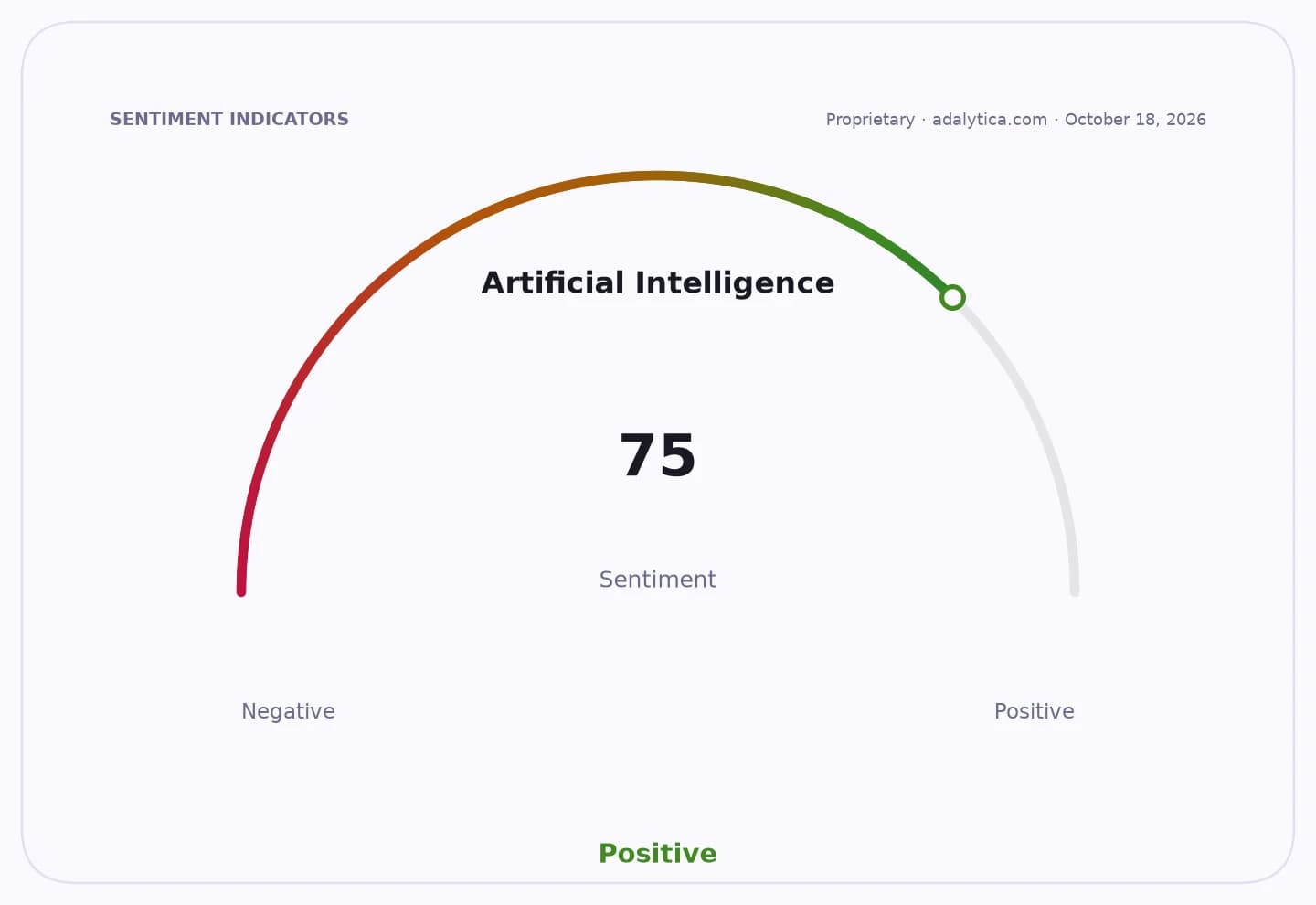
Sentiment IndicatorsⓘProprietary · adalytica.com · October 17, 2026
This is a snapshot — live sentiment, awareness and momentum for 130+ markets update continuously in the dashboard.Open AlphaPulse
That matters because CoreWeave is not a conventional software name. It is a capital-hungry, debt-dependent infrastructure play sitting in the middle of the AI arms race, where returns depend on sustained spending from hyperscalers and model builders. When rates are high, the entire economics of that model get harder: refinancing becomes more expensive, cash flow gets discounted more aggressively and every incremental data-center dollar has to earn its keep faster.
The warning from Gartner only sharpened that debate. The market is now asking whether AI capex can keep expanding at the same pace if funding costs stay sticky and investors begin to punish companies that need continuous access to debt markets. CoreWeave’s own filings have already flagged the risk plainly: if cash flows and capital resources prove insufficient to service debt, the company could be forced to delay investments, raise more debt or equity, or dispose of assets. That is exactly the kind of language investors tend to dismiss — until the stock starts breaking down.
Technically, the picture is deteriorating fast. CoreWeave is now well below its 50-day and 200-day moving averages, with its RSI at 26.4, a level that points to heavy selling pressure. The stock’s collapse from above $130 in May to the low $60s this week shows how quickly momentum can reverse when a high-multiple, leverage-heavy growth story loses the financing tailwind that made it possible.
This is why the story matters well beyond one company. If CoreWeave is the canary in the AI-mining shaft, then higher-for-longer yields are the pickaxe. They hit the entire ecosystem of AI builders, data-center operators, chip suppliers and cloud enablers whose business models depend on years of front-loaded spending before the payoff arrives. Investors should expect more bifurcation from here: the companies with fortress balance sheets and recurring free cash flow should keep attracting capital, while the most levered AI infrastructure names remain vulnerable to sudden de-ratings.
For investors, the opportunity is in the second derivative. I believe the market still underestimates how much of the AI boom will migrate from speculative, debt-fueled expansion toward the best-capitalized picks-and-shovels names that can finance growth internally or at least on far better terms. If rates stay near current levels, the winners are likely to be the suppliers with pricing power and the platforms with balance-sheet strength — not the most aggressive borrowers.
CoreWeave’s selloff is a reminder that in the next phase of the AI trade, access to cheap capital may matter as much as access to chips. That makes this a moment to be selective, not bullish by default. The investors who focus on funding durability, not just growth rates, are the ones most likely to capture the next leg of the megatrend.
| Entity | Gains | Losses |
|---|---|---|
| Cash-rich AI platforms | ▲Lower funding pressure | ▼Less access to distressed bargains |
| Levered AI infrastructure plays | ▲Potential valuation reset buyers | ▼Higher refinancing risk |
| Treasury holders / bond investors | ▲Attractive yields | ▼Price risk if rates rise more |
| CoreWeave competitors with stronger balance sheets | ▲Relative capital advantage | ▼— |