SpaceX’s reported move to buy Nvidia chips could squeeze neocloud providers CoreWeave and Nebius by pulling a major AI customer further toward direct hardware sourcing, a shift that matters because it can weaken pricing power, reduce scarcity premiums and slow the growth of third-party AI cloud demand.
CoreWeave, Nebius Face Pressure After SpaceX Nvidia Shift
For investors, the key issue is not the deal itself but what it says about the next phase of the AI infrastructure boom. As hyperscalers, frontier labs and well-capitalized customers gain more leverage to secure their own compute, the market for rented Nvidia capacity gets more competitive, and the high-multiple stocks built on supply shortages become more vulnerable.
Sentiment IndicatorsⓘProprietary · adalytica.com · August 8, 2026
This is a snapshot — live sentiment, awareness and momentum for 130+ markets update continuously in the dashboard.Open AlphaPulse
CoreWeave, one of the market’s most visible neocloud names, has already shown how quickly sentiment can swing around AI infrastructure demand. Its shares closed at $90.67 on Aug. 7, up from $60.82 on July 29, after a brutal selloff that had sent it to $60.82 late last month and left it well below its 50-day moving average near $92.13. The stock’s RSI reading of 61.2 suggests momentum has recovered, but it still sits under the level that had served as resistance in recent sessions.
Nebius has also seen sharp trading around the AI-buildout theme. Its shares finished at $187.97 on Aug. 7, after tumbling from $276.17 on June 30 and still trading far below the 50-day average of $223.54. That kind of volatility reflects a market that is still pricing the company more as a levered AI infrastructure play than a stable recurring-revenue cloud business.
Nvidia Corp — 30-day sentimentadalytica.com
Explore this data interactively — full history, time series and cross-market comparisons.Open AlphaPulse
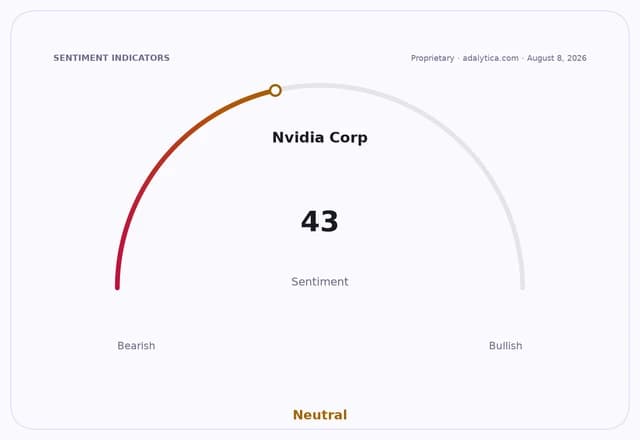
Nvidia remains at the center of the trade. Its shares rose to $223.96 on Aug. 7, close to the upper end of the recent range, as investors continued to price in relentless demand for AI accelerators. But the same demand that benefits Nvidia can compress margins elsewhere in the chain if customers such as SpaceX decide to bypass intermediaries and secure chips more directly.
The broader read-through is that the AI cloud market may be moving from pure capacity scarcity to a more selective purchasing cycle, where customers with scale can shop aggressively for chips and infrastructure. That could favor chipmakers and the largest platform operators while leaving smaller neoclouds exposed to tighter spreads, higher financing needs and less predictable utilization.
The next catalyst is whether more AI buyers follow SpaceX’s lead, or whether neocloud providers can defend growth with long-term contracts and differentiated capacity. The answer will help determine whether CoreWeave and Nebius stay momentum stocks or start to look like the most crowded names in the AI supply chain.
| Entity | Gains | Losses |
|---|---|---|
| Nvidia | ▲Direct chip sales | ▼Intermediated cloud demand |
| SpaceX | ▲More control over compute supply | ▼Dependence on neocloud rental pricing |
| CoreWeave | ▲Near-term AI demand | ▼Pricing power and utilization |
| Nebius | ▲AI infrastructure growth | ▼Customer stickiness and margin leverage |
