CoreWeave’s stock has fallen 42% from its late-July level, underscoring how quickly investors are reassessing one of the purest plays on rented AI compute as doubts about the durability of the AI buildout intensify.
CoreWeave stock falls 42% from late July
The selloff matters because CoreWeave is not a diversified cloud provider; its economics are tied to continued demand for high-end Nvidia GPUs and to customers willing to pay up for scarce AI capacity. That leaves the company exposed if the market moves from a phase of frantic infrastructure spending to one of slower utilization and tighter capital discipline. When the AI trade weakens, the risk is not just lower sentiment but a direct hit to leasing demand, pricing power and the ability to finance an asset-heavy model.
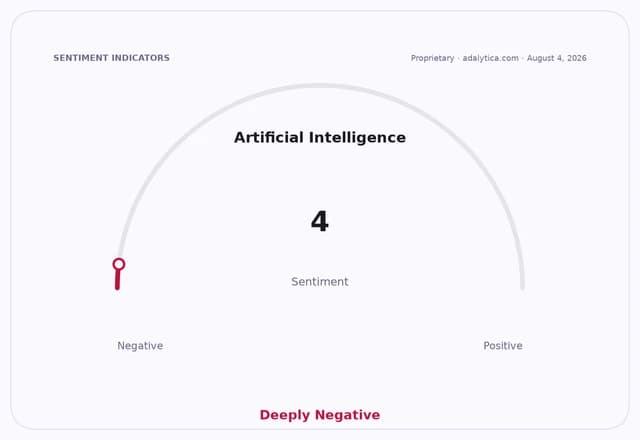
Sentiment IndicatorsⓘProprietary · adalytica.com · August 4, 2026
This is a snapshot — live sentiment, awareness and momentum for 130+ markets update continuously in the dashboard.Open AlphaPulse
CoreWeave shares closed at $71.77 on July 31, down from $139.93 on Oct. 29 and $124.82 on June 1, after a violent round-trip that has also dragged the stock below its 50-day and 200-day moving averages. The latest reading leaves the stock well under both technical benchmarks, with the 50-day average at $93.75 and the 200-day at $94.83, a sign momentum has broken sharply. Volume has remained elevated, suggesting the move is being driven by more than routine profit-taking.
The weakness comes as the broader semiconductor and AI complex is also under pressure. The VanEck Semiconductor ETF, SMH, fell to $540.53 on July 31 from $655.89 on June 30, while Nvidia ended July at $200.75 after trading as high as $235.47 in mid-May. Nvidia’s own technical picture has softened, with the stock below its 50-day average of $206.12. Adalytica’s AI sentiment gauge now shows “Extreme Fear,” while Nvidia’s earnings sentiment has dropped to 21, reinforcing the sense that the market is questioning the sustainability of the AI capex cycle.
That is a particular problem for CoreWeave because its business model depends on renting compute from Nvidia-linked hardware and then monetizing that capacity with customers that often have similar, and sometimes overlapping, ties to the same AI ecosystem. Bulls argue the company is still positioned to benefit if AI training and inference demand keeps outrunning supply, and that long-term contracts can support revenue visibility. Bears counter that the model is highly leveraged to a still-unproven pace of AI monetization, with the risk that GPU supply stops being scarce before demand matures.
For investors, the key question is whether CoreWeave is a durable infrastructure platform or a cyclical pass-through on the hottest trade in the market. If AI spending keeps expanding, the stock can recover quickly given its beta to the theme. If the bubble perception deepens, CoreWeave is among the names most vulnerable to multiple compression because its fortunes are tied less to software adoption than to the economics of renting chips into an increasingly skeptical market.
| Entity | Gains | Losses |
|---|---|---|
| CoreWeave bulls | ▲AI demand rebound | ▼Bubble-burst scenario |
| Nvidia | ▲GPU demand stays tight | ▼Customer capex pullback |
| Short sellers | ▲Valuation compression | ▼Renewed AI frenzy |
| AI infrastructure peers | ▲Sector rerating higher | ▼Model scrutiny and margin pressure |