Crypto’s 2026 reset is doing what every major washout eventually does: it is separating durable businesses from speculative bets, and that is pulling capital toward regulated players with real revenue, custody infrastructure and institutional access.
Crypto 2026 Reset Favors Regulated Firms
That matters because the industry is not just cheapening; it is shrinking in the places that depended on endless liquidity. Total crypto market value sat around $2.26 trillion in early August, still about 50% below the October 2025 peak, after the market lost $304.8 billion in the second quarter alone. Trading volumes weakened, stablecoin market cap slipped for the first time since 2023, and more than 100 projects have already shut down, gone bankrupt or effectively gone inactive this year. For investors, that is not a cosmetic correction. It is the kind of drawdown that forces a business model test.
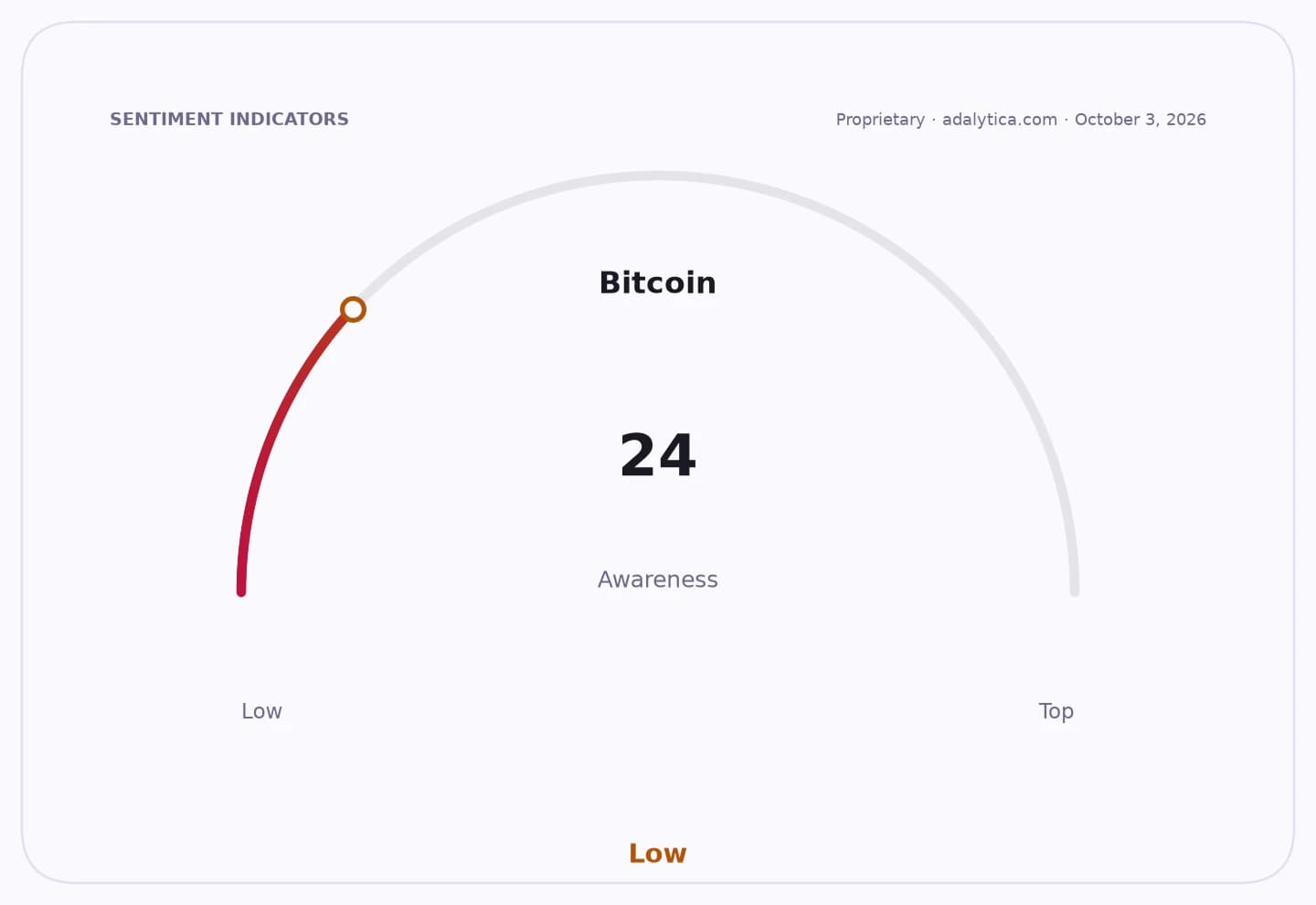
Sentiment IndicatorsⓘProprietary · adalytica.com · October 3, 2026
This is a snapshot — live sentiment, awareness and momentum for 130+ markets update continuously in the dashboard.Open AlphaPulse
The core message is simple: in a tougher funding climate, money is no longer chasing token narratives the way it did at the top of the cycle. Galaxy Research said crypto and blockchain venture funding fell to about $4 billion across 355 deals in the first quarter, down 50% from the prior quarter by capital deployed. Yet mergers and acquisitions stayed strong, with Architect Partners tracking $12.9 billion in announced crypto acquisitions across 71 transactions in the second quarter, the second-highest quarterly total by value. That is the market telling you where value is now being assigned — to custody, payments, licensing, tokenization and compliance, not to growth at any cost.
The rotation is showing up in the market structure too. Bitcoin still dominates the asset mix, which has limited a broader altcoin rebound, and U.S. spot bitcoin ETFs saw about $4.9 billion in net outflows in the second quarter, according to NYDIG. At the same time, Bitcoin and Ether balances on exchanges have fallen to levels last seen years ago. That used to read as a clean bullish signal. Now it may also reflect the migration of coins into institutional custody, ETFs, decentralized finance and OTC desks. In other words, lower exchange balances no longer automatically mean investors are simply hoarding coins; they can also mean the plumbing of the market is maturing.
That shift is exactly why regulated players matter more in the next phase. Companies with licenses, custody capabilities and compliance systems are better positioned to capture the capital that is still entering the sector. That includes exchanges, brokers and fintech platforms that can meet tightening standards on transaction monitoring, sanctions screening and anti-money-laundering controls. It also explains why market participants are increasingly willing to pay for infrastructure rather than speculation.
The long-term lesson for investors is that crypto is becoming less of a broad beta trade and more of a selection market. Some of the weakest projects will disappear, especially those reliant on token emissions or repeat fundraising. But that is precisely how stronger survivors emerge. The firms most likely to compound from here are the ones that can earn fees, hold assets safely, satisfy regulators and serve institutions that need scale and trust.
There is also a darker reason the compliance premium is rising. Authorities and blockchain analytics firms have documented growing criminal use of crypto through exchanges, OTC brokers, P2P platforms and services with weak controls. That does not destroy the investment case for digital assets, but it does raise the bar for every business that touches them. Real-time monitoring and sanctions checks are no longer back-office niceties; they are core product features.
For long-term investors, the playbook is not to chase every rebound. It is to focus on the businesses that can survive a full cycle and still expand when the next bull market arrives. The 2026 correction is likely to leave the crypto industry smaller, cleaner and more institutional. That is painful for the weak, but potentially powerful for the survivors — and worth watching closely for patient investors.
| Entity | Gains | Losses |
|---|---|---|
| Regulated crypto firms | ▲Higher institutional inflows | ▼Less room for pure speculation |
| Unregulated startups | ▲None | ▼Funding drought and closures |
| Exchanges and custodians | ▲Compliance premium | ▼Higher operating costs |
| Token-only projects | ▲None | ▼Capital rotation away from them |