Mortgage borrowing costs are rising again, and the most immediate force behind the move is a renewed jump in global rate expectations as the war around Iran feeds inflation fears and keeps central banks on a tightening path.
Danish Mortgage Rates Rise on War-Driven Inflation Fears
For Danish homeowners, the change is already translating into higher monthly bills. The popular F3 mortgage rate has climbed to 3.07% from 2.21% before the conflict, lifting the after-tax payment on a one million kroner interest-only loan by 490 kroner a month, according to Nordea calculations. On a three million kroner loan, that implies an extra 17,640 kroner a year after tax. Shorter reset loans have also moved higher: the six-month F-kort style rate is up to 2.63% from 2.05%, while the five-year F5 rate has risen to 3.21% from 2.46%.
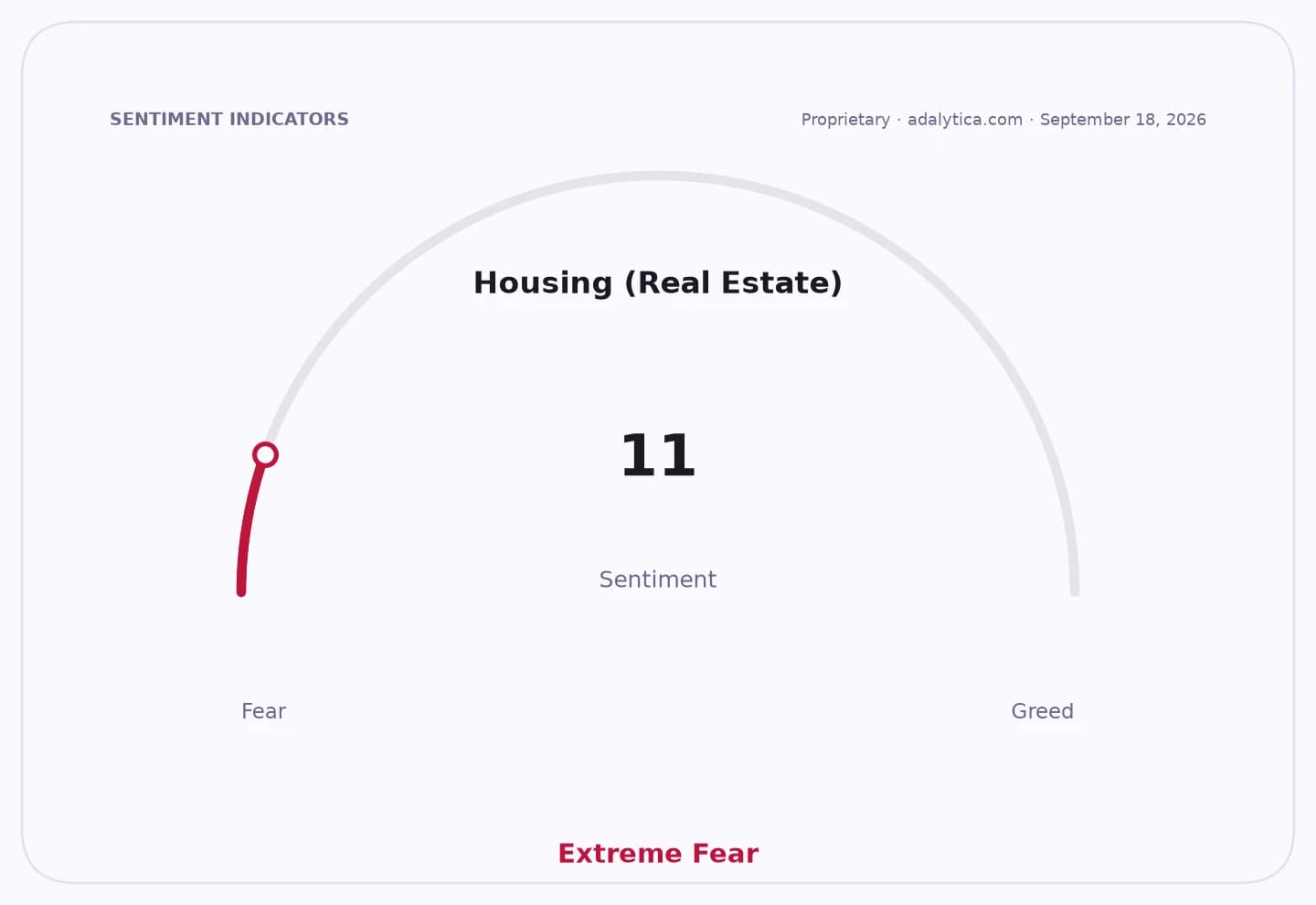
Sentiment IndicatorsⓘProprietary · adalytica.com · September 3, 2026
This is a snapshot — live sentiment, awareness and momentum for 130+ markets update continuously in the dashboard.Open AlphaPulse
The macro backdrop matters because housing costs are being set less by local property fundamentals than by the bond market’s view of inflation and central-bank policy. Escalating conflict in the Middle East has pushed energy prices higher, raising the risk that price pressures stay sticky and forcing markets to price more tightening from the European Central Bank. Traders now expect the ECB to raise rates three times before summer 2027, with a move on Sept. 10 priced as better than 99% likely. That outlook is what feeds through to Danish mortgage pricing, especially on adjustable-rate loans tied closely to short-term funding costs.
Longer-dated mortgages are also feeling the squeeze. Before the war, borrowers could get an interest-only 30-year fixed loan at 3.5% with a market price of 96.6. That has shifted to 4% at 94.6, implying a higher effective rate and a larger issuance discount. On Nordea’s math, the effective cost of a standard 30-year fixed mortgage is up by 0.37 percentage point since the February attack on Iran, adding about 360 kroner a month after tax on a one million kroner interest-only loan.
The market is also being pulled in opposite directions by policymakers and lenders. Totalkredit’s latest forecast agrees with market pricing that the ECB will hike on Sept. 10, but it then diverges sharply by expecting cuts during 2027, which would ease pressure on floating-rate borrowers. That split is a useful reminder that rate volatility is now driven as much by geopolitical risk as by traditional economic data. Higher energy costs could reinforce inflation and delay relief; a fast easing in conflict could do the opposite.
For investors, the implications are twofold. First, the housing market remains highly rate-sensitive, so the current move keeps demand under pressure and limits any near-term rebound in transaction volumes or refinancing activity. Second, the uncertainty creates winners and losers across mortgage products and lenders. Borrowers who can tolerate volatility may still find F-kort the cheapest option today, but those seeking certainty are being pushed toward fixed-rate or longer reset loans, or toward interest-only structures to preserve cash flow.
That mix of rising funding costs, policy uncertainty and geopolitical risk argues for a continued premium on balance-sheet resilience in lenders and on flexibility in household borrowing decisions. If oil-driven inflation persists, rates could stay elevated longer than many homeowners expect; if the conflict cools and ECB expectations reverse, floating-rate borrowers would be the first to benefit.
| Entity | Gains | Losses |
|---|---|---|
| Floating-rate borrowers | ▲Lower upfront cost now | ▼Higher payment volatility |
| Fixed-rate borrowers | ▲Payment certainty | ▼Higher initial rate/cost |
| Danish mortgage lenders | ▲Wider pricing options | ▼Softer refinancing demand |
| Homeowners with large debt | ▲Can use interest-only relief | ▼Higher cash-flow strain |