Parliament’s Budget and Finance Committee is pushing for a debt-limit law at a moment when rising borrowing costs and tighter financial conditions are making unchecked public debt more expensive for governments and more risky for markets.
Debt-limit push may improve fiscal credibility

The move matters because it goes beyond political housekeeping: a formal borrowing cap would aim to anchor fiscal discipline, reassure creditors and reduce the chance that debt servicing crowds out spending on growth, wages and essential services. For economies already facing strained household balance sheets and weaker repayment capacity, the signal is that lawmakers are treating debt as a macroeconomic constraint rather than a purely budgetary issue.
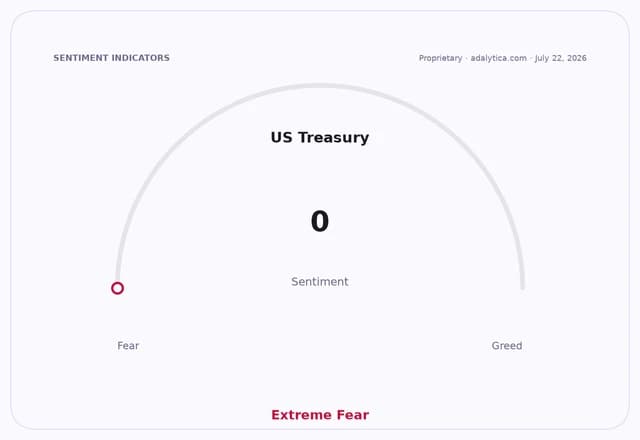
Sentiment IndicatorsⓘProprietary · adalytica.com · July 22, 2026
This is a snapshot — live sentiment, awareness and momentum for 130+ markets update continuously in the dashboard.Open AlphaPulse
That backdrop is becoming harder to ignore. Global funding conditions remain far tighter than they were through the previous decade, and even in advanced markets the cost of money has reset at higher levels. The US federal funds rate is projected around 3.627% in July, while the 10-year Treasury yield is forecast near 4.582%, a reminder that sovereign borrowing is no longer cheap even for the safest issuers. In that environment, countries with less fiscal room face a steeper penalty when debt rises faster than revenue.
Investors usually welcome debt-limit frameworks because they can improve policy credibility and reduce tail-risk around fiscal slippage. A credible law can support local bond valuations, lower risk premiums and help stabilize the currency by signalling that deficits will not be financed indefinitely by borrowing. But markets will look past the headline and focus on enforcement. A weakly drafted cap, or one that is easily waived, can become political theatre rather than a constraint on debt accumulation.
The market response in global duration also points to how sensitive fixed income is to fiscal narratives. The iShares 20+ Year Treasury Bond ETF, TLT, has been sliding recently, with its latest close at 83.39, below both its 50-day moving average of 84.85 and 200-day average of 85.98. Its RSI reading of 20.0 suggests the fund is deeply oversold by conventional technical measures, while Adalytica’s US Treasury Bonds Trade Signals show “Extreme Fear.” That combination reflects a market still wary of long-duration debt exposure even as recession and policy-risk debates continue.
The broader lesson for policymakers is that debt restraint is now a competitiveness issue as much as a fiscal one. Governments that can demonstrate borrowing discipline may preserve access to funding on better terms, while those that postpone adjustment risk paying more for every new issue. For investors, the key question is not whether lawmakers call for a limit, but whether they build one that can survive election cycles, spending pressures and shocks to growth.
If the committee’s proposal becomes law, the next test will be whether it is paired with transparent spending rules, realistic revenue assumptions and enforcement mechanisms that cannot be bypassed in the next budget squeeze. Without that, the market is likely to treat the initiative as a statement of intent rather than a durable change in sovereign credit quality.
| Entity | Gains | Losses |
|---|---|---|
| Fiscal disciplinarians | ▲Credibility boost | ▼Less room for deficit spending |
| Bond investors | ▲Lower default risk | ▼Less yield if risk premiums fall |
| Government borrowers | ▲Better market access | ▼Stricter funding constraints |
| Taxpayers | ▲Potentially lower debt burden | ▼Austerity pressure on spending |