The Democratic sweep of Congress has jolted markets into a rapid unwind of the Trump-era trade, hitting technology shares, the dollar and bitcoin as investors bet Washington will move toward tighter oversight and a slower pace of deregulation.
Democratic sweep hits tech, dollar and bitcoin
US Dollar
The biggest economic shift is not the election itself, but the policy mix it implies. A divided investment consensus built around deregulation, infrastructure spending and aggressive AI build-out is now being repriced against a Democratic-controlled Congress that is more likely to scrutinize the president’s agenda, constrain parts of the policy pipeline and alter the distribution of winners across sectors. That matters because markets had spent much of the year positioning for a pro-growth, pro-risk backdrop. The blue wave has forced a rethink of that thesis.
Sentiment Indicators
The immediate market response has been broad and telling. Nasdaq-linked exposure sold off sharply, with QQQ falling to 647.05 on Nov. 5 from 691.95 a day earlier, a drop of about 6.5% on heavy volume. The exchange-traded fund’s RSI slipped to 30.3, close to oversold territory, while the MACD turned more negative, underscoring the speed of the downdraft. Technology had been one of the market’s most crowded beneficiaries of expectations for lighter regulation and faster AI-related capital deployment. A policy reset in Washington is now challenging that positioning.
The dollar has also weakened, reflecting a sharp fall in confidence in the greenback as a policy anchor. Adalytica’s US Dollar Trade Signals snapshot showed sentiment at 1, labeled “Extreme Fear,” with 30-day change down 84%. A softer dollar usually helps overseas assets and commodities, but in this case the move appears to be less about growth optimism and more about investors reducing exposure to a policy regime they had assumed would favor U.S. exceptionalism and higher real yields.
US Dollar — 30-day sentimentadalytica.com
Explore this data interactively — full history, time series and cross-market comparisons.
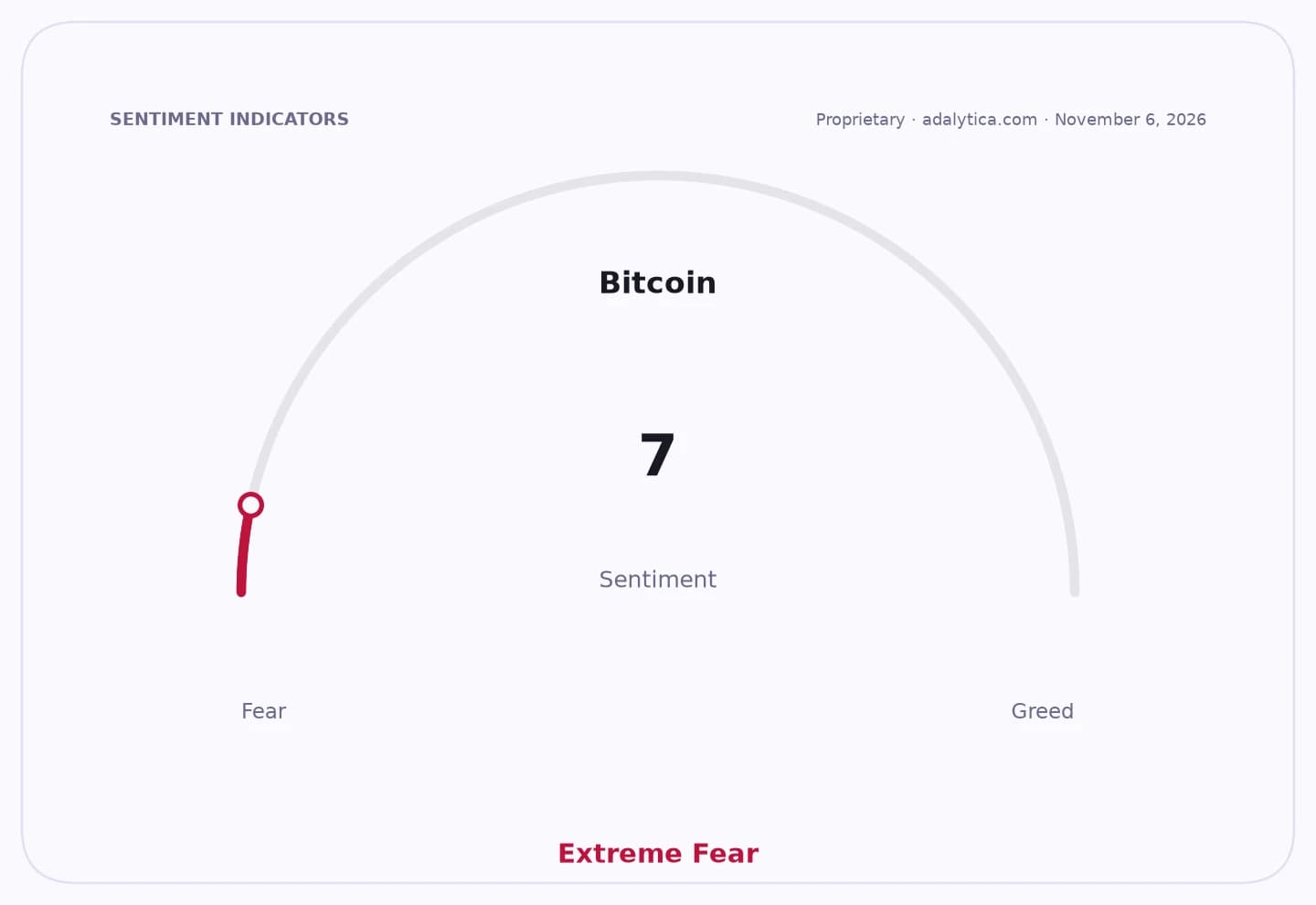
Bitcoin has suffered in parallel, with the token falling to $75,621.45 on Nov. 6 from $80,405.29 two sessions earlier. Adalytica’s Bitcoin Fear & Greed Index stood at 7, in “Extreme Fear,” even as its awareness gauge remained elevated. The drop points to a market that is struggling to decide whether tighter political scrutiny will eventually curb speculative excess or whether the larger risk is a broader deleveraging in risk assets. Bitcoin’s weakness also matters because it has increasingly traded as a high-beta liquidity proxy: when crypto sells off alongside tech and the dollar, it often signals stress in the market’s risk appetite rather than an isolated asset-specific move.
By contrast, U.S. Treasuries have caught a bid. The 10-year yield edged down to 4.90% on Nov. 4 and was forecast at 4.891%, while the two-year yield held around 4.58%-4.59%. That pattern suggests investors are leaning into a lower-growth, more policy-constrained environment, or at minimum trimming the probability of a further acceleration in fiscal or corporate-friendly momentum. The move also implies that the market is not pricing a disorderly inflation shock from the election result; instead, it is pricing uncertainty about how much of the prior agenda survives under a Democratic Congress.
The sectoral implications are likely to be more important than the headline selloff. Technology and crypto are the clearest losers if Washington turns more combative on antitrust, platform oversight, data governance or capital-intensive AI spending. More defensively positioned sectors, or those less exposed to regulation, could benefit as money rotates away from crowded growth trades. The reaction in alcohol stocks, which rallied in the aftermath of the blue wave, shows that investors are already hunting for policy winners outside the obvious trade.
For investors, the key question is whether this is a one-day repricing or the start of a deeper regime shift. Bullish traders may argue that Democratic control of Congress limits the odds of fiscal excess, helps long-dated Treasuries, and eventually supports quality growth stocks once the initial regulatory fear subsides. The bear case is that the election has punctured a market narrative that was already stretched: tech valuations assumed abundant liquidity, minimal political interference and uninterrupted AI investment. If that narrative frays, the pressure could spread beyond Nasdaq heavyweights to any asset priced for policy ease and abundant risk capital.
The next catalyst will be whether Democratic control translates into concrete legislative or regulatory moves, or whether markets settle once the first-round positioning washout is complete. Until then, the blue wave is functioning less as a political event than as a broad repricing of Washington risk.
| Entity | Gains | Losses |
|---|---|---|
| Democrats | ▲Congressional control | ▼Market confidence in Trump agenda |
| Tech stocks / Nasdaq | ▲— | ▼Deregulation trade, valuations |
| U.S. Treasuries | ▲Safe-haven bid | ▼Growth-sensitive positioning |
| Dollar / Bitcoin | ▲— | ▼Risk appetite, speculative flows |