The enterprise AI race is shifting from proving that software can write code faster to proving it can run a business better, a change that favors platforms with deep workflow reach and raises the stakes for Microsoft, Salesforce and ServiceNow.
Enterprise AI Shifts From Coding Tools to Workflow
That pivot matters because the first wave of generative AI adoption was sold largely on productivity gains for developers and internal teams. The next wave has to show measurable impact on revenue, customer service, supply chains and decision-making — areas where budgets are bigger, implementation is harder and buyer scrutiny is much sharper. If AI cannot move from demo to deployment, spending could slow; if it can, it could become a durable driver of enterprise software demand and cloud consumption.
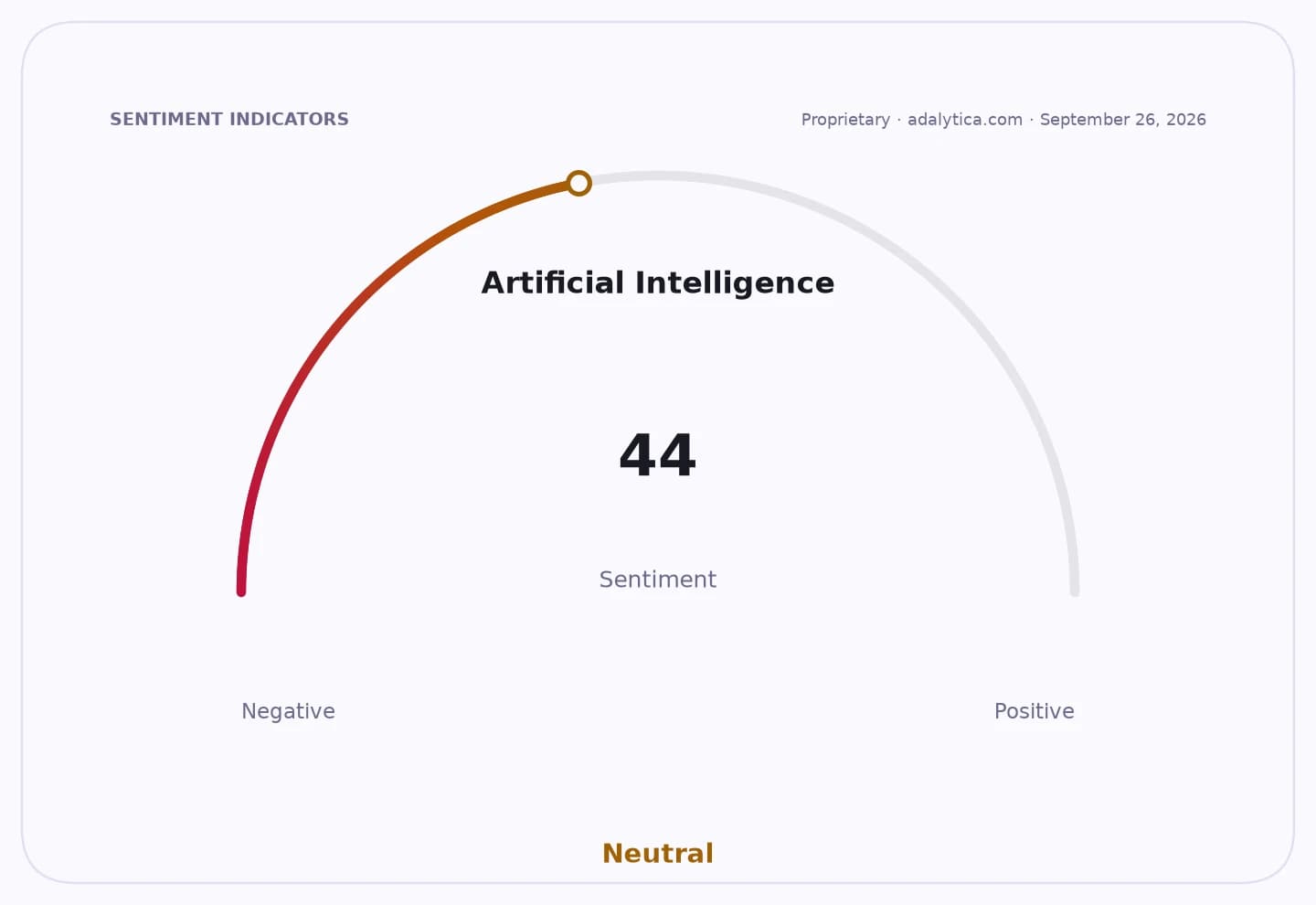
Sentiment IndicatorsⓘProprietary · adalytica.com · July 25, 2026
This is a snapshot — live sentiment, awareness and momentum for 130+ markets update continuously in the dashboard.Open AlphaPulse
The shift is visible in how large vendors are positioning their products. Microsoft has warned in filings that it will bear “significant development and operational costs” to build and support the AI models, services and infrastructure needed by customers, underscoring how capital-intensive the race has become. Salesforce said in its own filing that it is “increasingly building AI into many of our offerings,” including generative and agentic AI, but also flagged the risks that new AI products such as Agentforce face in customer adoption. ServiceNow, meanwhile, has been pushing AI around workflow automation, with its platform aimed at “comprehensive delivery of seamless workflows” across organizations.
Investors have already started to price in the difference between promise and execution. Microsoft shares, at about $381.70 in the latest trading data, remain well below a 50-day moving average near $399 and far under a 200-day average around $435, suggesting the market is still demanding proof that AI spending will translate into sustained earnings power. Salesforce, at roughly $163.66, is also trading below both its 50-day and 200-day averages, reflecting skepticism about how quickly its AI tools can drive a reacceleration in growth. ServiceNow, by contrast, has been far more volatile but is still under pressure, with the stock near $98.78 after a brutal selloff from levels above $180 late last year, even as investors continue to look for evidence that its AI-enabled workflow business can expand margins and bookings.
The economic significance extends beyond software vendors. If enterprise AI shifts toward business execution, it can support a broader capex and opex cycle across cloud infrastructure, consulting and systems integration. That would benefit hyperscalers, implementation partners and industrial users that can automate operations or improve forecasting. It would also help explain why firms in logistics, healthcare and manufacturing are increasingly framing AI as an operating model rather than a cost-cutting tool. The opposite is also true: if AI projects remain confined to coding assistants and pilot programs, the market may conclude that much of the enthusiasm was ahead of realized enterprise value.
The stakes are amplified by a more cautious market backdrop. Adalytica’s S&P 500 trade signals show “Fear” and “Extreme Fear” in awareness, a reminder that investors are less willing to pay up for long-duration growth stories without visible returns. At the same time, industrial production sentiment in Adalytica’s gauges sits in “Greed,” suggesting cyclical sectors are attracting attention as companies look for practical AI applications that boost throughput and efficiency. That split mirrors the current debate: whether AI is still a speculative software theme or becoming an industrial and operating tool.
There is a bull case. Vendors that own the workflow, the data and the user interface can turn AI into a recurring operating layer inside the enterprise, embedding themselves more deeply and increasing switching costs. That would support higher cloud usage, larger contract values and stronger retention. There is also a bear case: if customers see weak payback, security concerns or costly implementation, AI could remain a feature rather than a budget line item, pressuring multiples for the software names most exposed to the theme.
For investors, the key catalyst is no longer whether enterprises will adopt AI, but where it lands on the value chain. The winners are likely to be the companies that can prove AI improves workflows, not just developer output, and that can show it in bookings, margins and cash flow rather than product demos. The next phase of the story will be told in contract wins, deployment metrics and guidance — not in promises about productivity alone.
| Entity | Gains | Losses |
|---|---|---|
| Microsoft | ▲Cloud and AI spend | ▼Firms with narrow AI features |
| Salesforce | ▲Agentic AI adoption | ▼Hype without adoption |
| ServiceNow | ▲Workflow automation demand | ▼Point tools with limited reach |
| Enterprise buyers | ▲Operational efficiency | ▼Costly pilot projects |