The euro’s near-term bounce looks fragile because the biggest driver for EUR/USD is still the relative path of U.S. and euro-zone rates, and that gap continues to favor the dollar.
EUR/USD Near-Term Bounce Looks Fragile, 1.160 Target
That is the core message from fresh FX calls that leave the pair’s year-end target unchanged at 1.160 even as both the Federal Reserve and the European Central Bank are now expected to deliver one more hike this year. The logic is straightforward: if both central banks end up tightening once more and then pause for an extended period, the repricing in front-end swaps should be broadly similar on both sides of the Atlantic, limiting the scope for a sustained break higher in the euro.
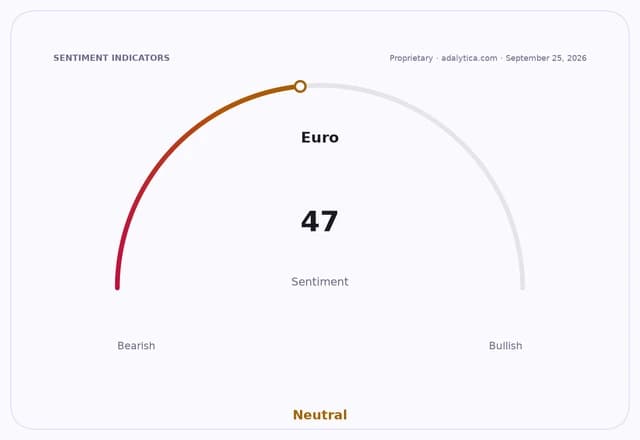
Sentiment IndicatorsⓘProprietary · adalytica.com · September 25, 2026
This is a snapshot — live sentiment, awareness and momentum for 130+ markets update continuously in the dashboard.Open AlphaPulse

In the near term, though, the dollar still has the better setup. The market is still pricing only about 13 basis points for an October Fed move, leaving room for a hawkish surprise if incoming data firm up or if energy prices keep climbing. That keeps U.S. rates, and therefore the greenback, supported even after Friday’s modest pullback.
Investors should care because FX is not just a currency trade here — it is a macro allocation signal. A stronger dollar tightens global financial conditions, weighs on risk assets and keeps pressure on commodities, emerging markets and European exporters. A softer dollar, by contrast, tends to ease those conditions and support cyclical assets. Right now, the balance of risks still points first to dollar strength, even if the medium-term view remains gradually USD-negative.
There is also a clear oil channel. Lower energy prices remain the base case behind the more dovish longer-term dollar view, and that is exactly why Brent matters so much for EUR/USD. If crude were to push back toward $110 a barrel, the euro would likely struggle, both because it would revive dollar support and because it would worsen Europe’s terms-of-trade backdrop. For now, the market has not seen enough evidence to price that kind of sustained energy shock.
The euro is also dealing with political noise in Germany after weak regional election results for Chancellor Friedrich Merz’s CDU, but that is a secondary issue. The bigger story remains that rate differentials and energy prices dominate EUR/USD, and neither has moved decisively in the euro’s favor. The ECB’s own speakers still sound hawkish enough to justify another hike, but not hawkish enough to create a meaningful policy gap against the Fed.
My view is that the market is underestimating how much of the dollar’s recent strength is still anchored in policy repricing rather than pure momentum. That matters because once the last hike from both central banks is discounted, the trade shifts from “who hikes more” to “who cuts first,” and that is where the euro can regain ground. Until then, rallies in EUR/USD are more likely to fade than extend.
For investors, that keeps the playbook simple: stay cautious on aggressive euro longs near term, respect the dollar’s carry advantage, and watch oil and Fed pricing as the two catalysts most likely to force the next move. If energy eases into the fourth quarter and the Fed stops sounding as hawkish as the market fears, the dollar’s upside should narrow and EUR/USD can work back toward the 1.160 target. For now, the path of least resistance remains a strong dollar and a range-bound euro.
| Entity | Gains | Losses |
|---|---|---|
| U.S. dollar | ▲Higher yields, hawkish repricing | ▼Euro upside, risk assets |
| Euro | ▲Lower energy prices, dovish USD repricing | ▼Stronger oil, wider rate gap |
| Fed hawks | ▲Market conviction, policy optionality | ▼Dollar bears, duration longs |
| European exporters | ▲Weaker euro, global competitiveness | ▼Euro strength, higher imported costs |