Europe’s bond market is flashing an old warning sign again: borrowing costs are climbing fast enough to revive the question of whether the eurozone is drifting toward another debt crisis.
Europe bond yields rise, debt stress fears return

The immediate problem is not just that yields are high. It is that they are rising at the front end and staying elevated across the curve, squeezing governments, banks and highly indebted borrowers at the same time. The U.S. 10-year Treasury is trading around 5.3%, while the 2-year sits near 4.8%, a reminder of how much global rate pressure still sits in the system. In Europe, investors are facing the same basic arithmetic: when benchmark rates stay restrictive, refinancing gets harder, fiscal room gets tighter, and the weakest borrowers feel the pain first.
Sentiment IndicatorsⓘProprietary · adalytica.com · October 5, 2026
This is a snapshot — live sentiment, awareness and momentum for 130+ markets update continuously in the dashboard.Open AlphaPulse
That matters because the eurozone’s last debt crisis was never just about Greece or any single country. It was about a feedback loop between sovereign borrowing costs, fragile bank balance sheets and investors demanding a higher premium for holding peripheral debt. When that loop tightens, funding costs spread through the real economy. Governments spend more on debt service instead of growth. Companies defer investment. Banks become more cautious with lending. And bondholders start asking which balance sheets can still absorb another leg up in yields.
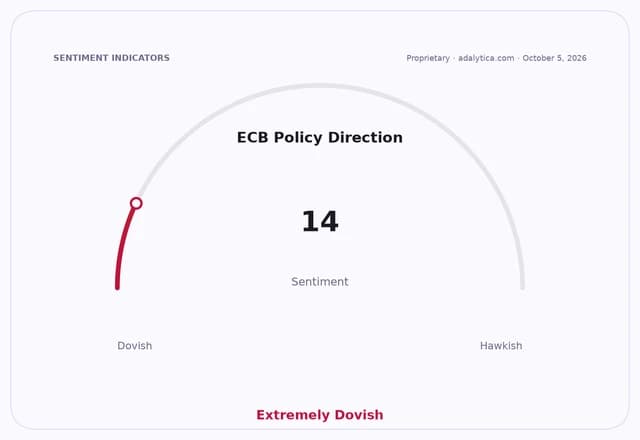
The market tone reflects that anxiety. Adalytica’s EU fiscal debt rules sentiment gauge stands at 61, technically neutral but falling sharply from 68 a day earlier and down 31 points over the past month. More telling is the European Central Bank policy sentiment reading, which has plunged to 14 — “extreme fear” — after a 68-point drop in a single day. That is not a prediction of crisis by itself, but it does show how quickly confidence around Europe’s fiscal and monetary backstop can erode when debt and rates move in the wrong direction together.
For investors, the key issue is not whether the eurozone will repeat 2010-2012 in identical form. It is whether higher-for-longer rates are exposing the next layer of vulnerability. The 10-year and 2-year yields in the U.S. remain above 5% and 4.8%, respectively, while the 10-year minus 2-year spread has narrowed to about 45 basis points, a sign that policy is still restrictive enough to keep pressure on credit markets. In Europe, that makes highly indebted sovereigns, cyclical lenders and lower-quality corporate credit more sensitive to any shift in growth, inflation or political discipline.
Exchange-traded funds tracking European equities are already behaving like a market that wants answers. The iShares MSCI Italy ETF, EWI, has fallen to $57.40 from a recent high above $61, while the iShares MSCI Eurozone ETF, EZU, is hovering near $67 after backing away from summer highs. Both remain above their 200-day moving averages, but their shorter-term momentum has weakened, with RSI readings in the high 20s to low 40s and MACD lines slipping negative. That kind of action suggests investors are not pricing a full-blown crisis yet — but they are definitely not paying up for complacency.
The broader backdrop is still one of resilience rather than collapse. European stocks have not broken down outright, and the eurozone retains tools that did not exist in the last sovereign-debt panic, from ECB backstops to stricter fiscal surveillance. But those safeguards work best when markets believe governments can still finance themselves without testing the system. The more yields rise, the more that confidence gets challenged.
For long-term investors, the lesson is familiar: debt crises rarely arrive all at once. They build through refinancing pressure, slowing growth and political hesitation. If Europe’s borrowing costs keep grinding higher, the winners will be the strongest balance sheets and the most diversified businesses. The losers will be leveraged sovereigns, shaky banks and investors who assume yesterday’s support mechanisms are enough on their own. This is a story worth watching closely, and one that favors patience, selectivity and a long-term horizon.
| Entity | Gains | Losses |
|---|---|---|
| Stronger eurozone borrowers | ▲Higher relative credibility | ▼Lower financing stress |
| Heavily indebted sovereigns | ▲None | ▼Rising debt-service costs |
| Banks | ▲Potentially wider lending spreads | ▼Higher credit risk |
| Equity investors in resilient exporters | ▲Relative safety | ▼Rate-sensitive domestic names |