The European Central Bank left its deposit rate at 2% for a third straight meeting, signaling that the euro zone’s economy is stable enough to keep policy on hold even as the Federal Reserve cuts and global trade tensions stay elevated.
ECB Holds Deposit Rate at 2% Again

That matters because the ECB is effectively telling markets it does not need to choose between inflation fighting and growth support right now. With euro zone GDP up 0.2% in the third quarter and 1.3% year on year, while inflation held near target at 2.2% in September, Christine Lagarde can credibly argue the bloc is in a “good position.” For investors, that is the key message: the ECB is preserving optionality, but it is not rushing to tighten, and it is not forced into emergency easing either.
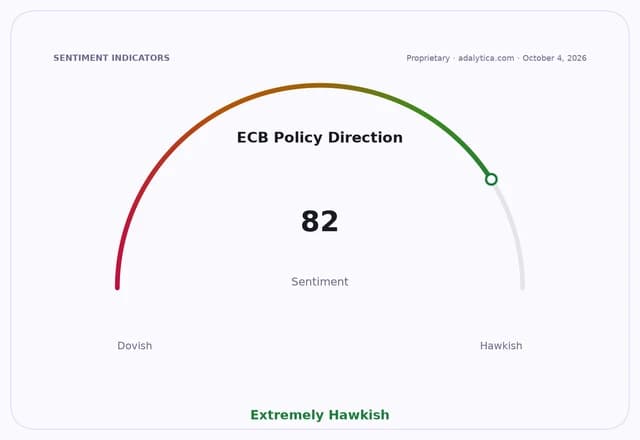
Sentiment IndicatorsⓘProprietary · adalytica.com · October 4, 2026
This is a snapshot — live sentiment, awareness and momentum for 130+ markets update continuously in the dashboard.Open AlphaPulse

The decision keeps the deposit rate at its lowest level in two years, with the main refinancing rate unchanged at 2.15% and the marginal lending facility at 2.40%. In practical terms, that anchors borrowing costs for households and companies and supports a slow but intact recovery across the currency bloc. It also reduces the risk that tighter financial conditions choke off growth just as tariff shocks from the U.S. and the war in Ukraine continue to test confidence.
Markets had expected no move, but the bigger signal is policy restraint. The ECB is comfortable waiting because inflation is close enough to target and the economy has not cracked. That is a fundamentally different backdrop from earlier cycles when the central bank was forced to chase inflation aggressively. The data now point to a soft-landing setup rather than a recession scare, which helps explain why euro zone equities have been able to hold up even after recent volatility.
The euro itself remains under pressure versus the dollar, with EUR/USD around 1.13, below its 50-day and 200-day moving averages and with RSI readings deep in oversold territory. That tells you the currency market is still pricing in dollar strength and policy divergence, not a fresh ECB tightening cycle. Yet the absence of a surprise cut or hike removes one source of volatility and keeps the focus on relative growth rather than a policy shock.
For investors, that creates a clear playbook. A steady ECB is supportive for euro-zone cyclicals, banks, exporters and broad-market vehicles such as EZU and FEZ, which tend to benefit when growth is stable and rate expectations are contained. It is less supportive for a sharp euro rally, especially with the Fed already easing and U.S. yields still offering a higher carry. But the more important point is that the ECB’s pause lowers the odds of a policy mistake, and that is often what drives the next leg higher in European risk assets.
The market underestimates how powerful “no drama” can be in Europe. If inflation stays near target and growth keeps grinding forward, the ECB has room to stay patient well into 2026. That favors investors positioned for a slow re-rating in European equities, not a panic trade on rate cuts. In this environment, the best opportunities are likely in quality euro-zone stocks, bank balance sheets that benefit from stable rates, and broad Europe ETFs that can capture a gradual confidence recovery as the policy backdrop stays benign.
| Entity | Gains | Losses |
|---|---|---|
| Euro zone borrowers | ▲Stable financing costs | ▼Higher-rate shock risk |
| European banks | ▲Policy clarity | ▼Fast margin expansion bets |
| EZU / FEZ holders | ▲Softer policy volatility | ▼Currency-led upside |
| Euro bulls | ▲Less policy uncertainty | ▼Stronger-dollar pressure |