Euro zone households saved less in the second quarter as spending grew faster than disposable income, a sign consumers are leaning into demand even as borrowing costs remain elevated.
Euro zone household savings rate falls in Q2

The savings rate fell to 14.2% from 15.1% a year earlier and 14.4% in the first quarter, Eurostat said, while the household investment rate was unchanged at 8.3%. The gap mattered because it shows the main support for domestic demand in the bloc is shifting away from precautionary saving and toward consumption, which rose 1.3% in the quarter compared with a 1.1% increase in gross disposable income.
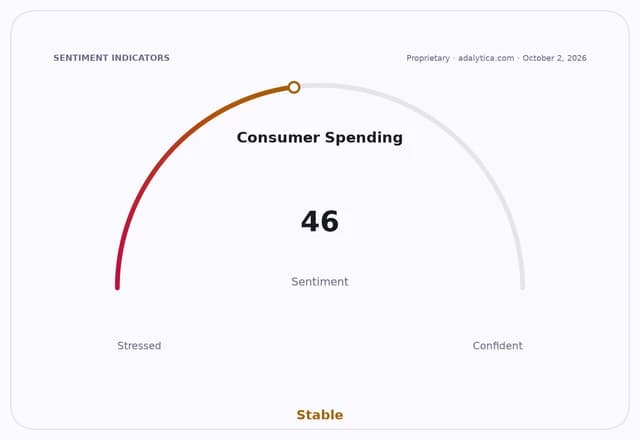
For the euro zone economy, that is a modestly constructive signal. Household consumption is the biggest driver of private demand, and a lower savings rate usually means more of the income pool is being spent rather than set aside. That can cushion growth at a time when higher rates, tighter financial conditions and weak external demand are all limiting momentum. It also suggests the consumer sector is proving more resilient than headline recession fears imply, even if the improvement is driven in part by households drawing down buffers rather than enjoying a strong income surge.
The data also point to a more complicated inflation and policy backdrop for the European Central Bank. If consumers are willing to spend more despite softer real income growth, the disinflation process can be slower than policymakers would like. That makes the ECB’s job harder: it must balance the risk that tighter policy continues to weigh on credit and investment against the possibility that household demand stays firmer than expected.
For investors, the release is relevant across rates, equities and the currency. A steadier consumer backdrop is supportive for retailers, travel, leisure and other domestic-demand names, while it is mildly negative for the case that the ECB can ease quickly. Lower savings can also be read as a sign that households are becoming less cautious, which helps cyclicals in the near term. But there is a bear case too: if spending is being maintained by running down savings rather than by stronger wage growth, the trend may prove fragile and vulnerable to any renewed energy shock, labour-market deterioration or further rise in borrowing costs.
The euro’s recent weakness against the dollar, with the currency trading near 1.12, reinforces the broader picture of an economy still struggling to gain convincing traction. Euro zone bond yields have eased from peak levels, but French debt remains under pressure and markets are still pricing a difficult mix of sticky inflation and slowing growth. In that setting, a lower household savings rate is best read as a cyclical support, not a structural turn.
The next test is whether consumption can keep outpacing income into the second half of the year without forcing households to rebuild savings more abruptly later on. If wages hold up and inflation cools, domestic demand could stay a stabilising force. If not, the current strength may fade quickly, leaving the ECB with less room to manoeuvre and investors with fewer reasons to expect a clean recovery.
| Entity | Gains | Losses |
|---|---|---|
| Euro zone consumers | ▲Higher current spending | ▼Lower savings buffer |
| Retailers and services | ▲Firmer demand | ▼Less margin relief from weak demand |
| ECB | ▲Evidence of demand resilience | ▼Harder path to faster easing |
| Households with debt | ▲Spending support now | ▼More exposed if borrowing costs stay high |