The eurozone’s private-sector economy appears to have kept expanding in November, but a deeper slowdown in France is undercutting confidence in the region’s recovery and raising the odds that growth remains too weak to shift the European Central Bank’s policy stance.
Eurozone PMI Stays Steady as France Slows

That matters because the bloc is still struggling to build momentum after months of near-stagnation. A broadly steady headline reading suggests the euro area is avoiding an outright contraction for now, but weakness in France — one of the currency union’s two largest economies — points to a recovery that is narrow, uneven and vulnerable to any further deterioration in demand.
Sentiment Indicators
PMI Trends
For investors, the message is that eurozone assets may not get much support from a stronger growth story in the near term. A sluggish economy usually limits corporate pricing power, keeps earnings expectations contained and leaves the ECB with room to stay patient on rates. If France continues to drag on regional activity, that could keep pressure on banks, cyclicals and domestically oriented European shares, even if exporters are cushioned by a softer euro.
The split matters economically because the eurozone is already operating with limited policy margin. Growth that merely “holds steady” is not the same as a durable expansion: it may be enough to avoid recession headlines, but not enough to lift hiring, capital spending or consumer confidence materially. In a currency bloc built on balance between its member states, a persistent French slowdown can offset resilience elsewhere and leave the aggregate data flatter than the underlying fragility would suggest.
Markets are already showing caution. FXE, the euro ETF, has slipped to around 101.38 after trading above 110 earlier this year, with the price now below both its 50-day and 200-day moving averages. Its RSI near 30 points to oversold conditions, but the broader technical picture still reflects a weak euro narrative rather than one of renewed growth optimism.
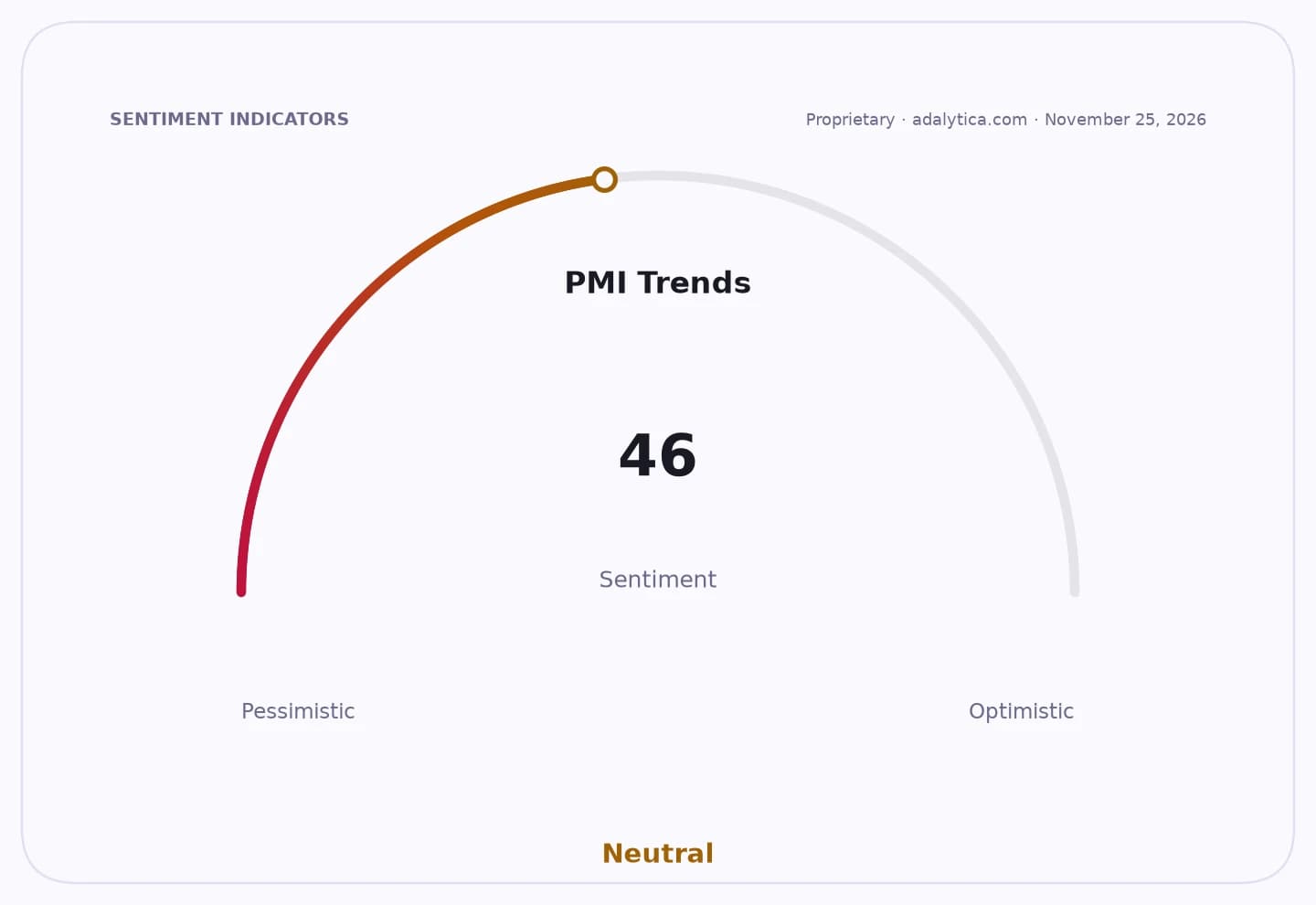
The PMI backdrop also fits a world in which investors remain cautious about macro surprises. Adalytica’s PMI Trend Recession Sentiment sits at 46, still neutral but coming off a volatile few sessions, suggesting the market is not yet convinced that the eurozone has escaped the risk of a deeper slowdown. That leaves the euro area vulnerable to any negative follow-through in coming releases, especially if French weakness spills into services and employment.
The broader macro context is also important. U.S. policy rates remain materially higher than in Europe, with Fed funds near 3.9% and the 10-year Treasury around 4.84%. That rate gap continues to favor the dollar and keeps financial conditions tighter for euro assets, particularly when European growth looks uninspiring. In that environment, the eurozone needs better activity data to change the market narrative — and this PMI reading does not yet provide it.
The immediate question is whether the rest of the bloc can offset France or whether the slowdown becomes more generalized. If Germany and the periphery hold up, the eurozone can muddle through. If not, investors may have to price in a longer stretch of mediocre growth, with the ECB constrained, earnings upside limited and European equities reliant more on valuation support than on a convincing economic rebound.
| Entity | Gains | Losses |
|---|---|---|
| Eurozone exporters | ▲Softer euro support | ▼Weak domestic demand |
| French economy | ▲None | ▼Growth drag |
| ECB | ▲More room to stay cautious | ▼Less room for hawkishness |
| European cyclicals | ▲Stable policy backdrop | ▼Slower earnings momentum |