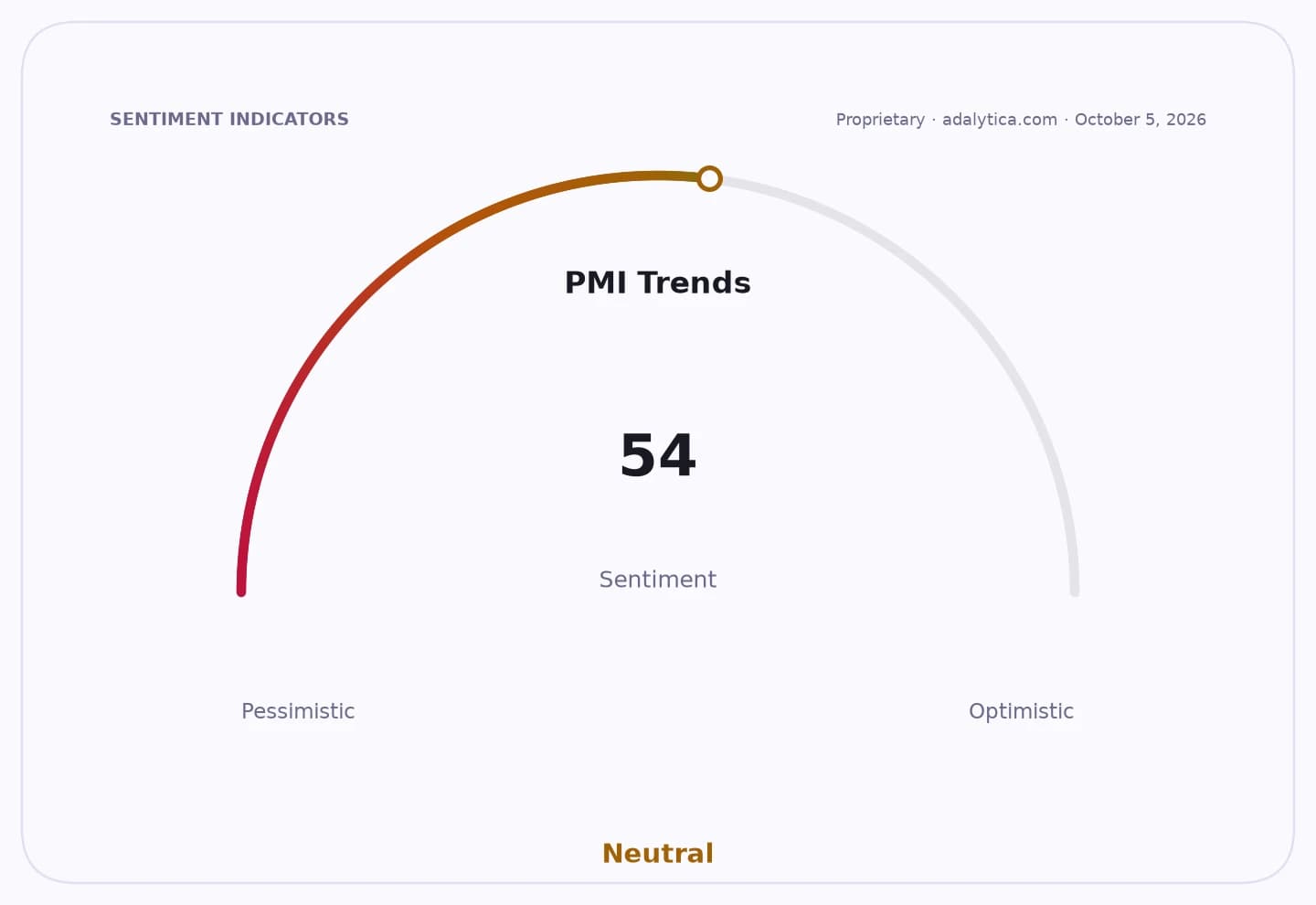
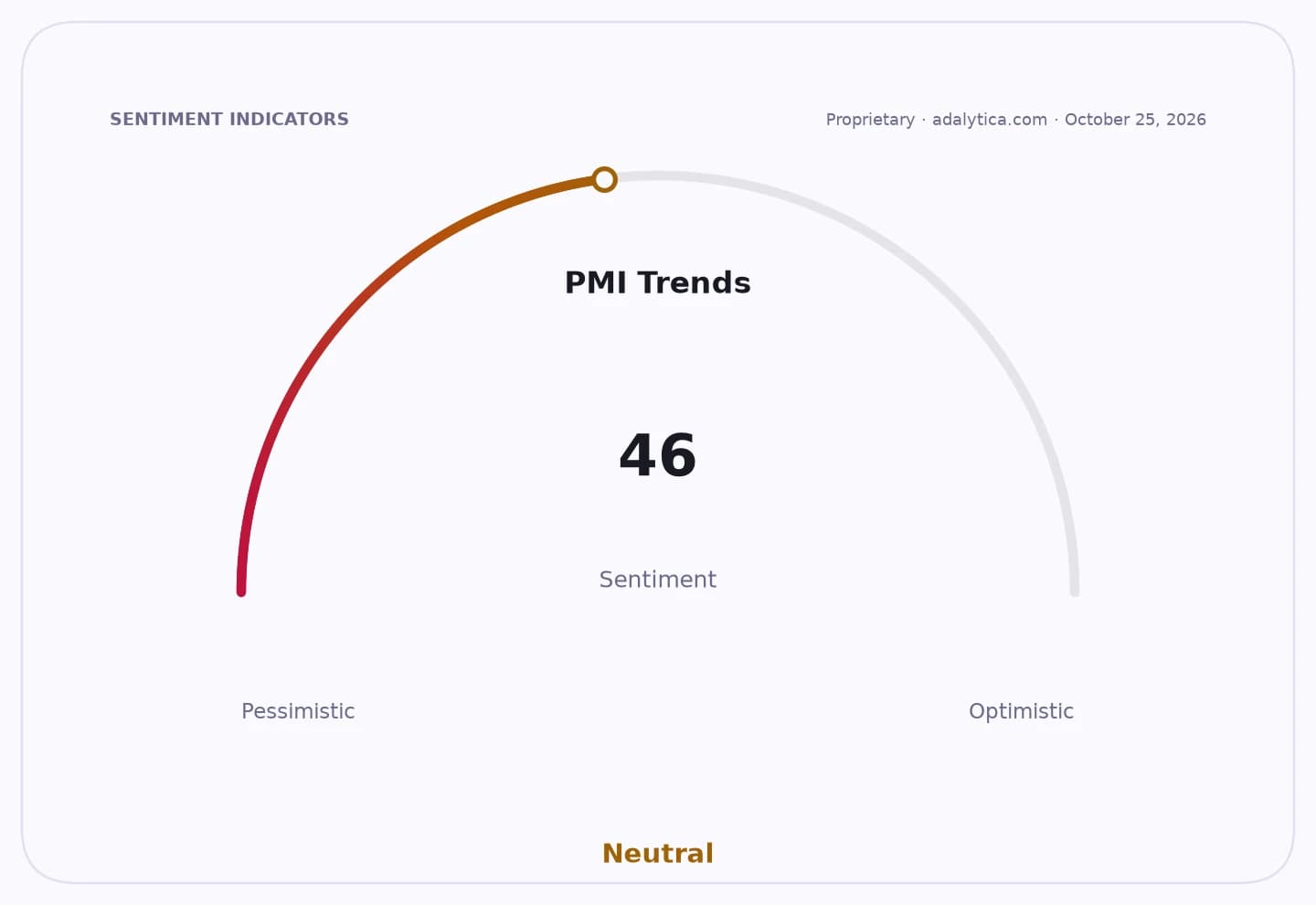
Eurozone factories are still growing, and that resilience matters because it gives the European economy a sturdier base than many investors expected even as supply-chain strains and inflationary pressure re-emerge.
Eurozone Manufacturing PMI Holds at 52.7 in October
The S&P Global Eurozone manufacturing PMI came in at 52.7 in October, just off September’s record 52.9 and above forecasts for 52.4, marking a ninth straight month of expansion. Output also stayed in positive territory at 52.8. For investors, the important takeaway is not just that factories are expanding, but that the bloc’s industrial engine is proving durable in the face of tariff risks, Middle East and Ukraine disruptions, and worsening delivery delays.
Sentiment Indicators
That durability is uneven. Germany, still the region’s manufacturing heavyweight, posted a 54.2 reading, its second-highest in more than four years. Spain also surprised on the upside at 52.2. France remained below 50 at 49.5, while Italy slipped back into contraction at 49.4. That split matters: a broad Eurozone recovery would support cyclicals, industrials and exporters across the region, but a patchwork recovery leaves the market reliant on a few stronger cores while politically and fiscally weaker economies lag.
The bigger market implication is that supply constraints are starting to bite just as growth holds up. Survey respondents reported the greatest stockpiling of inputs in almost four years, supplier delays worsened, and input cost inflation climbed to a five-month high. That combination is the kind of mix that can keep the European Central Bank under pressure even if overall growth remains modest. If costs keep rising before demand meaningfully weakens, rate cuts become harder to justify and the ECB’s next move becomes more complicated.
For the euro, this is a mixed signal. Stronger factory data should help sentiment around Europe’s growth outlook, but rising input costs and the prospect of further ECB tightening are not the kind of backdrop that supports a clean currency rally. Investors should read this as a selective positive for industrial exposure, not a blanket bet on Europe.
My view is that the market is still underpricing the second-order winners from this kind of resilience: German industrials, automation names, logistics and supply-chain beneficiaries, and exporters with pricing power. The losers are the more fragile domestic stories in France and Italy, and rate-sensitive sectors that depend on an easier ECB. The real trade here is not that Europe is booming — it is that manufacturing is staying alive long enough to create pockets of outperformance while inflationary frictions return.
If October’s reading holds into year-end, the narrative shifts from “Eurozone stagnation” to “uneven but investable industrial resilience.” That is where the opportunity lies.
| Entity | Gains | Losses |
|---|---|---|
| German exporters | ▲Stronger factory demand | ▼Weak-euro relief fades |
| Eurozone industrials | ▲Resilient output | ▼Higher input costs |
| ECB hawks | ▲Less need for easing | ▼Dovish rate-cut bets |
| France and Italy manufacturers | ▲None | ▼Growth lags remain exposed |