Eurozone consumers grew more cautious in October, pushing confidence deeper into negative territory and reinforcing the case that household demand will remain a weak spot for Europe’s economy.
Eurozone Consumer Confidence Falls in October

The European Commission’s flash consumer confidence gauge fell to minus 17.9 from minus 16.8 in September, a bigger drop than economists expected and the lowest reading in five months. Confidence across the wider European Union also worsened, slipping to minus 17.3. That may sound like a sentiment-only release, but for investors it matters because consumers set the tone for everything from retail sales to travel, autos and discretionary spending — the sectors that need households to feel secure before they start spending again.
Sentiment Indicators
The reading fits a broader picture of a eurozone economy that is struggling to build momentum. Inflation has eased from its peaks, but households are still wary about prices, employment prospects and the general economic backdrop. France’s protests and ongoing geopolitical uncertainty have added to that unease, while policymakers at the European Central Bank are still trying to balance stubborn price pressures against the risk of squeezing growth too hard.
For equity investors, weak consumer confidence is a warning sign for companies that depend on volume growth rather than pricing power. Retailers, consumer brands, leisure operators and parts of the industrial supply chain all rely on healthier household spending to justify stronger earnings growth. In contrast, exporters and defensive businesses tend to hold up better when domestic demand softens. That is one reason broad Europe exposure can be choppy even when regional stocks look cheap on paper.
Exchange-traded funds tracking European equities have reflected that push and pull. The VGK Europe ETF has traded above its long-term 200-day moving average but remains below its recent 50-day average, a reminder that the market is still trying to decide whether Europe can sustain a cleaner rebound. The more euro-sensitive FXE fund has also been under pressure, underscoring how growth concerns can sap enthusiasm even when valuations are not demanding.
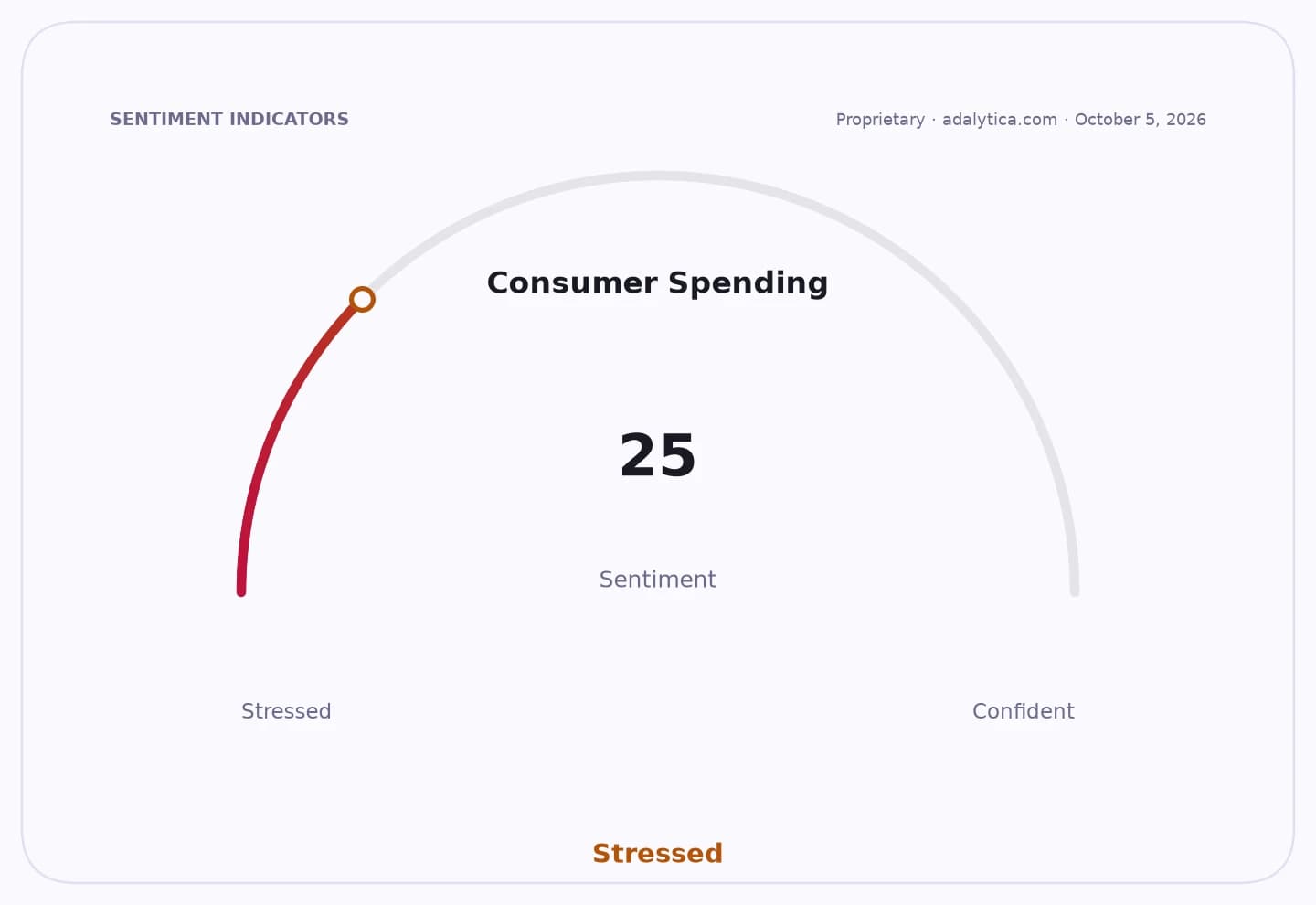
Adalytica’s Consumer Spending Sentiment gauge remains elevated, but that kind of high-level data should not obscure the real message here: official eurozone confidence is negative and getting worse. If households stay defensive into the holiday season, companies may be forced to lean more heavily on margins, cost cuts and overseas sales to keep earnings on track.
The next test is whether incoming inflation and activity data begin to stabilize the mood. Until then, investors should treat the October drop in consumer confidence as another sign that Europe’s recovery remains fragile — and that patience, diversification and a long-term horizon still matter most.
| Entity | Gains | Losses |
|---|---|---|
| Defensive stocks | ▲Relative demand resilience | ▼Cyclical sales growth |
| Retailers and consumers brands | ▲Pricing discipline from scarcity | ▼Unit volume and traffic |
| Exporters | ▲Weaker eurozone demand pressure | ▼Reliance on domestic spending |
| Eurozone consumers | ▲Lower inflation if growth cools | ▼Confidence and discretionary spending |