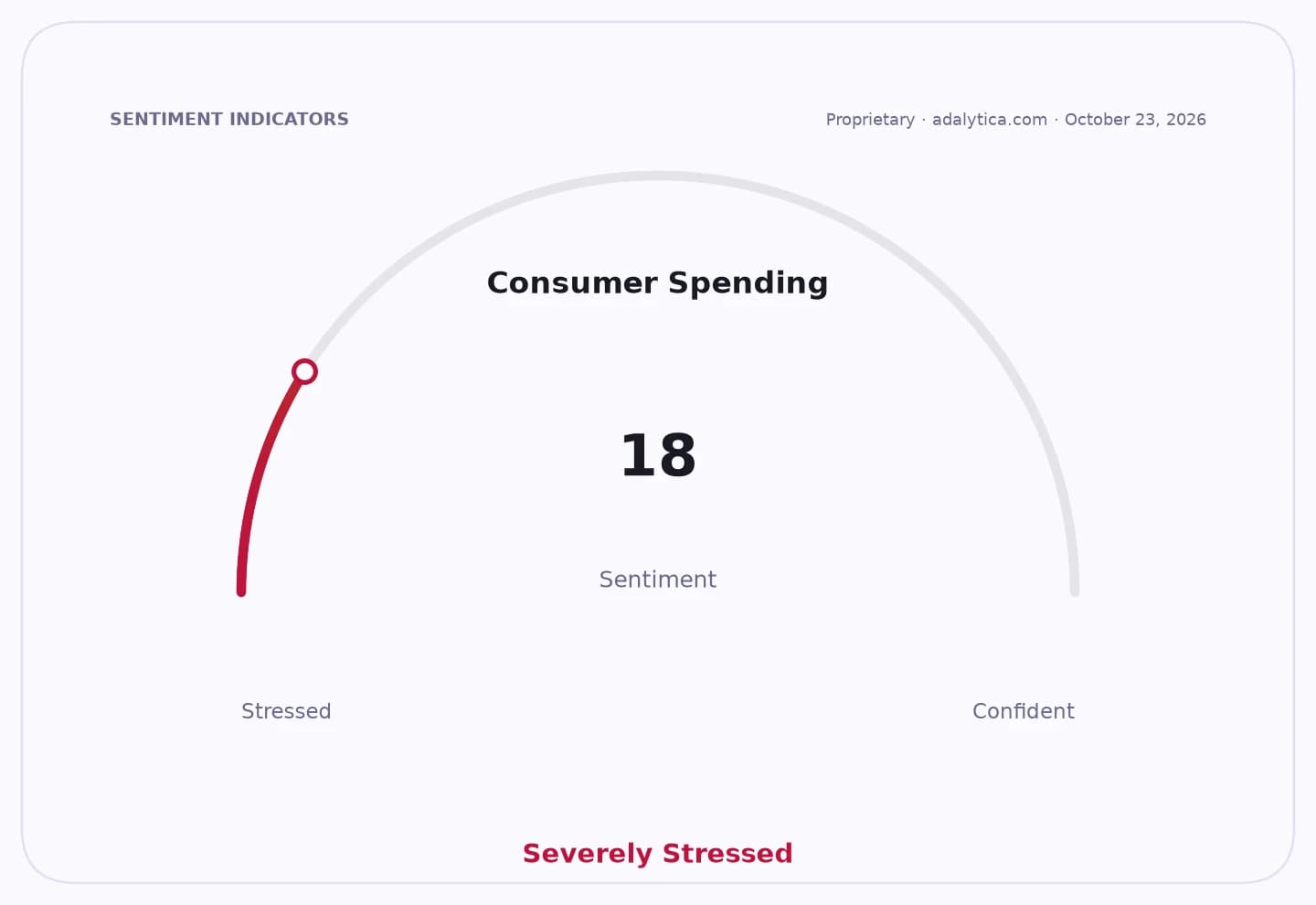
Belgian consumer confidence fell in October to its weakest level in 18 months, a sign that households are becoming more cautious about spending as worries about the economy and jobs intensify.
Belgium consumer confidence falls to 18-month low
The National Bank of Belgium said its consumer sentiment index slipped to -13.0 from -10.0 in September, the lowest reading since April 2025. The deterioration matters because consumer confidence is often an early read on retail spending, which is a key driver of growth in the euro area’s smaller economies.
Sentiment Indicators
The drop was broad-based. Expectations for the country’s economic situation over the next 12 months worsened to -44 from -41, while households’ assessment of their own financial situation also weakened, with that gauge falling to -7.0 from -2.0. Fears about unemployment rose too, with the index climbing to 19.0 from 16.0.
Belgium’s reading comes against a backdrop of softer confidence across major economies, including a weaker eurozone survey and a five-month low in U.S. consumer sentiment, reinforcing the view that higher uncertainty is keeping shoppers defensive. For investors, that points to a more cautious outlook for consumer-facing companies, banks with retail exposure and the broader cyclical trade if spending loses momentum.
The data also suggest households are becoming less willing to save and more worried about their ability to absorb shocks, a combination that can delay discretionary purchases and slow the pass-through from income gains to consumption. Markets will be watching upcoming eurozone activity data and any policy response for signs that confidence stabilizes, but for now the October figures point to a fragile consumer backdrop heading into year-end.
| Entity | Gains | Losses |
|---|---|---|
| Savers | ▲Higher caution on spending | ▼Lower confidence in finances |
| Belgian retailers | ▲Defensive positioning | ▼Softer discretionary demand |
| Belgian banks | ▲Lower loan growth risk if consumers save | ▼Weaker consumer credit demand |
| Eurozone cyclicals | ▲Relative safe-haven rotation | ▼Growth-sensitive sectors |